When people look at big-brand corporate websites, they often think:
“They must have spent a fortune on this.”
That’s partly true.
But money isn’t the real reason those websites work.
The real reason?
Big brands follow simple design rules that most businesses completely ignore.
These rules aren’t complicated. They’re just rarely explained clearly.
In this article, we’ll break down the real corporate website design secrets big brands never talk about, and show you how to apply them to build authority, credibility, and conversions.
Why Corporate Website Design Is More Strategic Than You Think
A corporate website isn’t a digital brochure. For big brands, it’s a strategic business asset.
It needs to:
- Establish instant credibility
- Communicate brand positioning clearly
- Support sales, partnerships, and recruitment
- Build long-term trust with stakeholders
The design choices you see — typography, spacing, layout, micro-interactions — are all intentional. Nothing is random. Everything serves a purpose.
And here’s the secret most companies miss:
Good corporate design doesn’t scream for attention. It earns it.
Corporate Website Design Secrets Big Brands Never Share
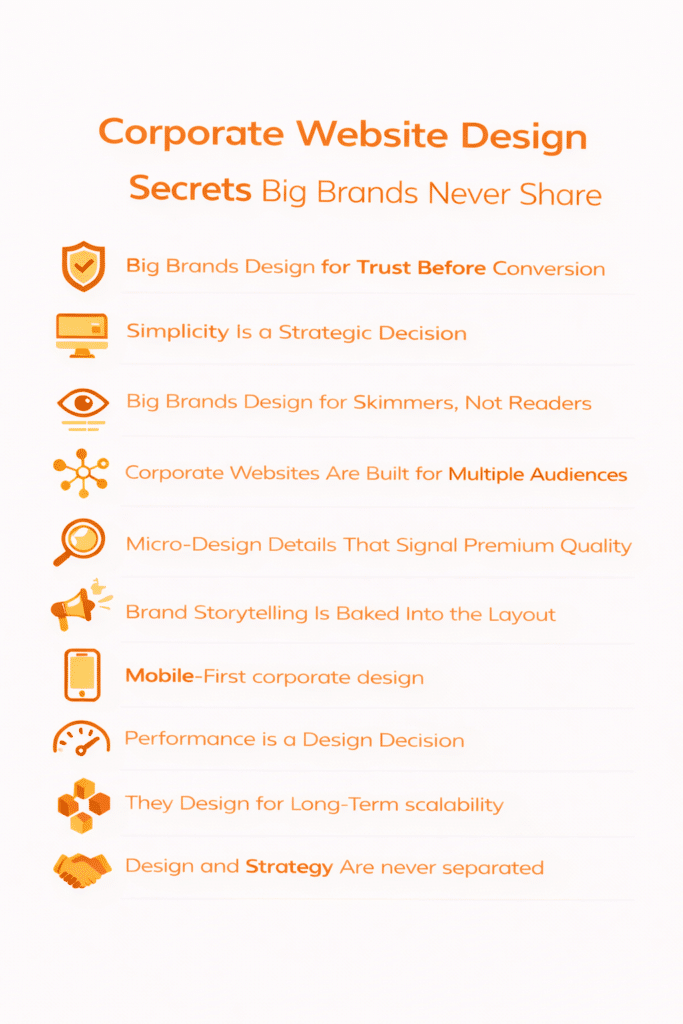
Big brands rarely talk openly about why their websites work so well. The real advantage lies in quiet design decisions that shape perception, trust, and behaviour long before users realise it.
Below are the core secrets behind high-performing corporate websites.
1. Big Brands Design for Trust Before Conversion
Many businesses obsess over CTAs, buttons, and lead forms. Big brands design trust before they design visuals.
Before a visitor ever considers converting, they subconsciously ask:
- Is this company legitimate?
- Do they feel established?
- Can I trust them with my money, data, or reputation?
How Big Brands Build Trust Through Design
- Clean, uncluttered layouts with generous white space
- Consistent typography across every page
- High-quality, original visuals (not stock-heavy designs)
- Calm, neutral colour palettes with strategic accents
Trust-first design slows users down just enough to make them feel safe — not overwhelmed.
2. Simplicity Is a Strategic Decision
Minimalism isn’t a trend—it’s a deliberate choice.
Big brands understand that simplicity costs more upfront but performs better long-term. Every element must justify its existence. If it doesn’t support the user’s goal, it’s removed.
Big brands invest heavily in:
- Content hierarchy
- Message prioritisation
- Visual restraint
They remove anything that doesn’t serve a clear purpose.
What They Don’t Do
- Overload pages with features
- Cram every service onto the homepage
- Use long blocks of unfocused text
Every page has one primary goal. Everything else supports it.
3. Big Brands Design for Skimmers, Not Readers
Here’s an uncomfortable truth:
Most visitors don’t read your website — they scan it.
Big brands know this, so they design content that works at a glance.
How They Make Skimming Easy
- Strong headline hierarchy
- Short, purposeful paragraphs
- Strategic use of bold text
- Clear visual breaks between sections
This allows decision-makers, investors, and executives to extract value in seconds.
4. Corporate Websites Are Built for Multiple Audiences
Small businesses often design for one user. Big brands design for many — simultaneously.
A single corporate website must serve:
- Customers
- Partners
- Investors
- Media
- Job seekers
Each audience has different motivations, but the brand story must remain consistent.
How Big Brands Handle This
- Clear navigation paths for each audience
- Purpose-built landing pages
- Distinct messaging without fragmenting the brand
The design guides users naturally, without forcing them to dig.
The result? Personalised journeys without brand dilution—and a website that feels relevant to everyone who lands on it.
5. Micro-Design Details That Signal Premium Quality
The most powerful design elements are often invisible.
Big brands sweat the small stuff:
- Button hover states
- Animation timing
- Line spacing
- Icon consistency
- Scroll behaviour
These micro-details create a sense of polish — and polish signals professionalism.
Users may not consciously notice these elements, but they feel them.
6. Brand Storytelling Is Baked Into the Layout
Corporate storytelling isn’t just about words — it’s about structure.
From hero sections to supporting content blocks, pages follow a logical flow:
- Identify the problem
- Introduce the brand’s perspective
- Present solutions
- Reinforce credibility
- Guide action
This flow is intentional and often repeated across key pages.
The Result
- Strong emotional connection
- Clear brand positioning
- Better recall and credibility
Visuals, spacing, and content placement work together to create emotional engagement. Users don’t just read the brand story—they experience it.
7. Mobile-First Corporate Design
Big brands don’t “adapt” desktop designs for mobile. They design mobile-first.
Why? Because:
- Decision-makers browse on mobile too
- Google prioritises mobile performance
- First impressions often happen on smaller screens
Mobile-First Design Means
- Thumb-friendly navigation
- Faster load times
- Simplified content structure
- Intentional spacing and readability
Desktop becomes an enhancement—not the foundation. A corporate site that struggles on mobile instantly feels outdated.
8. Performance Is a Design Decision
Big brands treat website speed as part of design — not a technical afterthought.
A beautiful website that loads slowly erodes trust instantly.
What They Optimise
- Image sizes and formats
- Clean code structure
- Minimal third-party scripts
- Efficient animations
Fast websites don’t just rank better — they feel more reliable.
9. They Design for Long-Term Scalability
Corporate websites aren’t built for “now.” They’re built for what’s next.
Big brands anticipate:
- New services
- Market expansion
- Content growth
- Rebranding phases
Their design systems are flexible, modular, and future-proof.
10. Design and Strategy Are Never Separated
Here’s the biggest secret of all.
Design alone doesn’t win.
Big brands align UX, SEO, content, and conversion strategy from the start. Their websites are structured for search engines and humans, without sacrificing visual quality.
Every visual decision supports:
- Brand positioning
- Search visibility
- Conversion paths
- User experience
This alignment is what turns a “good-looking” site into a high-performing corporate platform.
Why Most Corporate Websites Underperform
Many businesses invest in design but skip strategy. Others focus on functionality and ignore emotion.
The result?
- Websites that look fine but don’t convert
- Brands that feel generic instead of authoritative
- Missed opportunities at every stage of the buyer journey
Corporate website design isn’t about trends — it’s about intention.
How Hunters Digital Approaches Corporate Website Design
At Hunters Digital, we don’t design corporate websites as standalone projects. We build them as strategic business platforms.
Our approach combines:
- Deep brand and audience understanding
- Structured information architecture
- Performance-focused design
- Scalable, future-ready frameworks
We apply the same principles big brands use—without unnecessary complexity or inflated costs.
Because the real secret isn’t access to exclusive tools.
It’s knowing what actually works.
Conclusion
The biggest misconception in corporate website design is this:
“If it looks premium, it will perform.”
Reality?
If it’s clear, focused, and intentional, it will perform.
Big brands don’t win because they hide secrets. They win because they understand users deeply—and design for them.
And that’s exactly what smart businesses can do too.
Ready to Apply These Secrets to Your Website?
At Hunters Digital, we help businesses design websites that don’t just look professional—but work as growth tools.
If your website isn’t generating the results you expect, let’s fix that.
Contact us today and turn your website into a business asset—not just an online presence.
FAQs
A corporate website clearly explains a company’s services, values, and credibility. It helps visitors decide whether the business is right for them.
Content tells visitors what you do and how you help them. Good design makes that message easy to follow.
Because their website is often the first thing decision-makers see. A well-designed site builds trust, improves search visibility, supports long buying decisions, and helps drive growth and revenue.
Yes. Many decision-makers browse on their phones, and a poor mobile experience can lead to quick exits.
Extremely important. Slow websites increase bounce rates, reduce SEO rankings, and damage credibility. Corporate decision-makers expect fast-loading, seamless digital experiences — especially on mobile devices.

Suggested Articles
- Website Maintenance in Singapore: What SMEs Should Expect from a Plan That Protects Leads, Security, and Search Visibility

- SEO Pricing in Singapore: What a Good SEO Retainer Should Include – and What to Question Before You Sign
- How to Choose a Digital Marketing Agency in Singapore: 10 Questions That Protect Your Budget, Accounts, and Data
- Why B2B Service Pages Don’t Generate Enquiries – and the Proof Assets Buyers Need Before They Contact You