B2B digital marketing in 2026 feels very different from what it was just a few years ago. If you’re still chasing vanity metrics, blasting cold emails, or publishing blog posts “just for SEO,” you’re already behind.
Today’s B2B buyers are smarter, more skeptical, and heavily supported by AI tools. They research deeply before talking to sales. They compare brands silently. And most importantly, they trust expertise—not hype.
So the big question is simple: what actually works now? Let’s break it down, step by step.
The State of B2B Digital Marketing in 2026
B2B marketing in 2026 operates in a buyer-first ecosystem. Buyers control the journey, not brands. According to recent industry research, over 80% of B2B buyers complete more than half of their research before ever speaking to sales. That single statistic explains why traditional funnel-based marketing no longer works on its own.
Several forces define the current state:
- AI-driven personalization is now expected, not optional
- Third-party cookies are effectively dead
- Long sales cycles demand deeper trust signals
- Content is consumed across platforms, not just websites
At the same time, marketing teams are under pressure to prove ROI faster. This has pushed B2B marketers to focus on fewer channels, higher-quality content, and tighter alignment with sales.
What’s changed most?
The shift from volume-based marketing to value-based engagement. Instead of chasing traffic, successful brands now chase relevance.
How B2B Buyer Behavior Has Evolved
Understanding buyer behavior in 2026 is the foundation of every winning strategy. Modern B2B buyers are:
- Self-educated
- Cross-functional (6–10 stakeholders per deal)
- Risk-averse
- Short on time
They don’t want to be sold to. Instead, they want guidance, clarity, and proof.
Key behavioral shifts
- Buyers trust peers more than brands
- Video and interactive content outperform static PDFs
- AI search tools influence early-stage research
- Buyers expect personalization without sacrificing privacy
Modern B2B Buyer Journey
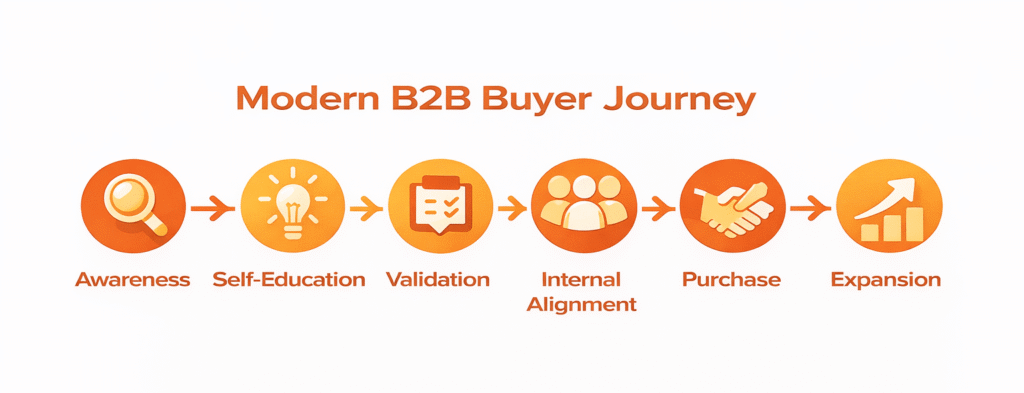
Each stage requires different content, messaging, and channels. Brands that fail to map content to these stages lose momentum fast.
SEO in 2026: Optimizing for Humans and AI
SEO in 2026 goes far beyond ranking for blue links. Today, you’re optimizing for:
- Google Search
- AI Overviews
- Voice assistants
- Enterprise AI tools
Search engines now prioritize experience, expertise, authority, and trust (E-E-A-T) more than ever.
What actually works in B2B SEO now
- Topic clusters instead of single keywords
- Long-form, expert-driven content
- First-party data integration
- Structured data and schema markup
Table: Old SEO vs SEO in 2026
| Old SEO Tactics | SEO That Works in 2026 |
| Keyword stuffing | Semantic topic coverage |
| Short blog posts | In-depth authoritative guides |
| Backlink quantity | Backlink relevance |
| Traffic focus | Engagement and intent |
To rank on both Google and AI tools, your content must answer real questions clearly, with context and credibility.
Content Marketing That Drives Real B2B Results
Content marketing remains the backbone of B2B digital marketing, but the format and intent have evolved. In 2026, content must do three things:
- Educate deeply
- Build trust quickly
- Support sales conversations
High-performing B2B content formats
- Thought leadership articles
- Original research reports
- Interactive calculators
- Case studies with metrics
- Video explainers and demos
Content that performs best feels less like marketing and more like expert advice. It anticipates objections, addresses risks, and uses real-world examples.
AI-Powered Personalization Without Being Creepy
AI plays a major role in B2B marketing in 2026, but not in the way many predicted. Instead of replacing marketers, AI enhances decision-making, personalization, and efficiency.
Where AI actually works
- Predictive lead scoring
- Content recommendations
- Email timing optimization
- Chat-based website experiences
What doesn’t work?
Over-automation. Buyers can spot robotic messaging instantly.
Best practice:
Use AI to support human strategy, not replace it.
Account-Based Marketing (ABM) Is No Longer Optional
ABM has moved from “nice to have” to essential. In high-value B2B sales, generic messaging simply doesn’t convert.
Modern ABM focuses on
- Account-level intent data
- Personalized content hubs
- Multi-channel orchestration
- Sales and marketing alignment
Bullet breakdown of an effective ABM stack
- CRM with real-time data
- Intent monitoring tools
- Personalized landing pages
- Sales enablement content
ABM works because it mirrors how buyers actually buy: as a group, with shared concerns and internal politics.
The Rise of Community-Led B2B Marketing
One of the biggest shifts in 2026 is the rise of community as a growth engine. Slack groups, private forums, LinkedIn communities, and niche events now influence buying decisions more than ads.
Why community works
- Peer-to-peer trust
- Organic brand advocacy
- Real-time feedback loops
- Lower customer acquisition costs
Brands that invest in communities don’t just generate leads; they build ecosystems.
Email Marketing Still Works (If Done Right)
Despite countless predictions of its death, email remains one of the highest ROI B2B channels.
What’s different now
- Hyper-segmentation
- Behavior-triggered campaigns
- Plain-text, human emails
- Value-first messaging
Table: High-Performing Email Elements
| Element | Best Practice |
| Subject line | Curiosity-driven, specific |
| Content | Short, actionable, human |
| CTA | One clear next step |
| Frequency | Consistent, not aggressive |
Email works when it feels like a conversation, not a campaign.
Video and Interactive Experiences Dominate
B2B buyers in 2026 expect rich, interactive experiences. Video is no longer optional.
Top video use cases
- Product demos
- Founder-led thought leadership
- Customer stories
- Onboarding and education
Video Across the Funnel
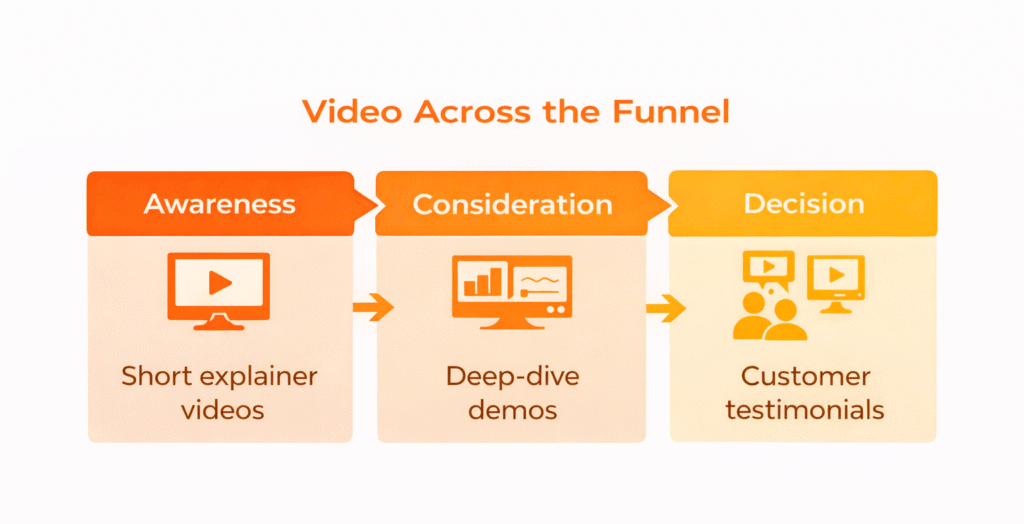
Interactive content such as quizzes, ROI calculators, and assessments also increases time on site and lead quality.
Social Media for B2B: Less Noise, More Authority
B2B social media in 2026 is about authority, not virality. Platforms like LinkedIn dominate, while others play supporting roles.
What works now
- Founder-led content
- Personal brand storytelling
- Educational carousels
- Comment-driven engagement
Brands that hide behind logos struggle. People want to hear from people.
Data, Privacy, and Trust as Competitive Advantages
With increasing data regulations, trust has become a differentiator.
Best practices
- Transparent data usage
- Consent-first tracking
- Secure data infrastructure
- Ethical AI implementation
Companies that respect privacy earn long-term loyalty.
Measuring What Actually Matters in 2026
Vanity metrics no longer impress leadership. Modern B2B teams focus on:
- Pipeline influence
- Revenue attribution
- Sales velocity
- Customer lifetime value
Metrics That Matter
| Metric | Why It Matters |
| MQL to SQL rate | Lead quality |
| Sales cycle length | Efficiency |
| Deal size | Revenue impact |
| Retention rate | Long-term growth |
Measurement now informs strategy, not just reporting.
Common B2B Marketing Mistakes to Avoid in 2026
Even experienced teams fall into these traps:
- Chasing every new platform
- Overusing automation
- Ignoring post-sale marketing
- Treating content as a one-time asset
The best marketers simplify instead of adding complexity.
The Future-Proof B2B Marketing Framework
To win in 2026 and beyond, align your strategy around three pillars:
- Trust – Built through expertise and transparency
- Relevance – Delivered via personalization and intent
- Consistency – Across channels and touchpoints
When these pillars align, growth becomes predictable.
Building a Future-Proof B2B Digital Marketing Strategy
Integrated Omnichannel Approach
Everything connects:
- SEO
- Content
- Paid
- Social
- Email
Long-Term Brand + Short-Term Demand
Strong brands win faster and cheaper.
Conclusion
B2B digital marketing in 2026 isn’t about hacks, shortcuts, or jumping on new algorithms. Rather, it’s about learning how people decide in a high-stakes environment and helping them to do so with clarity, credibility, and value. The brands that win are the ones that listen more, personalize smarter, and build relationships instead of campaigns.
If you develop content, trust-driven AI-enabled personalization, community engagement, and purposeful measurement, you won’t just survive change — you’ll drive it.
And if you’re ready to put these principles into action and see real business results, Hunters Digital provides B2B brands with the marketing engine for trust, demand, and growth. From strategy to solution, we lead with value—because when you put value first, results always follow. Contact us to build marketing that delivers real business growth.
Focus on value. The results will follow.
FAQs
Yes. SEO is more powerful than ever when done with authority and intent.
AI is critical for efficiency and personalization, but strategy and creativity remain human-led.
Absolutely. Especially through thought leadership and peer validation on platforms like LinkedIn.
Long-form educational content combined with video and interactive elements performs best.
Use real data, customer stories, transparent messaging, and consistent value delivery.