Search has changed forever.
For years, brands competed for blue links on Google. Then came featured snippets. Now, we are entering the age of AI-generated answers powered by platforms like OpenAI, Microsoft, and Google’s own AI systems.
Instead of ten blue links, users see one intelligent response.
And this shift raises a powerful question:
Can AI search engines create new opportunities for customer acquisition — or will they eliminate traditional traffic?
At Hunters Digital, we believe this transformation is not a threat. It is a strategic advantage — if you understand how to leverage it.
Let’s break it down.
What Are AI Search Engines?
AI search engines go beyond keyword matching. They use large language models and contextual understanding to:
- Interpret natural language queries
- Understand search intent
- Provide summarized, conversational answers
- Recommend products and services
- Learn from user behavior
Platforms such as ChatGPT, Google Gemini, and Microsoft Copilot are changing how users interact with information.
Instead of typing:
“Best digital marketing agency Singapore”
Users now ask:
“Which agency in Singapore can increase my B2B leads with SEO and paid ads?”
AI engines respond with curated recommendations — sometimes without requiring users to click multiple websites.
This is where new acquisition opportunities emerge.
How AI Search Changes Customer Behavior
AI search engines influence users at three key levels:
1. Faster Decision-Making
Users receive summarized insights instantly. Less friction means quicker buying decisions.
2. Higher Intent Queries
AI encourages conversational searches. These tend to be specific and solution-oriented.
Example:
- Traditional: “SEO services”
- AI-driven: “Who can improve organic traffic for a fintech startup in Singapore within 6 months?”
The second query signals immediate buying intent.
3. Fewer but More Qualified Clicks
AI reduces random traffic but increases qualified leads. Businesses may see fewer visits — but better conversions.
This shift favors strategy over volume.
The New Customer Acquisition Funnel in AI Search
Traditional Funnel:
Awareness → Consideration → Decision → Conversion
AI Search Funnel:
Question → AI Answer → Brand Mention → Trust → Direct Contact
If your brand appears inside AI-generated recommendations, you enter the funnel earlier — sometimes at the decision stage.
That shortens the buying cycle significantly.
New Opportunities AI Search Creates for Businesses
1. Authority-Based Visibility
AI engines prioritize trusted, well-structured, authoritative content.
If your website demonstrates:
- Expertise
- Clear structure
- Data-backed insights
- Case studies
- FAQ-rich content
AI models are more likely to reference or summarise your brand.
Authority is the new ranking factor.
2. Zero-Click Brand Exposure
Zero-click searches are increasing. AI engines answer questions directly in results, reducing website visits.
But zero-click doesn’t mean zero impact.
When your brand is cited within AI-generated answers, you gain:
- Brand recognition
- Trust signals
- Authority positioning
The key is optimizing content for extraction, not just ranking.
3. Hyper-Targeted Lead Generation
AI-driven searches are intent-heavy.
When someone asks:
“Which agency can handle SEO for an F&B chain expanding across Southeast Asia?”
That query indicates readiness.
If your content directly addresses niche scenarios, you position your brand as the logical solution.
This creates:
- Better-qualified inbound leads
- Higher close rates
- Reduced cost per acquisition
4. Conversational SEO (Answer Engine Optimization)
We are moving from Search Engine Optimization (SEO) to Answer Engine Optimization (AEO).
Instead of optimizing for: “Digital marketing Singapore”
You optimize for:
- “How much does digital marketing cost in Singapore?”
- “What ROI can I expect from SEO in 6 months?”
- “Is paid ads or SEO better for startups?”
This involves:
- Long-form content
- Structured FAQ sections
- Clear headings
- Direct, concise answers
AI engines extract structured insights more easily than vague content.
5. Content Depth Over Keyword Density
AI understands context.
Keyword stuffing no longer works.
Instead, focus on:
- Topical authority
- Related subtopics
- Real examples
- Case studies
- Data explanations
6. Multi-Channel Data Signals
AI models draw signals from:
- Website content
- Reviews
- Social mentions
- Business listings
- News features
- Backlinks
Your digital footprint matters more than ever.
Practical Strategies to Win Customer Acquisition Through AI Search
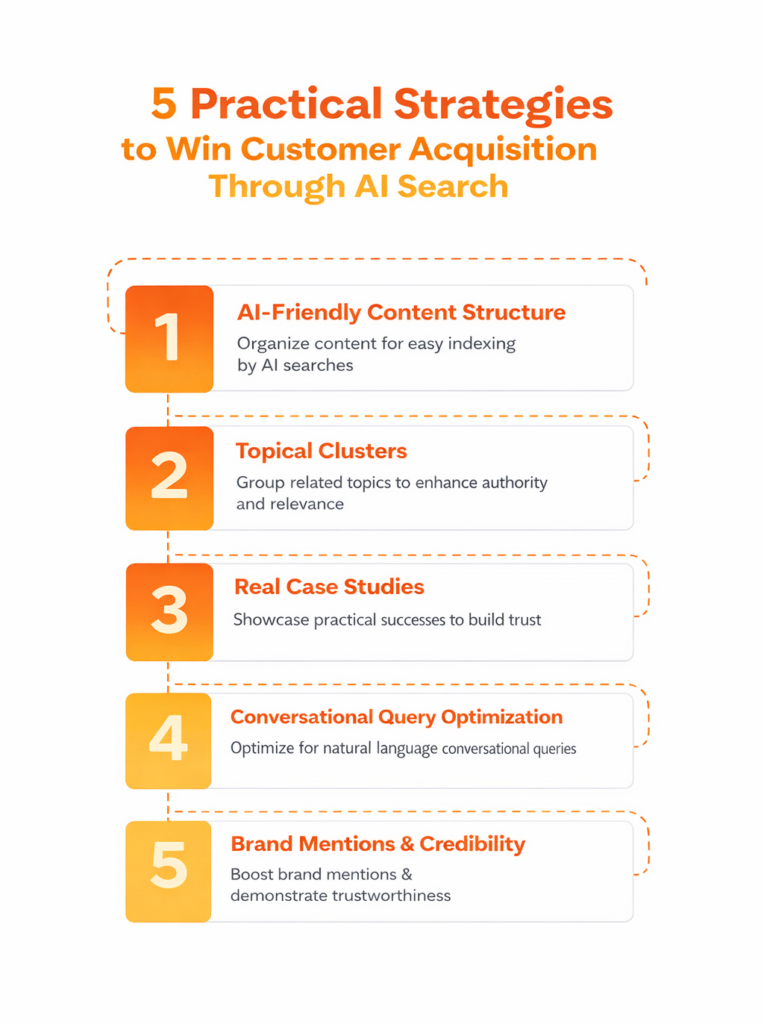
Here is how businesses can adapt immediately.
1. Create AI-Friendly Content Structure
Use:
- Clear H1, H2, H3 hierarchy
- Bullet points
- Short paragraphs
- FAQ schema
- Direct answer boxes
AI extracts clean content more efficiently.
2. Build Topical Clusters
Instead of isolated blog posts, create pillar and cluster models.
Example:
Pillar Page:
“Complete Guide to Digital Marketing in Singapore”
Cluster Articles:
- SEO Cost Breakdown
- Paid Ads ROI Guide
- AI in Marketing Automation
- Conversion Rate Optimization Strategies
This strengthens contextual authority.
3. Add Real Case Studies
AI engines trust evidence.
Include:
- Metrics
- Timeframes
- Industry
- Before-and-after comparisons
Specificity builds trust signals.
4. Optimize for Conversational Queries
Research long-tail, question-based searches such as:
- “How do I choose a digital marketing agency?”
- “What is the best SEO strategy for startups?”
- “How long does SEO take to work?”
Answer them clearly and directly.
5. Strengthen Brand Mentions
Encourage:
- Client testimonials
- Google reviews
- LinkedIn recommendations
- Industry collaborations
AI engines reference credibility signals beyond your website.
Will AI Search Reduce Website Traffic?
Yes — but that is not necessarily negative.
AI may:
- Reduce low-quality clicks
- Reduce comparison browsing
- Deliver higher-intent leads
Customer acquisition shifts from traffic quantity to traffic quality. Smart marketers focus on conversion efficiency.
The Competitive Advantage for Early Adopters
Many companies still optimize purely for traditional SEO.
Few are:
- Structuring content for AI extraction
- Writing conversational answers
- Building authority clusters
- Creating data-rich case studies
This gap creates opportunity.
Businesses that align with AI search behavior today can dominate tomorrow’s discovery landscape.
The Future of Customer Acquisition
AI search engines are evolving toward:
- Personalized results
- Contextual recommendations
- Voice-driven search
- Predictive intent modeling
Soon, customers may not search for agencies manually. Instead, they might ask AI:
“Find me a reliable digital marketing agency in Singapore that specializes in fintech and guarantees measurable ROI.”
Only brands with strong authority signals will appear.
Customer acquisition will increasingly depend on:
- Credibility
- Depth
- Trust
- Expertise
- Structured content
Conclusion
So, can AI search engines create new opportunities for customer acquisition?
Absolutely — but only for brands ready to evolve.
AI search shifts the focus from keywords to intent, from traffic volume to authority, and from broad messaging to hyper-personalized engagement.
The opportunity is clear: build authority, create structured content, and implement AEO + GEO strategies. The brands that do this will win better leads and faster conversions.
At Hunters Digital, we believe the future belongs to brands that are not just searchable — but recommendable.
If your business wants to stay visible in an AI-driven world, now is the time to evolve your strategy.
Ready to future-proof your growth? Contact us today and let’s build your AI-first strategy.
Frequently Asked Questions
No, but they evolve it. Traditional SEO foundations still matter, but strategies must incorporate AEO and GEO to remain competitive.
Focus on Answer Engine Optimization (AEO) by using structured content, direct answers, FAQ sections, and authority-driven publishing strategies.
Yes, but it must evolve. SEO now supports AI visibility. Strong technical SEO, backlinks, and authority remain essential foundations.
It depends on competition and authority level. Brands with strong digital foundations may see visibility improvements within months, while new websites require consistent publishing and authority building.
AEO focuses on optimizing content to be selected as a direct answer, while GEO focuses on appearing within AI-generated summaries and conversational responses.