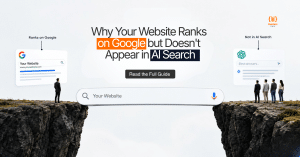
A few years ago, ranking on Google meant earning a place on page one.
Today, that is no longer enough.
Search is rapidly evolving beyond blue links. Buyers are now asking tools like Google AI Overviews, ChatGPT, and Perplexity direct questions such as:
- Which is the best website design agency in Singapore?
- What is the top SEO company for SMEs in Singapore?
- Who offers AI search optimisation services in Singapore?
And instead of showing a list of websites, these platforms increasingly generate direct answers — often recommending specific businesses, summarising their services, and citing the websites they trust.
That raises an important question for every Singapore business owner:
If a potential customer asked an AI search engine about your services today, would your website be recommended — or ignored?
The answer has less to do with flashy design and more to do with whether your website is structured for AI search visibility.
Businesses that adapt now will gain a powerful competitive edge in Google AI search, Answer Engine Optimisation (AEO), and Generative Engine Optimisation (GEO).
Those that delay risk becoming invisible.
Why This Is a Business Problem, Not a Technical One
Search behaviour in Singapore has shifted more sharply in the past 18 months than in the five years before. Google’s AI Mode now handles over a billion queries monthly — with usage more than doubling every quarter. ChatGPT and Perplexity are part of how professionals and buyers research before they spend.
When someone asks one of these tools for a “corporate website agency in Singapore” or “best SEO company for a professional services firm,” they do not get ten links. They get a direct answer — often naming specific businesses, summarising services, referencing sources considered credible enough to cite.
The question for your business: would your website give a search tool enough to work with?
Most businesses do not have a bad website. They have a website built to look credible — not to communicate clearly. That distinction matters more now than it ever has.
What Search Tools Actually Look For
Before examining what to fix, it helps to understand what search tools care about. They draw from indexed content, structured data, third-party mentions, and authority signals. Not clever copy. Not impressive visuals.
They look for five things:
- Clarity — Does this page explain what the business does, who it serves, and where it operates?
- Structure — Is the content formatted for extraction — headings, FAQs, tables, direct answers?
- Credibility — Are there consistent trust signals — reviews, citations, schema markup?
- Relevance — Does the content directly answer questions buyers are asking?
- Consistency — Does the business describe itself the same way across its website, Google Business Profile, and LinkedIn?
“A technically solid website that fails on two of these is likely to be overlooked — not penalised, just quietly not chosen.”
The Six Areas to Check for AI Search Readiness
As AI-powered search engines like Google AI Overviews, ChatGPT, and Perplexity AI continue reshaping how customers discover businesses online, Singapore companies must ensure their websites are fully optimized for AI search visibility.
To become AI-search ready, your website needs more than traditional SEO — it requires clear content structure, technical optimization, strong trust signals, and conversion-focused user experience.
Here are the six critical AI SEO areas every Singapore business should evaluate to improve rankings, visibility, and lead generation.
1. Service Page Clarity
Many service pages describe what a business offers without explaining who it helps, how it works, or what the outcome looks like. Phrases like “comprehensive solutions tailored to your needs” are common — and give search tools almost nothing specific to extract.
A service page ready for AI search answers these directly:
- What is this service?
- Who is it for — industry, business size, situation?
- What does the work actually involve?
- What does the client receive at the end?
- Where does the business operate?
Each answer should appear as a clear sentence — not buried in marketing copy.
2. FAQ Sections
FAQ sections are among the highest-value elements on any service page. Search tools are designed to surface direct answers to direct questions. A well-structured FAQ gives them exactly that.
Strong FAQs reflect what buyers actually type into Google:
“How long does it take to build a corporate website in Singapore?” “What is the difference between SEO and AEO?” “How much do Google Ads cost for a small business?”
Weak FAQs answer questions nobody asked: “Do you offer free consultations?” “Can we meet in person?”
FAQ schema markup — a small piece of structured code — signals that this content is formatted as question-and-answer, increasing the likelihood it gets surfaced in featured snippets and AI Overviews.
3. Schema Markup
Schema is structured data added to a website that tells search engines what type of content is on each page — ts context, relationships, and purpose. Your customers never see it. Search tools rely on it.
Priority schema types for Singapore service businesses:
- LocalBusiness — name, address, phone, hours, service area
- Service — what you offer, who it is for, coverage area
- FAQPage — question-and-answer content in structured form
- Article — for blog posts: author, date, topic context
- BreadcrumbList — helps tools understand site structure
Most Singapore business websites are missing at least three of these. Each is a straightforward implementation — not a rebuild.
4. Entity Consistency
In search terms, an “entity” is a clearly defined, consistently described thing: a business, a person, a location, a service. If your business describes itself differently across your website, Google Business Profile, LinkedIn, and online directories, search tools struggle to build a confident picture of who you are.
Entity consistency for a Singapore business means:
- Business name spelled identically across all platforms
- Address in the same format everywhere
- Services described using consistent terminology
- Team members named and linked consistently across the site and LinkedIn
- The same core business description used wherever it appears
This is one of the most underestimated factors in AI search visibility — and one of the quickest to address.
5. Content Authority and Depth
Search tools prioritise content that is specific, accurate, and genuinely useful. A post listing five generic tips consistently underperforms a piece that explains a real business problem in detail, with examples and context.
For Singapore businesses, authority means writing about what you actually know: your sector, your clients’ problems, your process, your market. A clinic that publishes a clear, detailed guide on what to expect from a specific procedure will outperform a competitor posting generic health content.
Topical clusters matter here. A single blog post has limited authority. A connected set of articles addressing the full buyer journey — from “what is this service” through “how do I choose a provider” to “what does the process look like” — signals depth that compounds over time.
6. Conversion Pathway Quality
Visibility without conversion is half a job. When a buyer finds your business through an AI-generated result and clicks through, the page they land on needs to earn the enquiry: explain the service clearly, build trust quickly, and make the next step obvious.
Conversion pathway quality means:
- Fast mobile load time (under 3 seconds)
- A headline that matches what brought them there
- A low-friction enquiry path — WhatsApp button, short form, click-to-call
- Trust signals above the fold — client names, reviews, years in operation
- No dead ends — every page has a clear next step
A business can rank well in AI search and still convert poorly if the website does not close the gap between interest and enquiry.
Self-Audit: Eight Quick Checks for AI Search Readiness
You do not need technical knowledge for this — just honest answers.
| Check | Yes | No | Unsure |
|---|---|---|---|
| Each service page explains who it’s for, what you do, and what the outcome is | ☐ | ☐ | ☐ |
| Main service pages include a FAQ section | ☐ | ☐ | ☐ |
| Schema markup includes LocalBusiness, Service, and FAQPage | ☐ | ☐ | ☐ |
| Business name and address are consistent across website, GBP, and LinkedIn | ☐ | ☐ | ☐ |
| Blog content addresses more than one stage of the buyer journey | ☐ | ☐ | ☐ |
| An enquiry pathway is visible on every page | ☐ | ☐ | ☐ |
| Website loads under 3 seconds on mobile | ☐ | ☐ | ☐ |
| Team members have author bios linked to LinkedIn profiles | ☐ | ☐ | ☐ |
More than three “No” or “Unsure” responses? Your website likely has gaps affecting both AI search and standard Google ranking — and the fix is more methodical than dramatic.
What Changes When You Do This Work
The businesses recommended most consistently by AI search tools are not always the best-known. They are the ones that made it easiest to be understood.
This is not a complete rebuild in most cases. It is a structured content review, targeted schema implementation, FAQ depth on service pages, and consistent entity signals across platforms. That combination — done methodically — builds a visibility advantage that compounds over time.
The window is still open. Most Singapore competitors are still at the awareness stage of this conversation.
Conclusion
Begin with your most important service page. Ask: does this page clearly explain what we do, who we help, what they get, and how to contact us? Does it include a FAQ section? Does it load quickly on mobile?
If the answer to any of those is no — that is the starting point.
For structured AI search visibility work across your website, our GEO and AEO services cover schema implementation, entity optimisation, FAQ structuring, and authority-building.
If the underlying structure, speed, or architecture needs attention, our website development team builds with SEO and AI readiness built in from day one.
For the technical and content foundations that support both traditional search and AI visibility, our SEO services cover both.
Ready to see where your website stands? Contact us for a straightforward website and search readiness review — clear insights, practical recommendations, and no hard sell.
Frequently Asked Questions
An AI-search-ready website clearly communicates what a business does, who it serves, where it operates, and why it is credible — structured so tools like Google AI Overviews, ChatGPT, and Perplexity can extract and cite the content accurately.
No. It builds on the same foundations — crawlable pages, structured content, mobile performance, quality backlinks, and local signals. AI search adds requirements around schema depth, entity consistency, FAQ structure, and direct-answer formatting.
Structural and content changes often show early results within 4 to 8 weeks. Schema and entity consistency tend to move faster; content authority builds over a longer horizon.
Yes. Search tools prioritise clarity and relevance, not brand size. A small business with a well-structured, clearly written service page can appear ahead of a larger competitor with poor content organisation.
SEO improves rankings in traditional search results. AEO (Answer Engine Optimisation) structures content for direct extraction — featured snippets, AI Overviews, voice search. GEO (Generative Engine Optimisation) builds brand visibility and citation likelihood within tools like ChatGPT and Perplexity. All three share the same technical and content foundation.
Schema markup strengthens existing rankings and significantly increases the likelihood of appearing in AI-generated summaries. High-ranking pages without schema are at a growing disadvantage as search shifts toward direct answers.