
Choosing a digital marketing agency based on a polished proposal and a confident pitch is understandable. It’s also one of the more reliable ways to end up in a frustrating retainer three months later.
The agency that presents well in a first meeting is not always the agency that delivers consistently, measures the right outcomes, or hands your accounts back cleanly if things don’t work out. The most important things to understand about any agency relationship are not revealed in a presentation. They’re revealed when you ask the right operational questions before signing.
This guide gives Singapore SMEs a ten-question framework for evaluating any agency engagement – whether you’re choosing a new partner or reviewing an existing one.
Why Most Agency Selection Decisions Miss the Operational Questions
Most agency evaluation processes focus on visible, surface-level signals: portfolio quality, team size, client list, and price. These matter, but they tell you relatively little about what the working relationship will actually look like.
The questions that most directly affect your experience – and your business outcomes – are the operational ones. Who has admin access to your accounts? What exactly will the agency produce each month? How will you know whether a lead is qualified or not? What data do you see, and when? What happens to your website, accounts, and content if you leave?
A credible agency will have clear, confident answers to all of these. An agency that hesitates, deflects, or answers vaguely is showing you something important before the contract is signed.
The 10 Due-Diligence Questions Every Singapore SME Should Ask
Before choosing a digital marketing agency, it is important to understand how they will manage your accounts, what they will deliver, and how they will measure results.
These 10 questions will help you compare agencies, identify potential red flags, and make a more informed decision before signing a contract.
Questions 1–3: Ownership and Access
First, make sure your business owns its important digital accounts and that you have the right level of access.
| # | Question to Ask | Good Answer | Warning Sign |
| 1 | Who owns the Google Ads, Meta Ads, and LinkedIn Ads accounts? | The client owns all ad accounts. The agency is added as a manager – not the owner. | Agency says the account is “theirs” or that they manage it on a shared company account. |
| 2 | Who has admin access to my website, Google Analytics, and Search Console? | Client retains admin access to all platforms. Agency operates as a contributor or manager. | Agency holds admin. Client access is read-only or withheld until contract end. |
| 3 | What happens to my accounts, data, and website content if we stop working together? | Clean handover: all credentials, assets, and access transferred immediately. No lock-in. | Data stays with the agency. Accounts need to be “re-created.” Assets are agency property. |
Questions 4–6: Deliverables and Measurement
Next, find out exactly what the agency will do each month and how they will measure success. Clear deliverables and realistic targets make it easier to understand what you are paying for and whether the campaign is working.
| # | Question to Ask | Good Answer | Warning Sign |
| 4 | What specific work will your team deliver each month? | A named monthly deliverable list: content pieces, ad campaigns, technical fixes, links built, reports. Specific, not vague. | Generic scopes such as “ongoing optimisation” or “management of your campaigns” without specifics. |
| 5 | How do you define a qualified lead? | The agency aligns the definition with your sales process: the type of enquiry that typically converts. KPIs are tied to qualified outcomes, not just form submissions. | Dashboard metrics are leads. No distinction between a genuine prospect and a form submission from anyone. |
| 6 | What can I realistically expect in the first three months? | Honest, conditional answer based on your starting position. Includes a caveat about competitive factors and what won’t change overnight. | A specific lead number or ranking guarantee with no conditions. |
Questions 7–9: Reporting, Approval, and Responsibility
Good communication is an important part of any agency relationship. Ask how often you will receive reports, how campaigns and content will be approved, and what the agency will do if results are not meeting expectations.
| # | Question to Ask | Good Answer | Warning Sign |
| 7 | How often do I receive reports and what do they include? | Monthly (minimum), covering channel-level spend, results, qualified outcomes, key changes made, and next steps. Written, not verbal. | Ad platform screenshots forwarded monthly. No explanation of what changed or why. |
| 8 | How are campaign changes and new content approved before they go live? | A clear approval workflow: you see changes before they run. Creative, copy, and strategy changes are shared for sign-off. | Agency makes changes without prior approval. “Trust us, we know what works.” |
| 9 | If results are poor, who is responsible and what changes? | Agency takes responsibility for the quality of its execution. A clear review protocol exists: what triggers a strategy change and when. | Results are attributed to market conditions, seasonality, or algorithm changes — not agency execution. |
Question 10: Exit and Handover
Finally, understand what happens if you decide to end the partnership. Your business should be able to retain access to its accounts, data, website, content, and other digital assets without unnecessary complications.
| # | Question to Ask | Good Answer | Warning Sign |
| 10 | If we decide to stop working together, what is the process? | Defined notice period (typically 30 days). All assets, accounts, passwords, and access transferred. No penalty for leaving. | Long minimum terms (12 months). Accounts, content, or site held by agency. Penalties for early exit. |
The answers to these questions can give you a clearer picture of how an agency works and help you choose a partner that is transparent, accountable, and aligned with your business goals.
Red Flags to Watch For
A few specific phrases and practices are worth paying particular attention to:
- “We manage your accounts on our platform.” – This often means you don’t own the account and will lose all history if you leave.
- “We guarantee Page 1 results.” – No agency can guarantee specific rankings. Google’s algorithm is not within an agency’s control.
- “Our pricing covers everything.” – Vague bundled pricing usually means it’s hard to know what you’re actually paying for.
- “We can’t share the specifics of what we do – it’s proprietary.” – This is a transparency problem, not a competitive advantage.
- Reports that only show impressions, clicks, and reach – without connecting activity to leads or revenue – are measuring effort, not outcomes.
- Pressure to sign quickly, especially with a long minimum commitment.
What the First 90 Days Should Actually Look Like
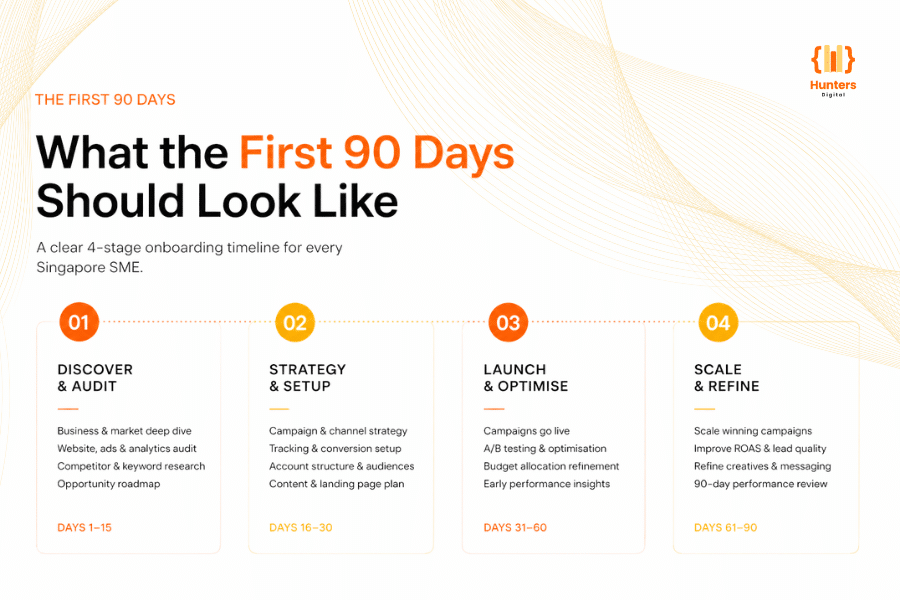
A well-run agency engagement in the first 90 days has a recognisable structure:
| Period | What Should Happen |
| Days 1–14 | Account access setup, technical audit, baseline data review, strategy documentation, alignment on qualified-lead definition. |
| Days 15–30 | First deliverables in motion: campaign structure built or audited, initial content, tracking verified, clear monthly plan agreed. |
| Days 30–60 | Initial results visible. First report shared with specific insights, not just data. Questions answered in writing. |
| Days 60–90 | Performance review against the baseline. Clear picture of what’s working, what’s being adjusted, and the next 90-day plan. |
The exact timeline will vary depending on the service.
SEO, for example, may require more time before meaningful organic growth becomes visible. Paid advertising can produce data much faster, but that does not automatically mean the campaigns are profitable from day one.
The key is that the agency should be able to explain what is happening, why it is happening, and what it plans to do next.
If an agency has reached day 90 without producing a report that clearly explains what has been done, what was measured, what was learned, and what comes next, that is information you should act on.
Conclusion
A digital marketing agency should not be evaluated only by its portfolio, presentation, or promises.
The real test is how transparent the agency is about ownership, access, deliverables, measurement, reporting, accountability, and exit procedures.
The right agency will not be uncomfortable with these questions. In fact, it should welcome them.
Before committing your marketing budget, make sure you understand exactly what you’re getting, what you own, how performance will be measured, and what happens if the relationship changes.
If you’re choosing a digital marketing agency in Singapore and want clear answers to all 10 questions before committing, request a consultation with Hunters Digital.
We’ll walk you through how we work, what we deliver, what you own, how we measure performance, and what happens if your requirements change.
Ready to evaluate your next digital marketing partner with confidence? Get in touch with us for a consultation.
Frequently Asked Questions
In most cases, yes. Your ad account contains your campaign history, audience data, pixel data, and conversion history. That data has significant value and should, where possible, belong to you. A well-structured agency relationship typically sees the agency added as an authorised manager – not as the account owner. If an agency builds your campaigns under their own account, you may lose that history if you change providers, so it’s worth clarifying this before signing.
A short initial minimum – often around three months – can allow enough time for initial work to be implemented and for early data to become visible. Longer minimum commitments should be treated with caution, especially before any results have been demonstrated. After an initial period, rolling arrangements that continue based on actual performance are generally preferable to lengthy lock-in periods.
At minimum: channel-level spend and results, a comparison to the previous period and agreed benchmarks, the specific actions taken that month, what changed and why, and the planned focus for the next month. A useful report explains the numbers in plain language – it doesn’t simply forward a dashboard link and ask if you have questions.
There’s a difference between protecting a proprietary tool or process and refusing to explain what work they’ll do each month. An agency should be able to clearly describe their approach – which types of SEO work they prioritise, how they structure Google Ads campaigns, what their content production process looks like. If they can’t or won’t, that’s worth taking seriously before committing budget.

Suggested Articles
- Website Maintenance in Singapore: What SMEs Should Expect from a Plan That Protects Leads, Security, and Search Visibility

- SEO Pricing in Singapore: What a Good SEO Retainer Should Include – and What to Question Before You Sign
- How to Choose a Digital Marketing Agency in Singapore: 10 Questions That Protect Your Budget, Accounts, and Data
- Why B2B Service Pages Don’t Generate Enquiries – and the Proof Assets Buyers Need Before They Contact You