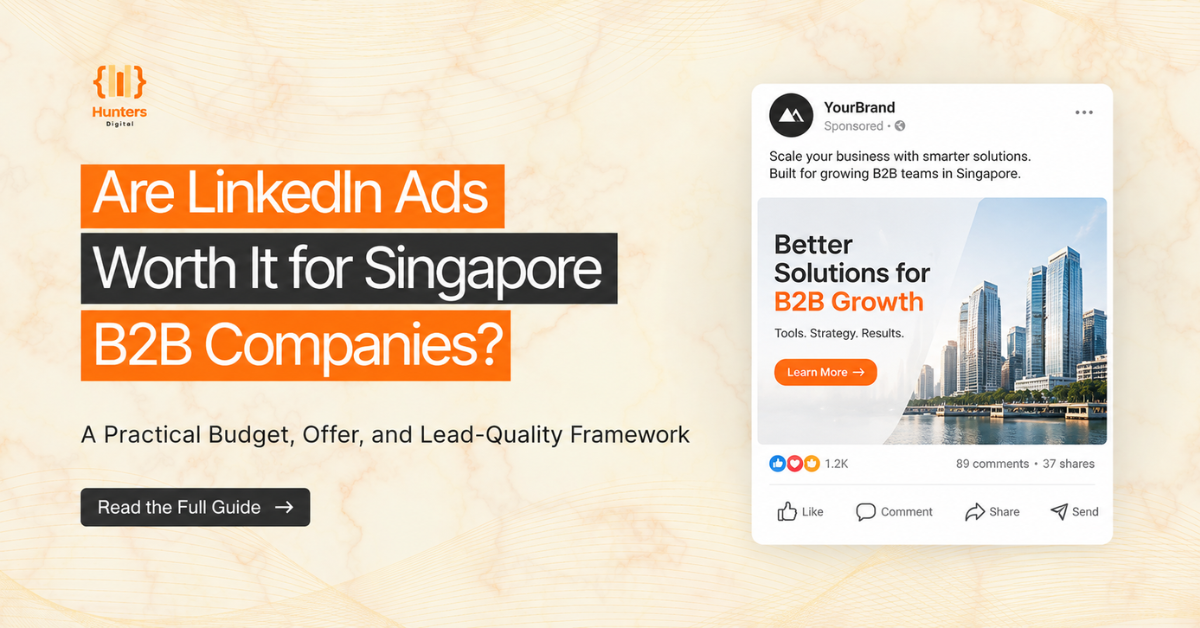
LinkedIn Ads are among the most expensive paid media options available to Singapore B2B businesses. The targeting is precise – job title, company size, seniority, industry – but that precision comes at a higher cost per click than most other platforms.
That cost is worth paying for some businesses. For others, the conditions that make LinkedIn Ads commercially viable simply aren’t in place yet. The mistake is not running or not running LinkedIn Ads – it’s making that decision without assessing whether the conditions are right.
This guide gives Singapore B2B companies a practical framework for evaluating whether LinkedIn Ads make sense for their specific business – and what to address before launching if they do.
Why LinkedIn Ads Cost More Than Other Paid Channels – and When That’s Worth It
LinkedIn’s cost per click is higher than Meta Ads or Google Display for a straightforward reason: the audience is professionally segmented. When you run a LinkedIn campaign targeting finance directors at Singapore companies with 200 or more employees, you’re paying for the precision of that reach. The audience is not a broad demographic approximation – it’s a specific professional profile.
That precision justifies the cost when:
- The decision-maker you’re reaching makes or heavily influences a purchase decision of meaningful value
- That audience is difficult to reach effectively through alternative channels
- The business can convert a LinkedIn lead into a qualified sales conversation and eventually a client
When those conditions are in place, a higher cost per click is irrelevant – cost per client acquired is the number that matters. When they’re not in place, LinkedIn Ads can generate professional-looking activity without producing commercially meaningful results.
The Six Factors That Determine Whether LinkedIn Ads Are Viable for Your Business
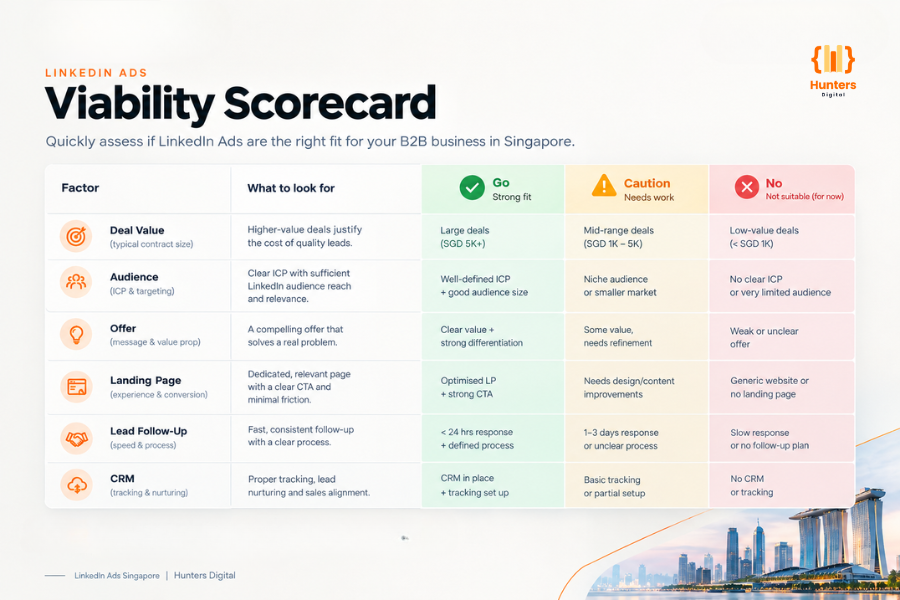
LinkedIn Ads can be a powerful B2B growth channel, but success depends on more than targeting the right audience. These six factors help you assess whether your budget, offer, audience, landing page, follow-up process, and sales tracking are ready to support a profitable campaign.
Factor 1: Deal Value and Average Contract Size
The most fundamental question: what is the typical value of a client relationship? LinkedIn Ads are difficult to justify commercially when average project values are low. The reason is straightforward – the cost of generating and converting a LinkedIn lead needs to be recoverable within a reasonable timeframe.
As a general orientation, businesses where an average engagement is worth several thousand dollars or more have a more viable path to a positive return on LinkedIn Ads. Businesses with lower average values, or where volume is required to make the economics work, typically find better returns on lower-CPL channels.
Factor 2: Addressable Audience on LinkedIn
LinkedIn’s targeting is precise – but the addressable audience in Singapore is finite. For some niches, the relevant audience may be small enough that even well-executed campaigns struggle to generate meaningful volume without exhausting the available pool quickly.
Before committing budget, it’s worth building an audience estimate using LinkedIn’s Campaign Manager. Enter your target job titles, company size filters, and industry restrictions, and observe the estimated audience size. An audience below a few thousand contacts will limit frequency management and campaign longevity significantly.
Factor 3: Offer and Content Quality
LinkedIn users are a professionally sceptical audience. An ad that says “contact us to learn more about our services” is unlikely to generate meaningful qualified engagement. LinkedIn Ads that perform better typically offer something specific and useful: a relevant piece of content, a particular insight, a specific offer tied to a business problem, or a clearly defined outcome from a short conversation.
If the offer requires significant explanation before its value is apparent, that’s a content problem to solve before advertising budget solves it.
Factor 4: Landing Destination and Conversion Path
Where does the LinkedIn ad send someone? A general “about us” or services page is a weak landing destination for a paid B2B campaign. An effective LinkedIn Ads conversion path includes a landing page or LinkedIn Lead Gen Form that:
- Directly continues the message of the ad
- Provides enough proof (case studies, specialist profiles, specific outcomes) for a cautious B2B buyer to act
- Has a clear, low-friction next step (a specific conversation, a downloadable resource, a defined process)
If the landing destination doesn’t meet these criteria, the likelihood of meaningful conversion drops significantly – and the cost per qualified lead tends to be high regardless of how well the ads are targeted.
Factor 5: Lead Qualification and Follow-Up Capacity
LinkedIn Ads can generate enquiries. Converting those enquiries into clients requires a sales process that can handle a B2B buyer with a longer decision cycle. If the business doesn’t have a defined lead qualification process – a way to assess whether a LinkedIn enquiry is a genuine prospect and a timely follow-up sequence – the ads are filling a funnel with no exit.
A LinkedIn lead who doesn’t receive a response within 24 hours, or receives a generic response that doesn’t acknowledge their specific situation, is unlikely to progress. The cost of generating that lead is then unrecovered.
Factor 6: Sales Cycle Length and CRM Feedback
LinkedIn-generated leads in a B2B context often have long evaluation periods. A company comparing professional services providers or technology solutions may take months to make a decision. This affects how LinkedIn Ads should be evaluated: a four-week campaign that produced few immediate sales does not mean the channel failed – it may mean the pipeline is still moving.
To understand whether LinkedIn Ads are working, the business needs a way to track a LinkedIn lead from first contact through qualification, proposal, and close. Without CRM feedback, the decision to continue or stop the campaign is based on incomplete information.
The LinkedIn Ads Viability Scorecard
| Factor | Go (2 points) | Proceed with caution (1 point) | Not yet (0 points) |
| Deal value | High average value per client (several thousand SGD or more) | Moderate value – economics work with good conversion rates | Low value – volume required to justify CPL |
| Addressable audience | Clear target audience of meaningful size on LinkedIn | Audience exists but is small or requires broad parameters | Very small niche or audience not well-represented on LinkedIn |
| Offer quality | Specific, compelling, with clear value to the target role | Reasonable offer, needs sharper messaging | Generic service offer without a clear hook |
| Landing destination | Dedicated page or Lead Gen Form with proof and clear next step | Existing service page – adequate but not optimised for LinkedIn traffic | Homepage or general contact page |
| Lead follow-up | Defined qualification process and timely follow-up in place | Follow-up exists but is inconsistent | No structured follow-up process |
| CRM feedback | LinkedIn leads tracked from enquiry to outcome in CRM | Some tracking, gaps in closed-loop data | No way to track whether LinkedIn leads become clients |
| Scoring: 10–12: strong viability case, proceed with a well-structured campaign. 6–9: viable with targeted improvements – address the lowest-scoring factors before scaling. Below 6: fix the foundations first. LinkedIn Ads are likely to underperform until the key gaps are resolved. |
When to Start LinkedIn Ads – and When Not to Yet
LinkedIn Ads are worth starting when the viability scorecard shows strong or adequate conditions across the six factors – particularly deal value, offer quality, and a functional lead-follow-up process.
It is not yet the right investment when:
- The average sale is too low for the CPL to be recoverable within a reasonable timeframe
- There is no specific offer – only a general “contact us about our services” message
- The landing page is a generic services page with no case studies, no process clarity, and a generic CTA
- Nobody has the capacity to follow up a LinkedIn enquiry within 24 hours
- There is no way to track whether a LinkedIn lead progresses to a proposal or a closed deal
These are not reasons to abandon the idea of LinkedIn Ads. They are conditions worth addressing first. A campaign launched with these gaps in place is more likely to generate cost without the commercial return to justify it, and the conclusion may then incorrectly be that “LinkedIn Ads don’t work.”
If LinkedIn Ads Are the Right Fit: What to Fix Before You Launch
For businesses where the viability scorecard shows a strong or moderate case, a pre-launch checklist:
- Build or review the landing page or Lead Gen Form – does it provide specific proof and a clear, low-friction next step?
- Define the lead qualification criteria – what makes a LinkedIn enquiry a genuine prospect vs a general contact?
- Agree on a follow-up protocol – who responds, how quickly, and with what initial message?
- Set up LinkedIn Insight Tag on the website – this enables retargeting and provides richer attribution data
- Define how LinkedIn leads will be tracked in the CRM from first contact to close
- Build the audience in Campaign Manager and confirm it’s large enough to sustain the campaign
Conclusion
LinkedIn Ads can be a strong growth channel for Singapore B2B businesses, but the right strategy starts with the fundamentals. Deal value, audience size, offer quality, landing page experience, lead follow-up, and CRM tracking all influence whether your campaign can deliver a meaningful return.
If your scorecard shows strong potential, the next step is to build a campaign around the right audience, offer, creative, and conversion path. If your score is low, fixing the gaps first can help you avoid wasting budget and improve your chances of success.
Ready to find out if LinkedIn Ads can work for your business? Contact us today and build a campaign focused on qualified B2B leads, not just clicks.
Frequently Asked Questions
Costs vary based on your audience, campaign objective, bidding strategy, and ad format. LinkedIn Ads generally have higher CPCs than Meta or Google Display, so businesses should focus on cost per qualified lead and customer acquisition cost.
Lead Gen Forms reduce friction by allowing users to submit their details without leaving LinkedIn. Landing pages can provide more information, proof, and context. Testing both can help identify which approach generates better-quality leads for your business.
Campaigns usually need several weeks to gather enough data for meaningful optimisation. Because B2B sales cycles can be longer, the impact on revenue may take several months. Track qualified leads and pipeline progress, not just immediate sales.
Yes. Organic content helps build credibility and gives prospects more information about your business, while LinkedIn Ads help you reach a specific professional audience faster. Using both can create a stronger path from awareness to conversion.

Suggested Articles
- Are LinkedIn Ads Worth It for Singapore B2B Companies? A Practical Budget, Offer, and Lead-Quality Framework

- Website Maintenance in Singapore: What SMEs Should Expect from a Plan That Protects Leads, Security, and Search Visibility
- SEO Pricing in Singapore: What a Good SEO Retainer Should Include – and What to Question Before You Sign
- How to Choose a Digital Marketing Agency in Singapore: 10 Questions That Protect Your Budget, Accounts, and Data