
The most useful question to ask before increasing any ad budget is straightforward: what is your cost per qualified lead by channel? Not total lead count. Not the number shown in the Google Ads dashboard. The cost per lead that actually entered the sales pipeline, broken down by source.
Most Singapore SMEs running paid campaigns can’t answer that question clearly. And that’s the real problem – not the ads, not the channels, not the competition.
If a business can’t distinguish where a qualified enquiry came from, it can’t make a sound decision about where to spend more or less. In Singapore’s competitive SME market, where ad costs are rising and margins are real, that uncertainty has a direct financial consequence.
Why “We Get Leads” Is Not the Same as “We Know What’s Working”
A form submission is not a lead. It’s an expression of interest. A qualified lead is someone who has the problem you solve, the budget to act on it, and the authority to make a decision. The distance between those two things varies enormously by industry.
When businesses say “our ads are working,” it often means the platform dashboard shows conversions, the enquiry inbox has messages, or the phone is ringing. What it rarely means is: “I can tell you which campaign, keyword, and ad produced our last five clients.”
That gap – between activity and qualified outcome – is where most ad budget optimisation goes wrong. Smart Bidding in Google Ads and the equivalent systems in Meta are only as accurate as the outcome data you feed them. If you’re telling those systems to optimise for “form submitted,” they will find people who submit forms – including people who submit and never respond to a follow-up call. That’s not a platform failure. It’s a measurement brief that was set incorrectly.
Conversion Tracking Readiness Checklist
Before looking at the four common tracking gaps, use this quick checklist to see how ready your business is.
The more “No” answers you have, the more opportunities you may have to improve your tracking and understand where your leads and customers are coming from.
Download Conversion Tracking Readiness Checklist here
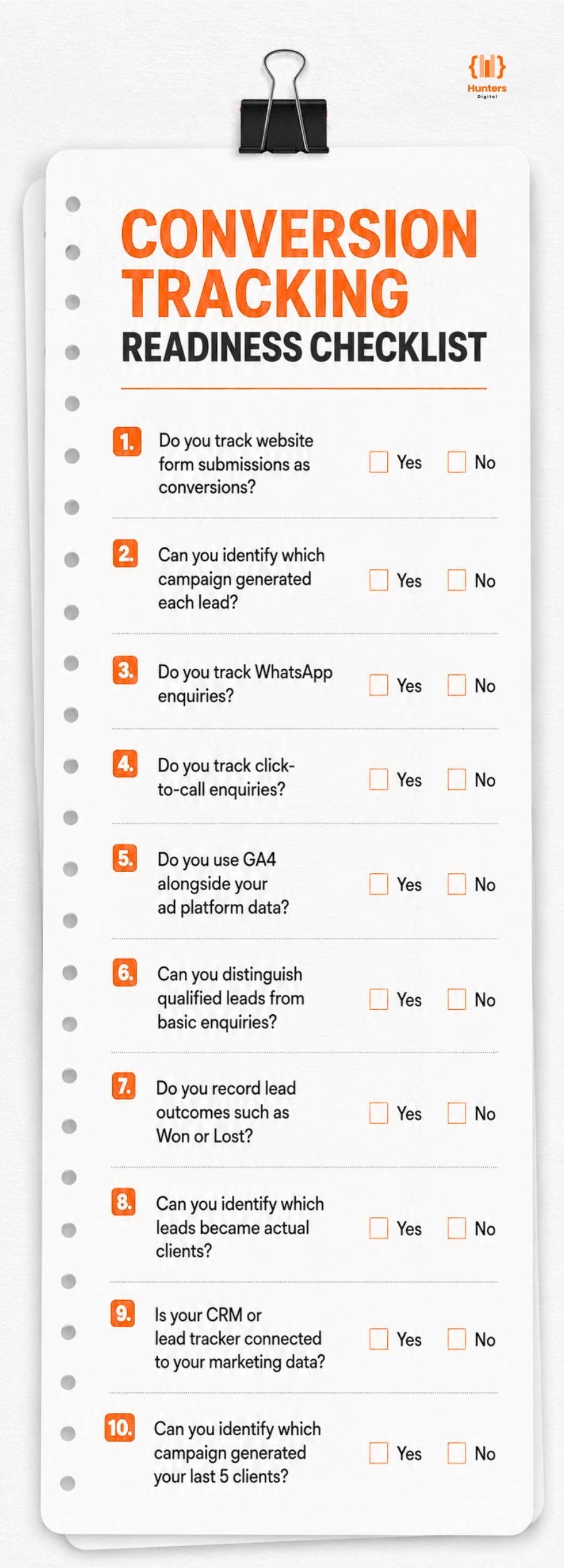
If you answered “No” to several questions, your advertising data may not be telling the full story.
The Four Gaps in Most Singapore SME Tracking Setups
Most tracking problems don’t come from a lack of tools. They come from gaps between what your marketing platforms measure and what actually happens after a prospect enquires. For Singapore SMEs, four gaps appear most often:
Gap 1: Tracking Events Instead of Outcomes
The most common setup: a Google Tag Manager container fires a “form submitted” tag when someone completes a contact form. Google Ads records a conversion. The dashboard looks healthy.
The problem: that tag fires whether the person was a genuine prospect, an existing client checking in, or someone who misidentified your service entirely. None of that context makes it into the conversion count. Smart Bidding then optimises toward finding more people who submit forms in this way – which may or may not correlate with finding more qualified buyers.
The fix isn’t complicated. It requires adding qualification signals downstream: a CRM stage update, a sales-team flag, or an offline conversion import that marks which form submissions became actual opportunities. This gives the platform more accurate outcome data to learn from.
Gap 2: Platform Data That Doesn’t Match Reality
Google Ads will typically show more conversions than GA4, and Meta Ads will often attribute sales that GA4 assigns to direct or organic. Neither is perfectly right. Attribution is a model, not a fact – every platform applies its own attribution window and credit system, and the numbers rarely align.
The practical implication for Singapore SMEs: don’t optimise against a single platform’s numbers. Use GA4 as an independent measurement layer alongside platform dashboards. Set consistent attribution windows across platforms – a 7-day click, 1-day view window is a commonly used starting point, though the right setting depends on your sales cycle. Compare channel performance directionally rather than with false precision.
If Google Ads says 40 conversions and GA4 says 22, the right question isn’t “which one is correct?” It’s: “What happened to the other 18, and does it change our channel allocation decision?” Usually, it doesn’t. But occasionally it reveals a significant misattribution.
Gap 3: WhatsApp and Call Enquiries Disappearing From Reporting
WhatsApp is the dominant enquiry channel for many Singapore service businesses. It’s immediate, familiar to buyers, and frequently the channel that closes the most value. And in most tracking setups, it’s completely invisible.
A prospective client clicks your Google Ad, reads your landing page, and taps your WhatsApp button. From Google Ads’ perspective, that’s a click that didn’t convert. From your business’s perspective, it’s potentially your best lead of the week. The disconnect is a tracking gap, not a campaign failure.
WhatsApp click-to-chat events can be tracked through GTM by firing a tag when someone clicks a wa.me or web.whatsapp.com link. That event can be passed to Google Ads as a conversion, to GA4 as a key event, and, if you use a CRM, matched to a contact record when the conversation arrives. For a site with GTM already installed, this is a relatively straightforward implementation that can meaningfully improve the accuracy of your Google Ads data for service businesses.
Calls are similar. If your business receives phone enquiries, call tracking through a forwarding number or GTM click-to-call tag attribution tells you which campaigns generate phone leads – not just form submissions.
Gap 4: No Connection Between a Lead and a Qualified Sale
The most sophisticated version of this problem: you have clean tracking, accurate form data, and WhatsApp conversion events – but you still can’t tell which campaigns produce clients, because no one has connected the marketing data to the sales outcome.
Offline conversion import is Google’s mechanism for closing this loop. When a lead comes in from an ad, you assign it a Google Click ID (GCLID). When that lead closes (or doesn’t) in your CRM or sales tracker, you import that outcome back to Google Ads. Over time, the platform learns which campaigns and audiences produce leads that close – and adjusts bidding accordingly. This is most valuable for businesses where the gap between a form submission and a signed contract is weeks or months.
For most Singapore SMEs, a basic version of this is achievable with a spreadsheet and a weekly import. More sophisticated businesses integrate their CRM directly. The outcome is the same: your ad platform stops optimising for leads and starts optimising for qualified revenue.
The Conversion Tracking Map: What to Measure and Where
| Conversion Event | Tracking Method | Tool | What It Tells You |
| Form submission | GTM form trigger → GA4 event + Ads tag | GTM / GA4 / Google Ads | Volume of inbound form enquiries by source |
| WhatsApp click | GTM click trigger on wa.me link → GA4 + Ads | GTM / GA4 / Google Ads | WhatsApp enquiry volume — typically the most underreported metric |
| Phone call click | GTM click trigger on tel: link | GTM / GA4 | Click-to-call intent (not call completion) |
| Page-based intent | GA4 key event on pricing / contact page visit | GA4 | High-intent behaviour before form or WhatsApp |
| Ecommerce purchase | GA4 ecommerce + platform pixel | GA4 / Ads / Meta | Revenue by channel and campaign |
| Offline qualification | CRM stage update → offline conversion import | Google Ads / CRM | Which ad-generated leads became qualified opportunities or clients |
WhatsApp, Calls, and Offline Conversions: The Channels Most Businesses Miss
Once the basic event tracking above is in place, the next layer that produces the most immediate improvement for Singapore SMEs is connecting ad-generated WhatsApp enquiries to outcomes.
A simple process that works for most businesses:
- When a WhatsApp enquiry arrives, note the time and any identifiable context (campaign name if visible, landing page they came from).
- Assign a simple status to the conversation: enquiry → qualified → proposal → won/lost.
- At month-end, calculate your qualification rate by channel. If Google Ads WhatsApp leads qualify at a meaningfully higher rate than Meta Ads leads, that changes your channel allocation decision – in a way that raw lead volume numbers would never reveal.
- If you have a CRM, build this into your pipeline stages. If you don’t, a shared Google Sheet with these fields is sufficient for most Singapore SMEs at the start.
This process doesn’t require sophisticated software. It requires consistent discipline over several weeks to start accumulating data that genuinely improves budget decisions.
How to Use Tracking Data to Make Better Budget Decisions
The point of this tracking infrastructure is not to produce more accurate dashboards. It’s to answer three specific questions that most Singapore SME advertisers currently can’t:
- Which channel produces qualified leads, not just enquiries?
- What is my true cost per client acquisition by source?
- Where should I put the next $1,000 of ad budget?
Once you can answer those questions with data rather than intuition, every subsequent budget decision – whether to increase Google Ads spend, test Meta, invest in SEO, or pause a campaign – is grounded in actual commercial evidence rather than platform metrics that may or may not correlate with revenue.
Tracking doesn’t need to be perfect to be useful. It needs to be consistent, honest about its limitations, and connected to the business outcomes that actually matter.
Stop Counting Leads. Start Tracking Revenue.
Getting more leads sounds good. But more leads do not automatically mean more business.
If you cannot see which campaigns generate qualified enquiries, which channels produce customers, and what you are actually paying to acquire each client, you are making advertising decisions with only half the picture.
The good news? You don’t need a complicated tracking system to start making better decisions. By connecting your website events, WhatsApp enquiries, calls, CRM data, and offline sales outcomes, you can turn fragmented marketing data into information that helps you spend your budget more intelligently.
At Hunters Digital, we help Singapore businesses identify tracking gaps and build conversion tracking systems that connect digital marketing activity to real business outcomes.
Not sure if your ads are actually generating revenue? Let Hunters Digital audit your tracking setup and show you where your marketing data may be leaking. Get in touch with us today and turn your tracking data into better marketing decisions.
Frequently Asked Questions
No. Start with the highest-impact gap for your specific business. For many Singapore service businesses, WhatsApp click tracking is a significant blind spot – particularly where WhatsApp is the primary enquiry channel but isn’t captured in any platform reporting. If form submissions are already tracked accurately, WhatsApp is typically the logical next layer. Then offline qualification. Build incrementally rather than trying to implement everything simultaneously.
Google Ads uses a longer attribution window by default and applies credit differently to view-through and cross-device journeys. GA4 uses last-click by default with a shorter window. Neither is “correct” – they measure different things. The practical answer: use GA4 as your independent measurement layer for trend analysis, and use the Google Ads dashboard for campaign-level optimisation decisions. Compare directionally, not absolutely.
In many cases, yes. If your website has GTM installed, a basic WhatsApp click event can be configured through GTM’s built-in click trigger without writing custom code. The complexity depends on your site setup and how your WhatsApp links are implemented. If GTM isn’t yet installed, that’s the prerequisite – and it’s supported on most common CMS platforms, including WordPress and Wix.
Offline conversion import tells Google Ads which of its generated leads became qualified opportunities or clients. It’s the most valuable tracking improvement for businesses with longer sales cycles or telephone-led enquiries. Implementation requires capturing the Google Click ID (GCLID) from each form submission or enquiry, tracking the outcome in a CRM or spreadsheet, and uploading the results to Google Ads on a weekly or monthly basis. It’s not technically complex, but it does require consistent sales-process discipline to maintain.

Suggested Articles
- Google Shopping Ads Singapore: Is Your Product Feed and Product Page Ready to Compete?

- Social Media Management in Singapore: The 90-Day Retainer Scope That Produces a Useful Content System – Not Just a Post Calendar
- Ecommerce SEO in Singapore: A Category-to-Product Discovery Blueprint for Stores Losing Organic Sales
- Website Maintenance in Singapore: What SMEs Should Expect from a Plan That Protects Leads, Security, and Search Visibility