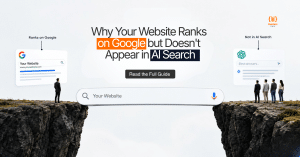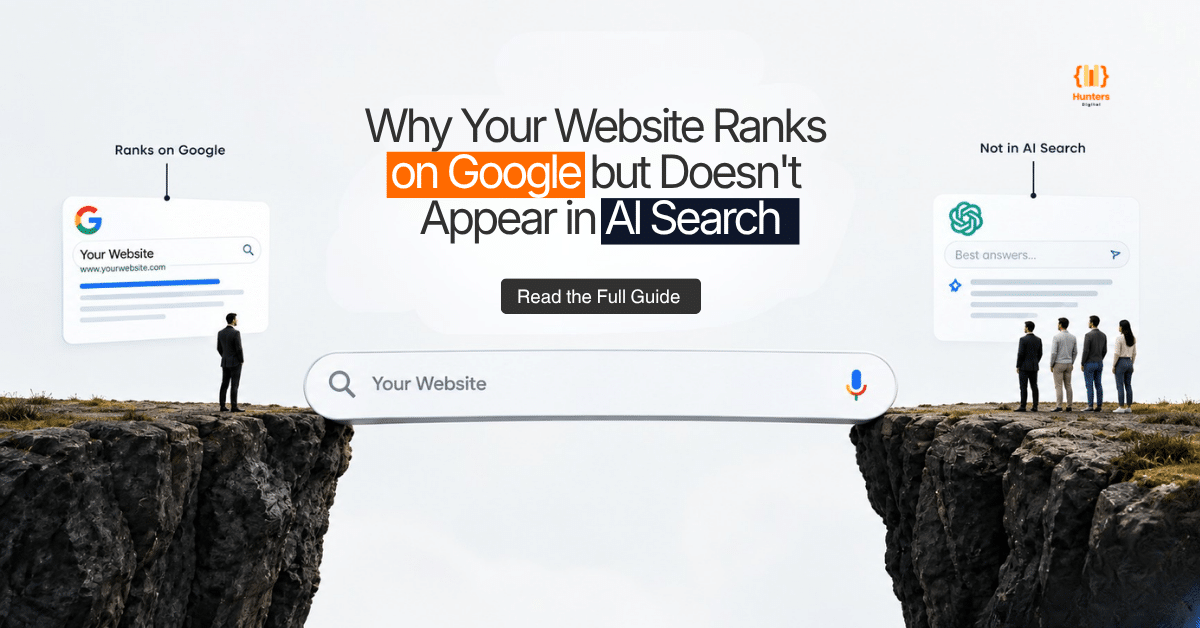
A page-one Google ranking is still an important SEO achievement. It means your website has earned visibility for a specific search query.
But there is a growing question among Singapore businesses:
“If my website ranks on Google, why doesn’t it appear when someone asks ChatGPT, Gemini or another AI search tool about my industry?”
The answer is simple: Google rankings and AI-search visibility are not the same thing.
AI search tools do not simply take the top Google result and use it as the answer. They can interpret the user’s question, search for related information, evaluate different sources and generate an answer based on what they find.
Google’s AI features can use a process called query fan-out, where related searches are performed to gather information from multiple sources. ChatGPT Search can also search the web and provide links to relevant sources.
This means a business can rank well on Google while still having limited visibility in AI-generated answers.
Google Rankings and AI Visibility Are Different
Traditional SEO and AI-search optimisation share many fundamentals, but they have different outcomes. SEO helps search engines crawl, understand and rank your pages. AEO (Answer Engine Optimisation) makes information easier to extract when someone asks a specific question. GEO (Generative Engine Optimisation) builds on this by improving the clarity, credibility and discoverability of your brand across the sources AI systems may use.
Traditional SEO
Traditional SEO focuses on helping search engines:
- Crawl your website
- Understand your content
- Index your pages
- Rank your pages for relevant searches
- Generate organic traffic
AI Search Visibility
AI search focuses on whether your website or brand can be discovered, understood and selected as a useful source when an AI system answers a user’s question.
For example, someone may search Google for:
“SEO agency Singapore”
But ask ChatGPT:
“Which SEO agencies in Singapore help SMEs improve their Google visibility?”
The second question requires more context.
The AI system may need to understand:
- What services you provide
- Who you work with
- Where you operate
- What industries you serve
- What experience you have
- What evidence supports your expertise
So ranking for the keyword “SEO agency Singapore” does not automatically make your business a source for the second question.
| Traditional SEO | AI search visibility |
| A page ranks in an ordered result list. | A page or brand is selected as a supporting source, citation or recommendation in a generated answer. |
| Usually assessed against a search query. | Assessed against the question, context and often several related retrieval queries. |
| Google’s crawl, index and ranking systems shape eligibility and position. | Each platform has its own access controls, source pool and response-selection process. |
| A ranking can be checked in search results. | A mention can vary by prompt, date, location and available sources. |
Google’s AI features still use its core Search systems, so strong SEO remains relevant. However, Google says a page must be indexed and eligible for a normal search snippet to be considered as a supporting link, and that meeting those conditions does not guarantee crawling, indexing or serving.
Why Doesn’t a High Google Ranking Guarantee AI Visibility?
There are several reasons your website may rank well in Google but appear less often in AI-generated answers.
1. AI Search May Interpret the Question Differently
Google users often search with short keywords.
AI users tend to ask longer, more conversational questions.
For example:
Google search:
Web design Singapore
AI search:
What should Singapore SMEs look for when choosing a web design agency?
The AI system now needs more than a page targeting the keyword “web design Singapore”.
It needs useful information about:
- Website development
- Mobile responsiveness
- UX
- SEO
- Website speed
- CMS options
- Pricing considerations
- Business requirements
- Agency experience
This is why creating content around real customer questions and decisions is becoming increasingly important.
Instead of creating pages only around keywords, build pages that provide complete answers.
2. AI Search Can Use Multiple Sources
An AI-generated answer may not rely on a single website.
It can gather information from different sources and use the information it considers relevant to the question.
For example, an answer about digital marketing in Singapore could potentially use:
- Agency websites
- Industry publications
- Government websites
- Business directories
- News websites
- Research reports
- Specialist blogs
- Company case studies
ChatGPT Search, for example, is designed to provide answers using information from the web and can include links to relevant sources. OpenAI also states that ChatGPT Search uses multiple factors when ranking search results, and specific placement is not guaranteed.
This means your competitors may appear in an AI answer even if your website ranks higher for a particular Google keyword.
3. Your Website May Not Provide Enough Specific Information
A common problem is generic content.
Consider two service pages.
Website A
We are a leading digital marketing agency providing innovative and results-driven solutions for businesses.
Website B
We help Singapore SMEs improve organic search visibility through technical SEO, content optimisation, local SEO, Google Business Profile optimisation and ongoing performance tracking.
The second example gives much more useful information.
It tells the reader:
- Who the company serves
- Where it operates
- What it does
- Which services it provides
- What problem it addresses
For AI search, clarity matters.
Your website should make it easy to understand what your business does, who it helps and why its information is relevant.
4. Your Important Information May Be Difficult to Access
Your content cannot contribute to search visibility if important pages cannot be properly accessed or crawled.
Technical issues can include:
- Incorrect robots.txt rules
- Noindex directives
- Canonical problems
- Broken internal links
- Server errors
- WAF or CDN restrictions
- JavaScript rendering issues
- Poor sitemap coverage
- Pages hidden behind login requirements
For ChatGPT Search, OpenAI specifically recommends allowing OAI-SearchBot to crawl your website if you want your content to be discoverable in ChatGPT Search. OpenAI also notes that the website host or CDN needs to permit relevant crawler traffic.
However, allowing a crawler does not guarantee that your website will be cited.
It simply removes one potential accessibility barrier.
5. Another Website May Answer the Question Better
Ranking well for a keyword does not mean your page is the best source for every related question.
A competitor may have:
- A more detailed guide
- A recent case study
- Original research
- Better examples
- Clearer explanations
- More specific industry experience
- Stronger supporting evidence
For example, your website may rank for:
“Google Ads agency Singapore”
But another website may have a detailed guide covering:
“How much should Singapore SMEs spend on Google Ads?”
If the AI user asks about Google Ads budgets, that second page may be more relevant to the question.
The lesson is not to copy competitors.
Instead, identify the questions your potential customers ask and create more useful, specific and evidence-based content around them.
6. Your Business Information May Not Be Consistent
AI systems need context to understand businesses and entities.
Make sure your important business information is consistent across your website and relevant online profiles.
Check details such as:
- Company name
- Location
- Services
- Industry expertise
- Contact information
- Business descriptions
- Author information
- Case studies
- Business Profile information
For Singapore businesses, local context can also be important.
Clearly communicate that you serve Singapore businesses where this is relevant, rather than relying only on a generic service description.
The goal is to make your business easier to understand, not to add keywords unnecessarily.
7. Your Content May Not Demonstrate Enough First-Hand Expertise
AI search is not simply about producing more content.
The quality and usefulness of the information matter.
Instead of publishing another generic article about:
“10 Benefits of Digital Marketing”
consider creating content based on your actual experience.
For example:
- SEO case studies
- Website migration lessons
- Singapore SEO examples
- Technical SEO audits
- Campaign insights
- Industry-specific strategies
- Before-and-after improvements
- Common mistakes found during client projects
This gives your website information that is more specific and useful than generic marketing content.
Google’s guidance for generative AI features continues to emphasise established SEO fundamentals and helpful, people-first content rather than a separate shortcut for AI visibility.
How to Improve Your AI Search Visibility
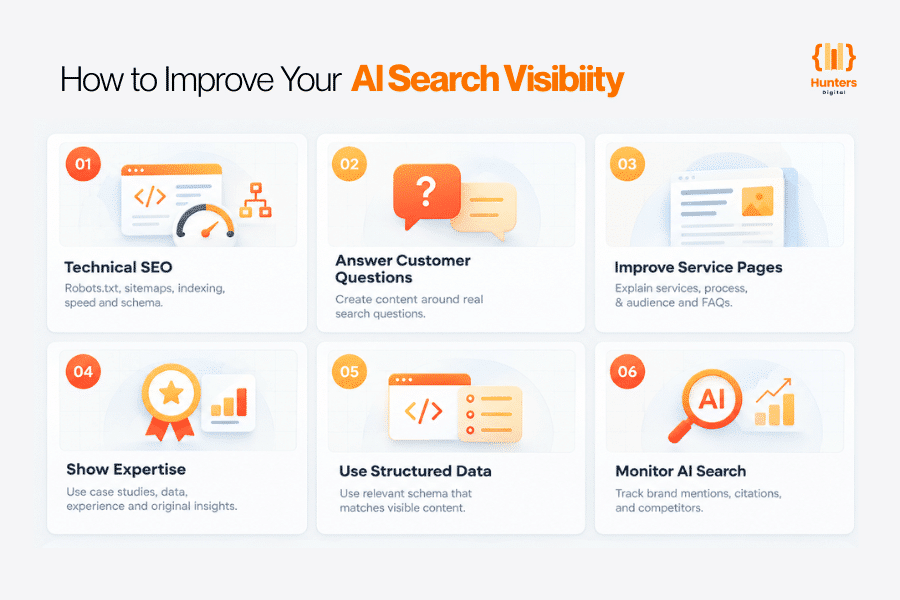
There is no guaranteed formula for appearing in ChatGPT, Gemini, Perplexity or Google’s AI features.
However, you can improve the foundations that make your website easier to discover and understand.
1. Keep Your Technical SEO Strong
Start with the basics.
Check:
- Robots.txt
- XML sitemap
- Noindex tags
- Canonical tags
- Internal linking
- Page accessibility
- Mobile usability
- Page speed
- Server response codes
- JavaScript rendering
- Structured data
Use Google Search Console to check important pages and make sure they can be crawled and indexed.
Technical SEO remains the foundation of search visibility.
2. Create Content Around Real Customer Questions
Don’t build your content strategy around keywords alone.
Think about what your customers ask before contacting you.
For example, an SEO agency could create content around:
- How much does SEO cost in Singapore?
- How long does SEO take to show results?
- Does SEO work for small businesses?
- How can a Singapore SME improve local rankings?
- What is the difference between SEO and GEO?
- How can businesses appear in AI search?
- What should a company check before hiring an SEO agency?
These questions can become:
- Blog articles
- Service-page sections
- FAQs
- Guides
- Case studies
- Comparison pages
This creates a broader information ecosystem around your expertise.
3. Make Your Service Pages More Useful
Your service pages should answer more than:
“What service do you provide?”
They should also explain:
- Who the service is for
- What problems it solves
- How the process works
- What is included
- What businesses should consider
- What results can realistically be measured
- What makes your approach different
- Frequently asked questions
For example, a Singapore SEO Services page could cover technical SEO, content strategy, local SEO, link building, reporting and AI-search optimisation.
This gives users and search systems more context about your service.
4. Strengthen Your Website’s Expertise and Evidence
Replace vague marketing claims with information that can actually be assessed.
Instead of:
“We are Singapore’s leading SEO experts.”
Use specific information such as:
“Our SEO campaigns combine technical optimisation, content development, local SEO, link building and performance tracking for Singapore businesses.”
Where appropriate, support claims with:
- Case studies
- Client examples
- Data
- Author information
- Industry experience
- Relevant credentials
- Original insights
The more specific your content is, the easier it is for readers to understand what your business actually knows and does.
5. Use Structured Data Correctly
Structured data can help Google understand information on your pages and can support eligible search features.
But it should not be treated as an “AI ranking hack.”
Google’s current documentation does not identify a special schema markup or separate technical requirement that guarantees visibility in AI Overviews or AI Mode.
Use structured data where it genuinely applies and make sure the markup matches the visible information on the page.
Good technical SEO is more important than adding unnecessary schema.
6. Monitor Real AI Search Queries
Traditional SEO reporting often focuses on:
- Keyword rankings
- Organic traffic
- Impressions
- Clicks
- Backlinks
These metrics still matter.
But businesses should also start monitoring how their brand appears in AI-generated answers.
Create a list of relevant questions, such as:
“Best SEO agency in Singapore for SMEs”
“How can a Singapore business improve Google rankings?”
“What is the best way to improve AI search visibility?”
“Which digital marketing services do Singapore SMEs need?”
Then check:
- Does your business appear?
- Is your website cited?
- Which competitors appear?
- Which websites are cited?
- What type of content is being referenced?
- What information do those sources provide?
Repeat the process regularly because AI-generated results can change as search systems, sources and queries change.
SEO + AEO + GEO: One Connected Strategy
Businesses do not need to choose between SEO, AEO and GEO.
They work best as connected parts of a broader search strategy.
SEO
Build a technically sound website that search engines can crawl, understand and rank.
AEO
Structure content so it clearly answers the questions your audience is asking.
GEO
Improve your brand’s clarity, credibility and discoverability across generative search experiences.
The foundation remains the same:
Useful content + technical accessibility + clear expertise + credible information.
AI search simply changes how users discover and consume that information.
What Singapore Businesses Should Do Next
If your website ranks well on Google but rarely appears in AI-generated answers, don’t immediately assume your SEO strategy has failed.
Instead, review the bigger picture.
Ask:
Can AI crawlers access my important pages?
Does my content answer the questions customers actually ask?
Is my expertise clearly explained?
Do I have original examples and evidence?
Is my business information consistent?
Are my important pages technically accessible?
Am I monitoring AI-search visibility as well as Google rankings?
These checks can reveal opportunities that a traditional keyword-ranking report may not show.
Conclusion
Google rankings remain an important part of digital visibility, but search behaviour is changing.
Users are increasingly asking longer, more specific questions and expecting direct answers.
AI search can bring information from multiple sources together instead of simply showing a traditional list of links.
That means businesses need to think beyond “How do I rank for this keyword?”
A better question is:
“Does my website provide the information, expertise and evidence needed to answer the questions my customers are asking?”
For Singapore SMEs, the opportunity is to build a website that is technically accessible, genuinely useful, specific to the business and easy to understand.
Strong SEO remains the foundation. AEO and GEO can build on that foundation to prepare your content for an evolving search landscape.
Is Your Website Visible in AI Search?
If your website ranks on Google but your business rarely appears in AI-generated answers, Hunters Digital can help identify potential visibility gaps. Our team can review your technical SEO, content structure, search visibility, entity signals, local SEO, AI-search accessibility, and AEO and GEO opportunities.
Book a free consultation with us to get a clearer view of your website’s visibility across Google and AI search.
Frequently Asked Questions
Google rankings and AI-search visibility are different. AI search tools may interpret a question differently, retrieve information from multiple sources and select sources based on relevance to the specific question. A high Google ranking therefore does not automatically guarantee an AI-generated mention or citation.
Yes, strong SEO remains an important foundation. However, it is not a guarantee of visibility in AI-generated answers. Your content also needs to provide clear, relevant and useful information that addresses the questions users are asking.
SEO focuses on crawling, indexing and ranking pages. AEO (Answer Engine Optimisation) focuses on providing clear answers to user questions. GEO (Generative Engine Optimisation) focuses on improving the clarity, credibility and discoverability of information across generative search experiences.
Start with strong technical SEO, create content around real customer questions, improve service pages, demonstrate first-hand expertise, maintain consistent business information and monitor how your brand appears in relevant AI-generated answers.
Useful formats include detailed service pages, FAQs, how-to guides, case studies, original research, industry insights, comparisons and articles that answer specific customer questions. The content should provide clear information rather than simply repeating keywords.

Suggested Articles
- Why Your Website Ranks on Google but Doesn’t Appear in AI Search

- Website Redesign vs SEO: What Should You Fix First?

- Are LinkedIn Ads Worth It for Singapore B2B Companies? A Practical Budget, Offer, and Lead-Quality Framework
- Website Maintenance in Singapore: What SMEs Should Expect from a Plan That Protects Leads, Security, and Search Visibility