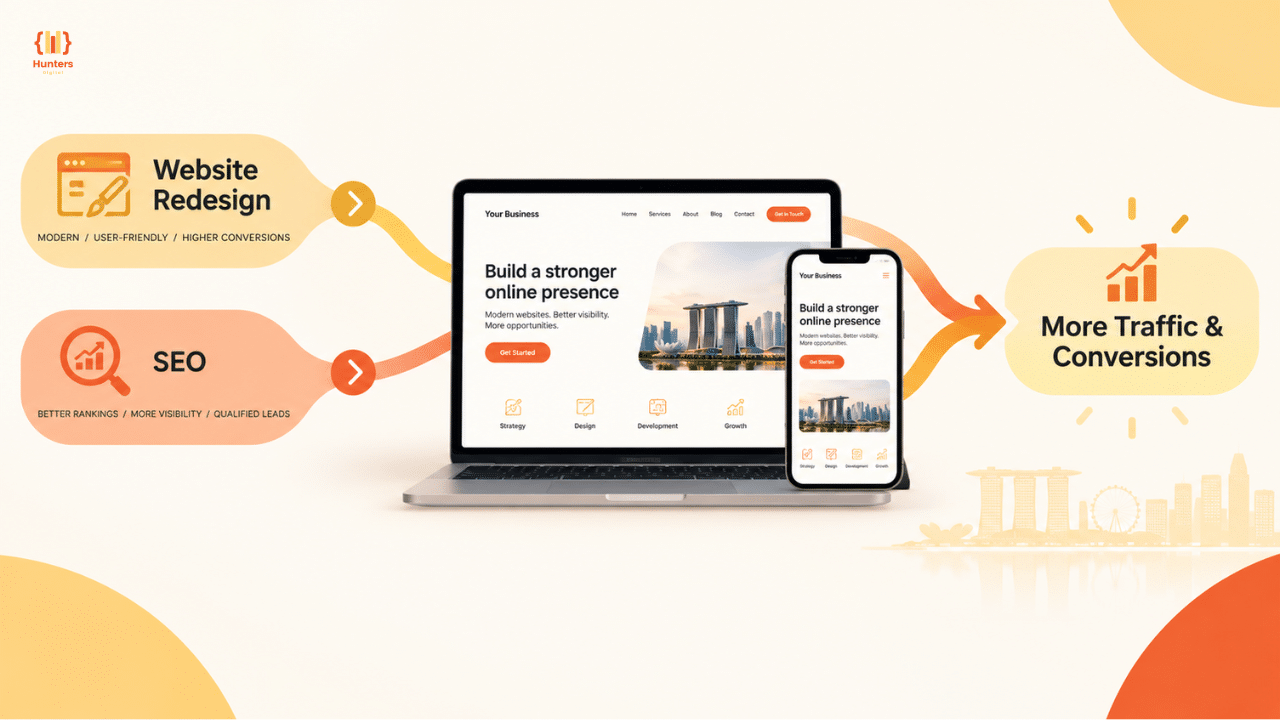
A website can look outdated, load slowly, have confusing navigation, or struggle to generate leads. At the same time, its organic rankings may be dropping, important pages may not be indexed, and competitors may be taking more search traffic.
This often creates a common question for businesses in Singapore:
Should you redesign the website first or fix SEO first?
The answer depends on what is holding the website back.
A complete redesign is not always the right starting point. Likewise, investing heavily in SEO before fixing serious website problems can limit the results. The better approach is to identify the issues affecting technical performance, search visibility, user experience, and conversions, then prioritise the work based on business impact.
What Is the Difference Between Website Redesign and SEO?
Website redesign focuses primarily on the website’s structure, design, user experience, functionality, and performance.
This can include:
- Updating the visual design
- Improving navigation
- Reorganising website pages
- Improving mobile responsiveness
- Reducing page load times
- Improving conversion paths
- Updating website functionality
- Restructuring the website architecture
SEO focuses on improving the website’s visibility in search engines and AI-powered search experiences.
SEO work can include:
- Keyword research
- On-page optimisation
- Technical SEO
- Internal linking
- Content optimisation
- Schema markup
- Local SEO
- Link building
- Google Business Profile optimisation
- Search Console and indexing improvements
- Content designed for AI search and answer engines
The two areas overlap significantly. A website redesign can affect SEO, while SEO findings can influence how a website should be structured.
That is why deciding which one comes first matters.
When Should You Fix SEO First?
If the website is technically sound and provides a reasonable user experience, SEO may be the first priority.
For example, your website may have:
- Poor keyword targeting
- Missing or weak title tags and meta descriptions
- Pages that are not properly indexed
- Weak internal linking
- Thin or outdated content
- Poor search visibility
- Limited backlinks
- Poor local SEO signals
- Missing structured data
- Content that does not match search intent
In these situations, redesigning the entire website may not solve the underlying problem.
A visually attractive website can still rank poorly if search engines cannot understand its content, important pages are not indexed, or there is little authority supporting the site.
An SEO audit can identify these issues before you commit to a major redesign.
When Should You Redesign the Website First?
A redesign becomes a higher priority when the website itself is creating a significant barrier for visitors and search engines.
For example, consider a website that:
- Is difficult to use on mobile devices
- Has confusing navigation
- Loads very slowly
- Uses an outdated page structure
- Has broken functionality
- Makes it difficult for visitors to contact the business
- Has poor conversion paths
- Contains duplicate or unnecessarily complicated page structures
- Uses an architecture that makes future SEO difficult
In these situations, continuing to send more traffic to the existing website may not address the core problem.
Imagine increasing organic traffic by 30%, but visitors cannot quickly find the service they need or complete an enquiry form. The SEO work may generate more visits without producing a corresponding increase in enquiries.
This is where website performance and SEO need to be considered together.
The Biggest Risk: Redesigning Without an SEO Plan
One of the most common SEO problems occurs when a business launches a new website without considering its existing search visibility.
A redesign can change:
- URLs
- Page names
- Website navigation
- Internal links
- Content
- Heading structures
- Metadata
- Canonical tags
- Images
- Structured data
If old URLs disappear without appropriate redirects, valuable search traffic can be lost.
For example, suppose an existing service page has been ranking for several relevant searches. During a redesign, that page is removed and replaced with a new URL.
If the old URL is not properly redirected and the new page is not optimised, search engines may need to reassess the page from scratch. In some cases, valuable rankings and backlinks can also be affected.
This is why SEO should be involved before the redesign begins, not after the new website goes live.
What Should You Check Before Making a Decision?
Before choosing between redesign and SEO, start with an audit.
A practical website and SEO audit should review four key areas.
1. Technical Health
Check whether search engines can efficiently crawl and understand the website.
Important areas include:
- Indexing
- Crawlability
- Robots.txt
- XML sitemap
- Canonical tags
- Redirects
- Broken links
- Page speed
- Core Web Vitals
- Mobile usability
- HTTPS
- Duplicate content
Technical problems can prevent otherwise good content from performing properly in search.
2. Website Structure
Review how the website is organised.
Ask:
Can visitors quickly understand what the business offers?
Can search engines identify the most important pages?
Are services, products and supporting content logically connected?
A clear website hierarchy helps both users and search engines.
For example, a Singapore digital marketing agency may organise its website around services such as SEO, SEM, social media marketing, website design and AI-search optimisation. Each important service should have a clear, accessible page supported by relevant internal links and useful content.
3. Search Performance
Use Google Search Console and analytics data to understand what is already working.
Look at:
- Organic clicks
- Impressions
- Search queries
- Ranking pages
- Click-through rates
- Indexed pages
- Traffic trends
- Conversions from organic search
Do not automatically remove pages simply because they receive little traffic. A page may have backlinks, rankings for valuable long-tail keywords, or potential that can be improved through optimisation.
4. Conversion Performance
Traffic is only one part of the equation.
Review whether visitors can easily:
- Contact the business
- Request a quote
- Book a consultation
- Make a purchase
- Find important information
- Navigate between related services
If a website receives organic traffic but generates very few enquiries, conversion and UX improvements may need to happen alongside SEO.
SEO and Website Redesign Can Work Together
In many cases, the answer is not SEO versus redesign.
It is an SEO-informed redesign.
Before designing new pages, SEO research can identify:
- What people are searching for
- Which existing pages attract traffic
- Which URLs have backlinks
- Which services have search demand
- Which pages need to be retained
- Which content needs improvement
- Which pages should be consolidated
- Which new pages could support the website
This allows the new website structure to support both users and organic search.
For example, keyword research may show that customers search for a specific service using several related terms. Instead of designing a generic services page, the website structure can be developed around a dedicated, useful service page that addresses those search needs.
The design then supports the SEO strategy rather than working separately from it.
What If the Website Needs a Complete Redesign?
If a complete redesign is necessary, SEO should be part of the project from the planning stage.
Before launch, create a list of important existing URLs and review their performance.
Pay particular attention to pages that have:
- Organic traffic
- Search rankings
- Backlinks
- Conversions
- Strong impressions in Search Console
Map old URLs to their corresponding new URLs where changes are necessary.
When URLs change, implement appropriate 301 redirects rather than simply deleting the old pages.
After launch, monitor:
- Indexing
- Organic traffic
- Ranking changes
- Search Console errors
- Redirects
- Broken links
- Sitemap status
- Canonicalisation
- Page performance
A redesign should not be considered complete simply because the new website is live.
A Better Way to Prioritise the Work
Instead of asking, “Should we redesign or do SEO?”, ask:
What is currently preventing the website from performing?
When the main problems involve search visibility, content, or technical SEO, start by addressing those areas. A website that is difficult to use, slow, outdated, or has poor conversion paths may require redesign work first.
For websites facing significant issues in both areas, begin with the highest-impact technical problems and plan the redesign around SEO requirements. This approach helps create a stronger website without sacrificing existing search visibility.
A phased approach can often work well:
Phase 1: Audit
Identify technical, UX, SEO, and conversion issues.
Phase 2: Prioritise
Separate critical problems from improvements that can be handled later.
Phase 3: SEO and Website Planning
Use keyword research, existing performance data, and user behaviour to define the new website structure.
Phase 4: Redesign and Optimisation
Build the new website with SEO-friendly architecture, content, navigation, and technical foundations.
Phase 5: Migration and Monitoring
Manage redirects, indexing, sitemaps, metadata, and Search Console monitoring after launch.
Conclusion
There is no universal rule that says SEO should always come before a redesign or vice versa. The right priority depends on your website’s actual condition.
If your website is usable but lacks organic visibility, SEO may be the priority. If it has serious technical, UX, or conversion issues, those foundations should be addressed first. And when a redesign is planned, SEO should be built into the process from the start to protect existing visibility and support future growth.
At Hunters Digital, we assess website structure, technical SEO, content, search visibility, user experience, and conversion opportunities together to identify what needs attention first.
Not Sure Where to Start?
Don’t redesign blindly. Don’t optimise blindly. Start with an audit.
Get your website and SEO audit started with us today. Discover what is holding your website back, what should be fixed first, and where to focus your next investment.
Frequently Asked Questions
A business should consider a redesign when its website is outdated, difficult to use on mobile devices, slow, difficult to navigate, technically problematic, or generating traffic without enough enquiries or conversions.
Website design can indirectly affect SEO through factors such as mobile usability, page experience, navigation, site structure, accessibility, and performance. Design should therefore support both users and search engine accessibility.
SEO results vary depending on the website’s existing authority, competition, technical condition, content quality, industry, and search demand. Some improvements may appear relatively quickly, while meaningful organic growth can take longer.
Before a redesign, review existing organic traffic, rankings, indexed pages, backlinks, high-performing pages, URLs, conversions, technical SEO issues, and valuable content. This helps prevent the redesign from accidentally removing assets that already perform well in search.
They can be planned together when both the website and its search visibility need improvement. Incorporating SEO during the redesign helps ensure the new website has an effective structure, URLs, content, internal linking, and technical foundation from launch.

Suggested Articles
- Website Redesign vs SEO: What Should You Fix First?

- Are LinkedIn Ads Worth It for Singapore B2B Companies? A Practical Budget, Offer, and Lead-Quality Framework

- Website Maintenance in Singapore: What SMEs Should Expect from a Plan That Protects Leads, Security, and Search Visibility
- SEO Pricing in Singapore: What a Good SEO Retainer Should Include – and What to Question Before You Sign