


Getting three quotes for a corporate website and receiving three wildly different numbers is a common experience for Singapore businesses. Each quote may cover entirely different scope assumptions – which makes comparison nearly impossible without a clear brief.
None of them are necessarily wrong. They’re just quoting for different things – because the brief didn’t tell them what they actually needed to know.
This guide covers what a corporate website brief should contain, why scope inputs determine quote accuracy, and how to approach agency proposals in a way that produces useful comparisons rather than apples-to-oranges numbers.
Why Most Corporate Website Quotes Are Not Comparable
The gap between the cheapest and most expensive quote for the same website project usually comes down to two things: different interpretations of the scope, and different assumptions about what’s included.
An agency that quotes SGD 8,000 may be pricing a template-based build with no custom functionality. The SGD 35,000 quote may include custom development, CMS training, SEO infrastructure, and a three-month post-launch support period. Neither agency has misrepresented their price – they’ve just quoted for what they assumed the project required.
The brief is the document that closes that gap. A well-structured brief tells every agency exactly what they’re quoting for, which is what makes the numbers they return actually comparable.
The Website Brief: What Information Agencies Actually Need
Most businesses submit a brief that describes what they want the website to look like. What agencies actually need to produce an accurate quote is information about what the website needs to do, who it needs to serve, and how it needs to connect with other systems.
Business Objectives vs. Design Preferences: Getting the Brief Order Right
Start with objectives, not aesthetics. “We want a clean, modern website” tells an agency almost nothing about what to build. “We need a website that positions us as the premium provider in our category, generates qualified enquiry submissions from mid-market Singapore businesses, and integrates with our CRM” gives them the commercial context to design appropriately.
Design references can follow – they help communicate visual direction – but they should come after the business objectives are clearly stated.
Scope Inputs That Determine Complexity and Cost
Three dimensions of scope drive most of the variation in corporate website development quotes: the number of pages, the functional requirements, and the integration requirements.
Pages, Functions, and Integrations: The Three Scope Dimensions
| Dimension | What to Define | Examples |
| Pages | Total page count, page types, whether pages require custom templates or can share layouts | Homepage, services (x8 sub-pages), about, team, case studies (CMS), contact, blog (CMS), resources |
| Functions | Interactive elements, user flows, forms, calculators, gated content, search | Enquiry forms with conditional logic, live chat integration, job listings, event registration, CPD tracking |
| Integrations | Third-party systems the website needs to connect with | HubSpot, Salesforce, Xero, booking systems, document management, marketing automation, SSO |
The more precisely these three dimensions are defined in the brief, the more accurate the quotes you receive will be.
Technical Requirements: What to Decide Before Briefing
Several technical decisions significantly affect build complexity and cost. Addressing them before briefing avoids mid-project changes that extend timelines and increase fees.
CMS Platform Choice: What Drives the Decision for Corporate Clients
The CMS platform determines how content is managed after launch, what flexibility you have for future expansion, and how much the agency’s development work will be based on existing frameworks versus custom builds.
| WordPress / Headless CMS | Custom Development |
| Lower initial cost; extensive plugin ecosystem | Higher initial cost; built for specific requirements |
| Familiar to most content managers | No plugin constraints; purpose-built workflows |
| Requires security maintenance and update management | Maintenance scope depends on architecture |
| Suitable for most corporate website requirements | Suitable when standard CMS platforms can’t meet functional needs |
Most Singapore corporate website projects are well-served by established CMS platforms unless there are specific functional or compliance requirements that standard platforms can’t meet.
Maintenance, Security, and Ongoing Support: Scoping Beyond Launch
A corporate website requires ongoing attention after launch: security updates, content changes, performance monitoring, and periodic updates as your business evolves. Many Singapore businesses underestimate this component when comparing quotes.
Ask each agency to include a post-launch support scope in their proposal. This makes it easier to compare the total cost of ownership rather than just the build cost.
How to Evaluate Agency Responses: Beyond Price
Once you’ve received proposals against a structured brief, price comparison becomes easier. But price alone is rarely the right basis for a decision on a project of this complexity.
Red Flags in Agency Proposals: What to Look Out For
- No discovery or scoping phase – agencies that jump to a quote without clarifying requirements are likely to miss something significant
- Vague deliverables – “a professionally designed website” is not a deliverable. Look for proposals that specify page counts, functionality, integration scope, testing, and handover
- No post-launch support included – this may mean ongoing work is being priced separately without being flagged upfront
- Unclear intellectual property terms – confirm who owns the code, designs, and content management system after the project completes
- No SEO infrastructure mentioned – a website that isn’t built with search visibility in mind will underperform regardless of how well it looks
The Development Process: What a Structured Corporate Website Project Looks Like
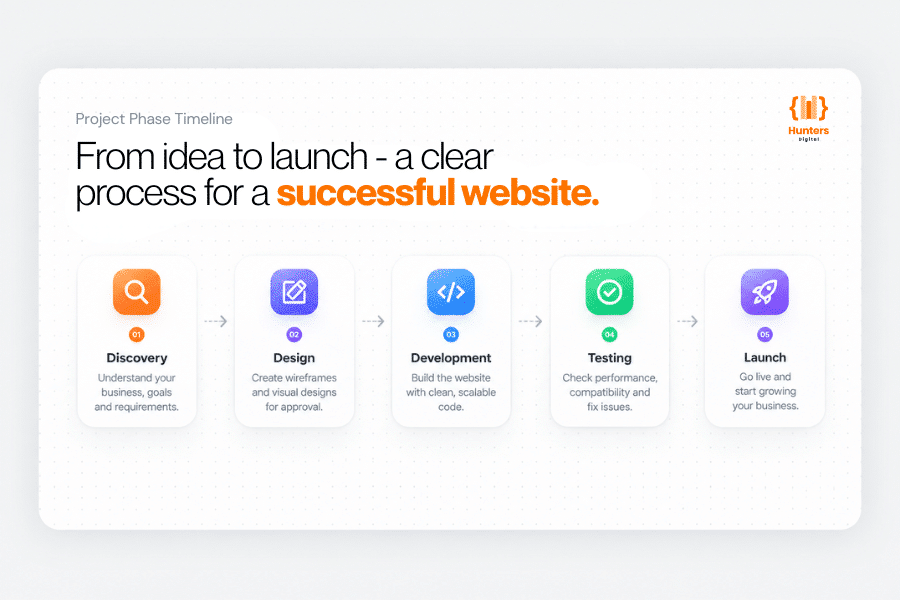
A structured corporate website project in Singapore moves through five phases. Understanding this sequence helps you manage expectations and plan internal resources accordingly.
| Phase | Activities | Typical Duration | What You Need to Provide |
| Discovery | Requirement analysis, technical audit, content inventory, stakeholder alignment | 1–2 weeks | Business objectives, brand guidelines, existing asset access, stakeholder availability |
| Design | Wireframes, UI design, design system, client review and approval | 3–5 weeks | Brand feedback, internal approval process, reference sites |
| Development | CMS build, template development, integration setup, content migration | 4–8 weeks | Final approved content, image assets, integration access |
| Testing | QA, browser/device testing, performance testing, content review | 1–2 weeks | Internal review team, test environment access, final content sign-off |
| Launch | Staging to live, DNS, monitoring, handover, training | 1 week | Domain access, hosting credentials, IT contact |
Website Brief Matrix: A Practical Framework for Singapore Businesses
Use this framework as the basis for your brief. Complete each section before approaching agencies.
| Brief Section | What to Include |
| Business Context | Industry, size, primary markets, competitive positioning, what makes you different |
| Objectives | What the website needs to achieve commercially – leads, brand, conversions, retention |
| Target Audience | Who visits the site, their knowledge level, what they’re trying to accomplish |
| Current Website | What’s working, what isn’t, traffic volumes if available, existing content to keep |
| Page Scope | List of all required pages with notes on complexity and whether CMS management is needed |
| Functional Requirements | Forms, calculators, gated content, events, jobs, search, user accounts |
| Integrations | CRM, marketing automation, accounting, booking, document management |
| Content | Who is producing content, what assets exist, whether copywriting is in scope |
| Technical | CMS preference, hosting requirements, compliance or security specifications |
| Design Direction | Brand guidelines, visual references, what to avoid |
| Timeline | Hard launch date if applicable, internal milestones, approval process |
| Budget | Indicative range – giving agencies a budget range produces more useful proposals |
| Post-Launch | Who manages content, maintenance expectations, growth plans |
Conclusion
A corporate website is a significant investment, and the right brief can make the difference between a clear, comparable proposal and a project filled with unexpected costs and delays. By defining your objectives, page scope, functionality, integrations, technical requirements, content, and post-launch needs upfront, you give agencies the information they need to build an accurate proposal.
At Hunters Digital, we help Singapore businesses plan and build corporate websites with business goals, SEO, user experience, and long-term growth in mind. From defining the right scope to developing a search-friendly website, our team can help you move from a brief to a website that supports your business.
Planning a new corporate website in Singapore? Talk to us about your project and get a clearer path from brief to launch.
Frequently Asked Questions
Corporate website development in Singapore varies significantly based on scope. Key cost drivers include the number of pages, level of custom development required, functional requirements, third-party integrations, content production, and post-launch support. The most useful step before seeking quotes is defining your scope clearly – agencies quoting against the same brief produce numbers that can actually be compared.
Timelines vary based on project scope, content readiness, functional complexity, and the speed of internal approvals and feedback. A straightforward corporate website may take eight to twelve weeks; more complex projects with custom development, integrations, or multiple stakeholder sign-off stages will take longer. Projects that launch on time tend to have a clearly scoped brief, prompt client feedback, and content delivered on schedule.
WordPress remains the most widely used CMS for Singapore corporate websites because of its flexibility, content editor familiarity, and large development ecosystem. Headless CMS platforms (Contentful, Sanity) are increasingly used for performance-critical or multi-channel applications. The right CMS depends on your functional requirements, content management team, and long-term growth plans.
Ideally, yes – or at least a clear content plan. A common cause of website project delays is content being delivered late or incomplete during the development phase. Agencies can proceed with placeholder content for initial builds, but final content is typically needed for QA and launch.
Beyond price and timeline, ask: Who specifically will work on my project? What does your testing process cover? Who owns the code and design after handover? What does post-launch support include? Can I see examples of comparable corporate projects you’ve delivered?