

Most Singapore ecommerce businesses experiencing organic traffic decline start by looking at the wrong things. They check title tags, update meta descriptions, add a few keywords to product pages – and see no meaningful change. That’s because the problem is usually structural, not superficial.
Many ecommerce SEO problems can originate at the architecture level: how the site is organised, how categories are structured, how Google’s crawler moves through the store, and whether the pages that rank highest in search intent – category pages – are doing any actual SEO work.
This guide covers the category-to-product discovery path: the route a Singapore shopper takes from a broad search query to a purchase, and the structural audit points that determine whether your store appears on that path or gets bypassed entirely.
Why Ecommerce SEO Fails at the Architecture Level
A standard product-focused approach to ecommerce SEO – optimising titles, adding alt text, generating a sitemap – treats individual pages in isolation. It doesn’t address how the pages relate to each other, how authority flows through the site, or whether the architecture gives Google’s crawler a clear, efficient path through the store.
Category pages are among the highest-value SEO assets in most ecommerce stores. These pages can target high-volume head-term queries while also consolidating internal links from dozens or even hundreds of product pages. When structured correctly, a category page becomes a key driver of organic discovery, helping both search engines and shoppers navigate towards relevant products.
When category pages are thin, poorly structured, or inaccessible to crawlers, the entire organic performance of the store suffers – regardless of how well individual product pages are optimised.
The Category-to-Product Discovery Path: How Singapore Shoppers Use Search
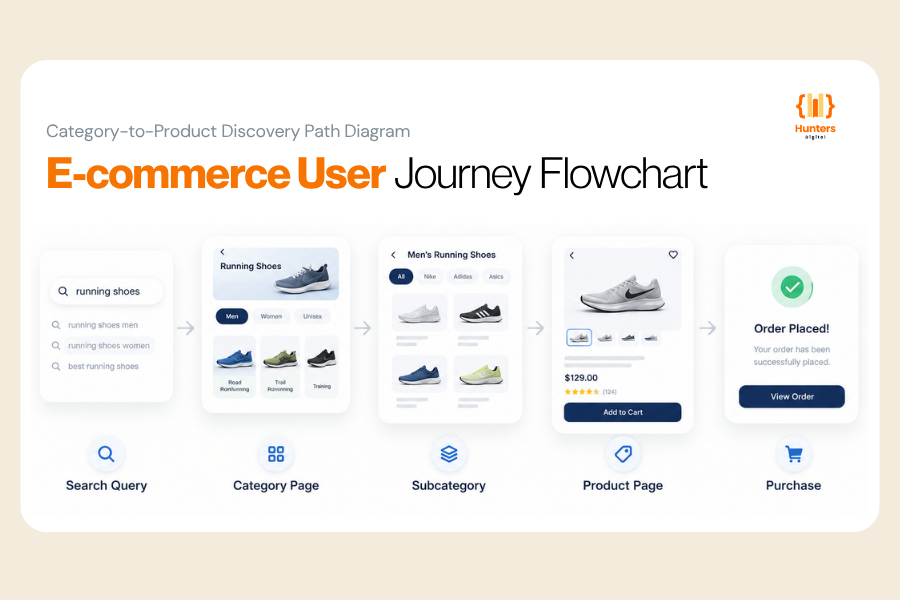
Understanding how Singapore shoppers search for products is the foundation of effective ecommerce SEO. The discovery path typically looks like this:
| Search Stage | Example Query |
| Awareness / Category | “office chairs Singapore”, “ergonomic furniture online” |
| Specification | “ergonomic office chair lumbar support”, “mesh office chair under 500 Singapore” |
| Product Comparison | “ErgoComfort Pro vs HermanMiller”, “best ergonomic chair review Singapore” |
| Purchase Intent | “ErgoComfort Pro price Singapore”, “buy ErgoComfort Pro Singapore free delivery” |
Your store needs pages designed to intercept traffic at each of these stages. Category pages and collection pages target Stage 1 and Stage 2. Product pages target Stage 3 and Stage 4. If your category pages aren’t optimised, you’re missing the highest-volume traffic at the top of the funnel.
Category Page SEO: The Most Underoptimised Asset in Singapore Ecommerce
Category pages in Singapore ecommerce stores consistently underperform their potential. The most common problems:
Thin Content at Category Level: The Silent Traffic Killer
A category page that contains nothing but a grid of product thumbnails and filter options gives Google very little to work with. The page has no text to rank for, no contextual signals to interpret, and no reason to be preferred over a competitor’s category page with substantive content.
Category pages that rank well typically include:
- A focused H1 incorporating the primary category keyword
- An introductory paragraph (100–300 words) contextualising the category – what’s in it, who it’s for, what problems it solves
- Internal links to relevant subcategories and featured products
- Structured filter and sort controls that don’t generate duplicate URLs
- User-generated content signals where available (reviews, Q&A, ratings aggregates)
User Intent Misalignment: When Category Pages Target the Wrong Keywords
A category page titled “Products” or targeting an internal taxonomy label (“Category A”) rather than the search terms Singapore shoppers actually use is targeting nobody. This is surprisingly common in stores built around internal product codes or supplier categorisation rather than customer search language.
Keyword research at the category level – not product level – is the starting point for any ecommerce SEO audit.
Product Page SEO: Beyond Titles and Meta Descriptions
Once category architecture is addressed, product pages need to be optimised for the later-stage queries that convert. The two highest-impact elements are product title structure and description uniqueness.
Product Title Architecture: Structuring Titles for Search and Conversion
Product page titles should be structured to capture long-tail search queries while remaining readable and conversion-friendly. For Singapore ecommerce, a consistent title structure across a product catalogue makes optimisation scalable:
Brand + Product Name + Key Specification + Category Keyword
Example: “ErgoComfort Pro Ergonomic Office Chair – Lumbar Support Mesh – Singapore”
This structure targets multiple query variations while maintaining readability and providing Google with clear product identity signals.
Product Description Strategy: Unique Content at Scale
Duplicate product descriptions – either copied from manufacturers or duplicated across product variants – are one of the most common technical SEO issues in Singapore ecommerce. Google doesn’t penalise duplicate content directly, but it does choose which version to index, which can result in the wrong page being surfaced or none of the duplicates ranking well.
For stores with large catalogues, a tiered content strategy works:
- High-value products (top 20% by revenue): Fully unique, long-form descriptions with specifications, use cases, and buyer guidance
- Mid-catalogue products: Template-structured descriptions with unique attribute fields
- Long-tail or low-volume variants: Minimal unique differentiator added to a shared base template
Faceted Navigation and Crawl Budget: The Technical Issue That Silently Kills Rankings
Faceted navigation – the filter system that lets shoppers narrow by size, colour, price, and other attributes – is one of the most technically damaging elements of a poorly configured ecommerce store.
Each filter combination generates a unique URL. A store with 10 filter options across 5 categories can generate thousands or even millions of URL combinations. If these URLs aren’t controlled, Google’s crawler spends its allocated budget indexing filter pages rather than product and category pages.
The standard approach is to use a combination of canonical tags (pointing filter page variants to the parent category) and robots.txt or meta robots directives to prevent low-value filter URLs from being indexed. The right solution depends on whether any filter combinations have genuine search demand – in which case they may warrant indexation.
Internal Linking in Ecommerce: How to Pass Authority from Category to Product
Internal linking plays an important role in ecommerce SEO. A well-planned internal link structure helps search engines understand how your store is organised while directing users towards relevant products and categories. It also helps distribute internal link equity across the site, giving important pages stronger contextual connections.
Internal Link Structure: Mapping the Authority Flow Through Your Store
The most effective internal linking structure for ecommerce flows downward from the homepage through category pages to subcategories and finally to product pages. Cross-category links (featured collections, “you might also like” recommendations, and editorial content) supplement this core structure.
What to audit:
- Do your category pages link to their highest-value subcategory pages?
- Do product pages link back to their parent category?
- Do blog posts and editorial content link to relevant category and product pages?
- Are high-authority pages (homepage, top-ranking categories) passing links to priority product pages?
Shopify-Specific SEO Issues Singapore Stores Frequently Miss
Shopify is the most common ecommerce platform for Singapore stores. It has several structural SEO behaviours that differ from other platforms and need to be understood before any audit.
Canonical Tags and Duplicate Content: The Shopify Problem Most Stores Ignore
Shopify generates two URLs for every product: one under the product’s own URL, and one under the collection URL when the product is accessed via a collection page. Both are accessible; Shopify adds a canonical tag pointing to the primary product URL, but this only addresses the issue if the canonical is implemented correctly and consistently.
Additionally, Shopify appends pagination parameters (?page=2) and sort parameters (?sort_by=price-ascending) to collection URLs by default. These need to be handled – either canonicalised to the base collection URL or excluded from indexation depending on whether they add search value.
A Singapore Shopify store underperforming in organic search will often find that a significant portion of its indexed pages are URL variants with no standalone search value.
Ecommerce SEO Audit Framework: Where to Start
The following framework prioritises audit activities by likely impact for Singapore ecommerce stores:
| Priority | Audit Area | What to Check | Typical Fix |
| 1 – High | Crawl & Index | Sitemap coverage, robots.txt, canonicals, indexed page count vs. actual page count | Fix canonical errors, block low-value filter URLs, update sitemap |
| 2 – High | Category Pages | Content quality, H1 accuracy, keyword targeting, internal links | Add unique category content, restructure H1s, add category-level internal links |
| 3 – High | Faceted Navigation | URL proliferation from filters, indexation of filter pages | Implement canonical tags on filter pages; review high-value filter combinations |
| 4 – Medium | Product Pages | Title structure, description uniqueness, image alt text, structured data | Implement consistent title template, add unique description elements, add Product schema |
| 5 – Medium | Internal Linking | Link flow from category to product, orphaned products | Add category-level internal links to priority products; fix orphaned product pages |
| 6 – Lower | Page Speed | Core Web Vitals for product and category pages | Optimise image compression, defer non-critical scripts, review theme performance |
Conclusion
Ecommerce SEO works best when your website has a clear path from search to product to purchase. Strong category pages, well-optimised products and a clean site structure can help your store attract the right customers and turn organic traffic into sales.
If your Singapore ecommerce store is losing organic traffic, ranking for the wrong keywords, or generating visits without enough sales, the problem may be deeper than your product pages. A structured ecommerce SEO audit can identify where crawlability, category architecture, internal linking and product optimisation are holding your store back.
Want to know what is stopping your store from ranking?
Hunters Digital helps Singapore ecommerce businesses strengthen their technical SEO, category architecture, product visibility and organic search performance.
Don’t keep optimising individual pages while a structural issue holds the entire store back.
Get a Free Ecommerce SEO Audit and find out what is preventing your store from turning organic searches into qualified traffic and sales.