

Getting to #1 on Google in 2026 isn’t about stuffing keywords or chasing backlinks blindly. It’s about strategy, user intent, and AI-driven optimization. Businesses that still rely on outdated SEO tactics are quickly losing ground to brands that invest in strategic, data-driven SEO services.
If your goal is to dominate search rankings, attract high-quality traffic, and convert visitors into customers, then investing in professional SEO services in Singapore is not just beneficial—it’s essential. The digital landscape in Singapore is highly competitive, with brands competing aggressively for visibility across industries like finance, F&B, eCommerce, and tech.
The truth is simple: ranking #1 requires a combination of technical excellence, high-value content, and continuous optimization. It’s not a one-time effort—it’s an ongoing growth strategy.
Let’s break down exactly how you can achieve it.
How to Rank #1 on Google in 2026
If you’re looking for a quick yet powerful overview, here’s what truly drives rankings in 2026:
- Focus deeply on user intent, ensuring every piece of content solves a specific problem or answers a precise query in a meaningful way
- Build topical authority by covering entire subject areas comprehensively rather than targeting isolated keywords
- Optimize for AI-driven search engines, which prioritize structured, clear, and context-rich content
- Deliver exceptional user experience, including fast load speeds, intuitive navigation, and mobile optimization
- Earn high-quality backlinks that signal credibility and trust to search engines
- Implement structured data and schema markup to enhance visibility in rich results and featured snippets
- Continuously update, refine, and expand content to maintain relevance and rankings over time
What Are SEO Services?
At its core, SEO services refer to a structured and strategic approach to improving a website’s visibility on search engines. However, in 2026, SEO is no longer just about rankings—it’s about connecting businesses with the right audience at the right time through relevant search experiences.
Modern SEO services encompass multiple layers of optimization, each playing a critical role in overall performance:
- Keyword Research & Intent Mapping
This involves not just identifying keywords, but understanding the intent behind them—whether users are looking to learn, compare, or purchase. - On-Page SEO Optimization
Structuring content in a way that is both search engine-friendly and highly engaging for users, including headings, internal links, and semantic keyword usage. - Technical SEO
Ensuring your website is fast, secure, and easily crawlable by search engines, which forms the foundation of all SEO efforts - Content Strategy & Development
Creating high-quality, in-depth content that establishes authority and keeps users engaged. - Link Building & Authority Signals
Acquiring backlinks from reputable sources to build credibility and trust. - Analytics & Continuous Optimization
Tracking performance metrics and refining strategies based on real data.
In Singapore, where competition is intense and user expectations are high, SEO services must go beyond basic optimization and deliver measurable business outcomes.
Why SEO Services in Singapore Are Critical for Growth
Singapore’s digital ecosystem is one of the most advanced in Southeast Asia, making it both an opportunity-rich and highly competitive environment. Competitors who dominate search results often overshadow businesses that fail to invest in SEO.
1. Hyper-Competitive Market Environment
Multiple businesses in Singapore target the same audience, creating a crowded environment in many industries. From F&B to finance, competition is strong. Without SEO, your website can easily get lost among competitors who are actively optimizing their online presence.
2. SEO Supports and Strengthens Paid Advertising
Paid ads are excellent for quick visibility and immediate traffic. SEO works alongside them by building long-term organic traffic. When used together, businesses can get faster results from ads while growing sustainable traffic through SEO.
By combining both strategies, businesses can:
- Capture immediate traffic through ads
- Build long-term visibility through SEO
- Reduce dependency on paid campaigns over time
- Improve overall marketing efficiency and ROI
This integrated approach allows brands in Singapore to achieve both short-term wins and sustainable growth.
3. Evolving User Search Behavior
Modern users are more informed and expect precise, relevant answers. They use voice search, long-tail queries, and conversational phrases. This shift means businesses must optimize their content to align with how users naturally search.
How Google Ranking Works in 2026
Google’s algorithm has become significantly more advanced, leveraging AI and machine learning to deliver relevant results.
1. Intent-Based Ranking System
Google prioritizes content that fully satisfies the user’s intent. This means your content must go beyond surface-level information and provide comprehensive, valuable insights that address the user’s needs.
2. Topical Authority as a Ranking Factor
Websites that consistently publish high-quality content in a specific niche receive higher rankings. This is because Google views them as trusted sources of information within that domain.
3. EEAT (Experience, Expertise, Authority, Trust)
Google evaluates the credibility of your content based on:
- Real-world experience
- Demonstrated expertise
- Strong authority signals
- Trustworthiness
This quality is particularly important for service-based industries where trust plays a key role in conversions.
4. User Experience & Engagement Metrics
User behavior directly influences rankings. Metrics such as time on page, bounce rate, and click-through rates provide signals about the quality of your content and overall user experience.
Step-by-Step Strategy to Rank #1
A clear, structured SEO approach is essential to achieve top rankings, combining research, optimization, and consistent execution to drive long-term results. Here is the step-by-step strategy to follow:
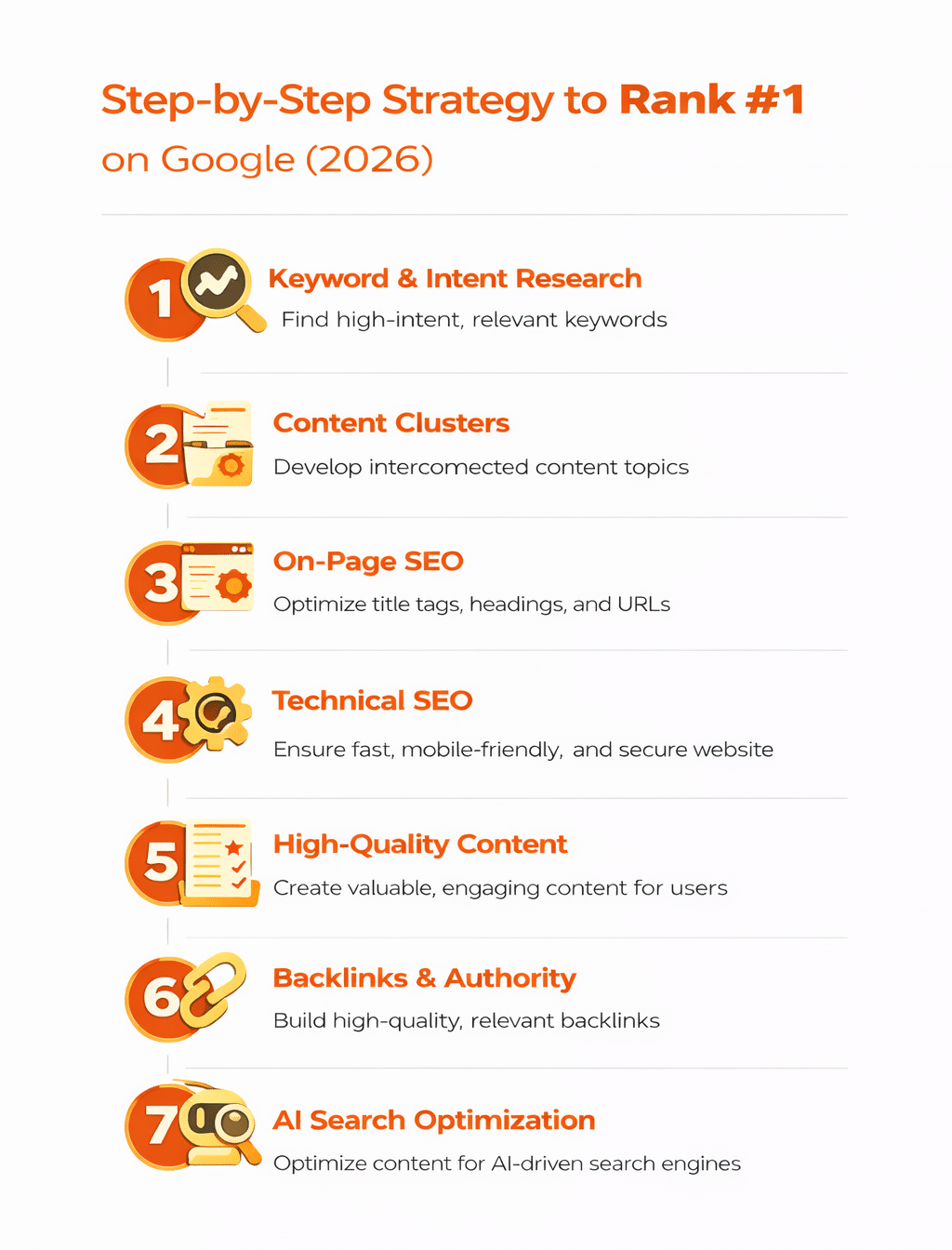
Step 1: Advanced Keyword & Intent Research
Effective keyword research involves understanding not just what users are searching for, but why they are searching for it. By targeting long-tail and intent-driven keywords, businesses can attract more qualified traffic that is more likely to convert.
Modern keyword research goes beyond search volume. You need to understand:
- What problem is the user trying to solve?
- What format do they prefer (blog, video, guide)?
- How competitive is the keyword?
Tools to use:
- Google Keyword Planner
- Ahrefs
- SEMrush
Targeting long-tail and conversational queries increases your chances of ranking faster.
Step 2: Build a Content Ecosystem (Topic Clusters)
Rather than publishing isolated articles, successful SEO strategies focus on building interconnected content clusters. This approach enhances topical authority and improves internal linking, making it easier for both users and search engines to navigate your site.
Example Cluster:
- Main page: SEO Services
- Supporting blogs:
- Technical SEO checklist
- On-page SEO guide
- Link building strategies
- SEO trends 2026
This signals authority to Google.
Step 3: Optimize On-Page Elements
On-page SEO is no longer just about placing keywords—it’s about optimizing the entire content experience.
Every page should include:
- Primary keyword in title, URL, and first 100 words
- Proper heading structure (H1, H2, H3)
- Internal links
- Image alt text
- Meta tags
Step 4: Technical SEO Excellence
Technical SEO ensures that your website performs seamlessly. A fast, mobile-friendly, and secure website improves user experience and boosts your chances of ranking higher.
Focus on:
- Fast loading speed (especially on mobile)
- Clean code and minimal errors
- Proper indexing and crawlability
- Secure browsing (HTTPS)
Even small technical issues can significantly impact rankings.
Step 5: Create High-Impact Content
Content remains one of the most powerful ranking factors. High-quality content should be comprehensive, engaging, and designed to provide real value to users. It should answer questions, solve problems, and guide users toward taking action.
In 2026, content must serve both users and AI systems.
Best practices:
- Answer questions directly
- Use structured formatting
- Add FAQs
- Include data and examples
Think of your content as the best answer on the internet for that query.
Step 6: Build Authority Through Backlinks
Backlinks act as endorsements from other websites. The more high-quality backlinks you have, the more credible your website appears to search engines. However, quality always outweighs quantity.
Focus on:
- Earning links from reputable websites
- Publishing guest posts
- Creating shareable content (guides, data, insights)
Avoid spammy backlinks—they harm rankings.
Step 7: Optimize for AI Search (AEO / GEO)
With the rise of AI-driven search engines, content must be structured in a way that is easily understood and extracted. Search engines are evolving into answer engines. To stay ahead:
- Write concise, direct answers
- Use structured formatting
- Add FAQ sections
- Implement schema markup
This increases your chances of appearing in featured snippets and AI summaries.
Common SEO Mistakes That Hold You Back
Many businesses unknowingly limit their SEO success by:
- Publishing low-quality or thin content
- Ignoring technical issues
- Over-optimizing keywords
- Neglecting mobile experience
- Failing to update outdated content
Avoiding these mistakes is crucial for long-term success.
Future Trends in SEO (2026 and Beyond)
SEO is changing fast with AI, personalization, and new user behavior, so brands need to focus more on user intent, quality content, and visibility—not just rankings. Here are the key trends shaping SEO:
AI-Driven Search Experiences
Search engines are becoming more conversational and personalized, requiring content to be more context-aware.
Voice Search Optimization
As voice search grows, optimizing for natural language queries becomes essential.
Video and Visual SEO
Multimedia content is playing an increasingly important role in search rankings.
Zero-Click Searches
Users often get answers directly on the search page, making visibility more important than clicks.
Conclusion
Achieving the #1 position on Google is not about shortcuts—it’s about consistency, quality, and strategic execution. Businesses that invest in professional SEO services in Singapore position themselves for long-term success, gaining not just traffic but also credibility and trust.
Ready to dominate search rankings?
Hunters Digital can help you build a powerful SEO strategy that drives real, measurable results and positions your brand as a leader in your industry.
Contact us today to begin your journey towards achieving higher rankings, improved visibility, and tangible business outcomes.
FAQs
SEO services are strategies used to improve your website’s visibility on Google. They include keyword research, content optimization, technical SEO, and link building to drive organic traffic.
SEO typically takes 3–6 months to show results. Competitive industries in Singapore may take longer, but early improvements can appear within weeks.
Yes. SEO provides long-term traffic, builds trust, and delivers better ROI compared to paid ads, especially in competitive markets like Singapore.
Costs range from SGD 500 to SGD 5,000+ per month, depending on the scope, competition, and level of service.
AEO (Answer Engine Optimization) focuses on optimizing content for AI-driven search results, featured snippets, and voice search.

Suggested Articles
- Are LinkedIn Ads Worth It for Singapore B2B Companies? A Practical Budget, Offer, and Lead-Quality Framework
- Google Shopping Ads Singapore: Is Your Product Feed and Product Page Ready to Compete?

- Social Media Management in Singapore: The 90-Day Retainer Scope That Produces a Useful Content System – Not Just a Post Calendar

- Ecommerce SEO in Singapore: A Category-to-Product Discovery Blueprint for Stores Losing Organic Sales