The SEO versus Google Ads question is one of the most common budget allocation decisions Singapore SMEs face. And it’s almost always framed the wrong way.
The real question isn’t which channel is “better.” Both work. Both have limitations. The right question is: given your current situation – your lead urgency, your conversion readiness, your existing search presence – what should your business be funding over the next 90 days?
This guide gives you a scoring framework to answer that specifically, rather than a generic comparison that leads you back to the same uncertainty.
Why the SEO vs Google Ads Debate Has the Wrong Starting Point
Most SEO vs PPC comparisons start by listing channel characteristics: SEO typically takes months to compound, Google Ads can generate clicks more quickly, SEO traffic doesn’t incur a per-click cost, Ads do. These generalisations are broadly accurate and almost entirely useless for making an actual business decision.
What the comparison rarely acknowledges: Google Ads without conversion-ready landing pages and accurate tracking is expensive guesswork. SEO without domain authority and consistent content investment produces very slow results. And both channels produce poor returns if the underlying business – service, offer, differentiation – isn’t clear.
The decision between SEO, Google Ads, or a combination should be driven by five factors specific to your business, not by a general channel preference.
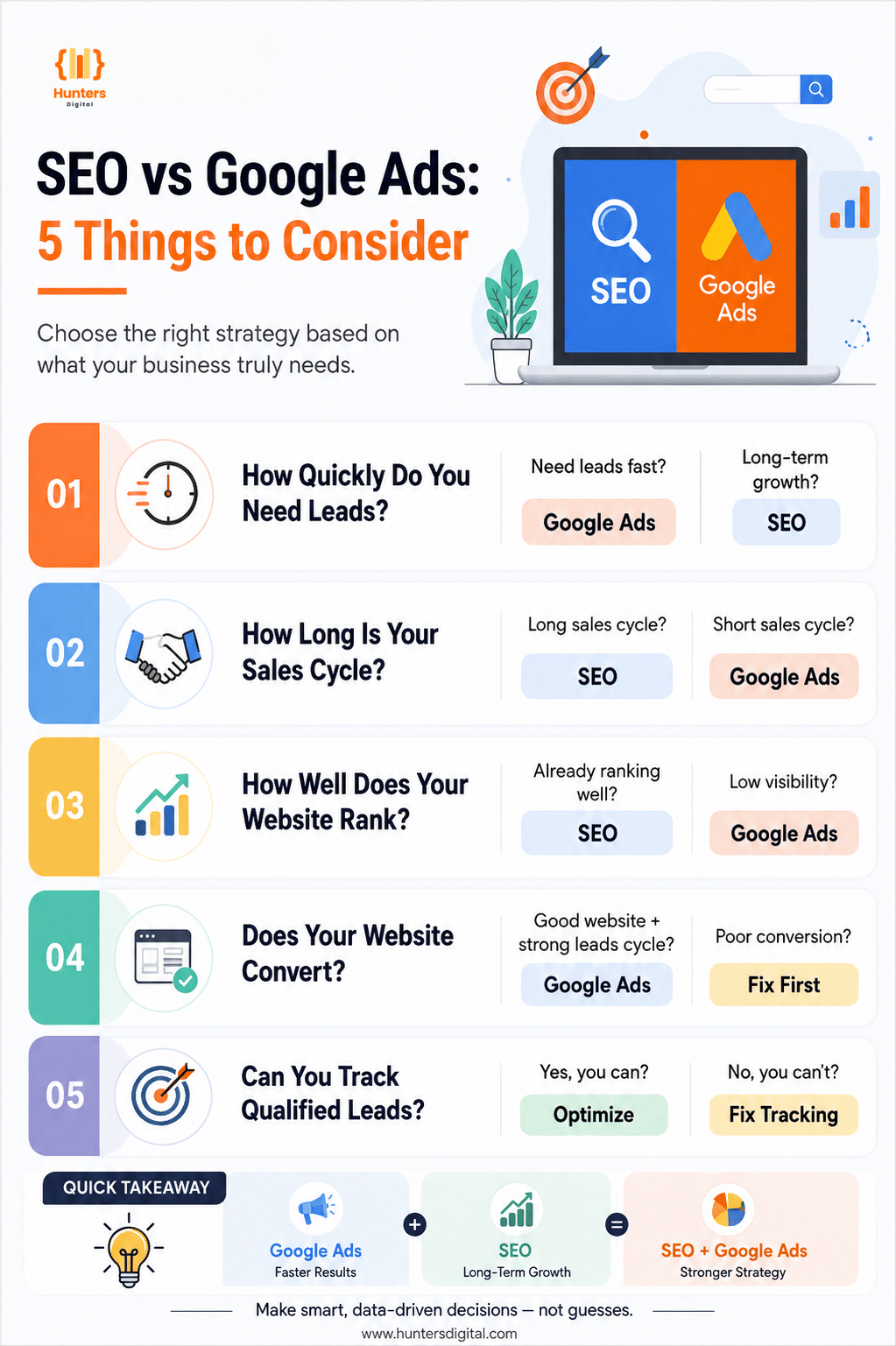
The Five Factors That Should Drive Your Decision
These five factors help you evaluate your business’s current position before deciding where to invest. From lead urgency and sales cycle length to search visibility, conversion readiness, and tracking, each factor can influence whether SEO, Google Ads, or a combination of both is the right choice.
Factor 1: Lead Urgency
If your business needs qualified enquiries within the next 30–60 days, Google Ads is generally the faster route. SEO, even when executed well, takes time – for content to be indexed, for authority to build, for rankings to stabilise. That timeline varies by competition and starting position, but it rarely produces meaningful results within weeks.
If you have 6–12 months before you need the channel to be the primary source of leads, SEO becomes a viable primary investment. If you’re somewhere in between, Ads buys time while SEO is being built.
Factor 2: Sales Cycle Length and Average Transaction Value
High-value, long-cycle sales (corporate services, B2B technology, professional services, renovation, healthcare) often benefit disproportionately from SEO and content authority. A buyer researching a $20,000 renovation project or a $50,000 enterprise software contract will read extensively before contacting anyone. Being visible across multiple search touchpoints over that research period is worth more than a single ad click.
Short-cycle, lower-ticket purchases or enquiries (F&B bookings, tuition enquiries, home services) often respond more directly to Google Ads because the decision is faster and the research window is shorter.
Factor 3: Current Search Visibility
If your website already ranks on page one for several relevant terms, you have an SEO foundation to build from. Incremental investment in that foundation can produce results more quickly than starting from scratch, because some baseline authority and indexation is already in place.
If your site is new, was recently migrated, or has never had a structured SEO strategy, the runway to meaningful organic results is typically longer. That doesn’t make SEO the wrong investment – but it does mean Google Ads is often a practical bridge while the SEO foundation is being built.
Factor 4: Conversion Readiness
Google Ads traffic is only as valuable as the page it lands on. If your current website doesn’t clearly communicate your offer, doesn’t have visible trust signals, and isn’t structured to convert a first-time visitor into an enquiry – Google Ads will be expensive and disappointing.
“Google Ads didn’t work” is a common conclusion that often reflects a conversion problem rather than a campaign problem. When a website isn’t structured to convert first-time visitors into enquiries, increasing ad spend typically amplifies the inefficiency rather than solving it. In most cases, addressing conversion readiness before significantly scaling ad spend produces better returns.
Factor 5: Your Ability to Measure Qualified Leads
Both channels are only as optimisable as your measurement allows. If you can’t distinguish a qualified lead from a form submission, you’ll struggle to improve either channel over time. This factor applies equally to SEO (which keywords produce genuinely interested visitors?) and Google Ads (which campaigns produce leads that turn into clients?).
If your tracking is incomplete, that’s the first investment – not more budget to either channel. We covered this in detail in our conversion tracking guide, linked below.
The 90-Day Decision Scorecard
Use this quick scorecard to assess your business needs and determine where to focus your marketing budget over the next 90 days. Compare your scores for SEO and Google Ads to identify the strategy that best matches your lead goals, website readiness, and current search presence.
| Factor | SEO Score (0–2) | Ads Score (0–2) | Notes |
| Lead urgency (need leads in 30–60 days) | 0 | 2 | Ads wins decisively on urgency |
| High-value, long sales cycle | 2 | 1 | SEO authority compounds over research period |
| Strong existing search rankings | 2 | 0 | Existing SEO foundation – build on it |
| New domain / no rankings yet | 0 | 2 | Ads bridges while SEO is built |
| Website converts paid traffic well | 1 | 2 | Strong landing pages amplify Ads ROI |
| Website not yet conversion-ready | 0 | 0 | Fix the site before funding either channel heavily |
| Tracking of qualified leads is in place | 1 | 2 | Ads optimises faster with clean conversion data |
| How to use this: Score each factor based on your current situation. Total the SEO and Ads columns. A clear Ads lead suggests prioritising Google Ads for the next 90 days. A clear SEO lead suggests building the organic foundation. Roughly equal totals suggest running both – with Ads providing immediate coverage while SEO compounds. If both scores are low, invest in conversion readiness first. |
When SEO Wins, When Ads Win, and When You Need Both
| Scenario | Recommended Mix |
| New website, no rankings, need leads within 60 days | Google Ads primary – 80%. Light SEO technical setup – 20%. |
| Existing website with page 1–2 rankings, long B2B sales cycle | SEO primary – 60%. Google Ads for high-intent commercial terms – 40%. |
| Established business, stable Ads performance, want to reduce long-term dependency | Maintain Ads. Build SEO foundation and content – aim for 50/50 within 12 months. |
| Limited budget ($1,000–$1,500/month total) | One channel done well beats two channels done poorly. Choose based on Factors 1 and 4. |
| Website not conversion-ready | Fix the site first. Neither channel will perform well sending traffic to a page that doesn’t convert. |
How Google Ads Data Makes Your SEO Strategy Sharper
One of the most underused advantages of running both channels simultaneously: Google Ads tells you, quickly and with real money, which search queries produce qualified enquiries and which don’t.
A term that converts consistently in Ads – “corporate website design Singapore,” “SEO agency for professional services” – is a proven commercial keyword worth targeting in SEO. A term that generates clicks but no qualified leads is a signal to either exclude it from Ads or deprioritise it in your content strategy.
This feedback loop means that Ads data doesn’t just produce leads. Used correctly, it identifies which SEO investments are commercially worth making. The two channels are more complementary than they are competitive – but only if the tracking infrastructure exists to make the data useful.
Conclusion
SEO and Google Ads are not competing strategies – they solve different business needs. The right choice depends on how quickly you need leads, how well your website converts, your current search visibility, and how effectively you track qualified enquiries.
Need immediate leads? Google Ads can help create faster visibility. Building sustainable long-term growth? SEO can strengthen your organic presence over time. For many Singapore SMEs, the strongest strategy is a combination that balances short-term lead generation with long-term growth.
Not sure which approach is right for your business? Let the team at Hunters Digital assess your current website, search visibility, conversion readiness, and lead-generation goals. We’ll help you build a practical SEO, Google Ads, or integrated digital marketing strategy designed around your business, not a one-size-fits-all package.
Ready to turn your marketing budget into measurable growth? Contact us today and let’s build the right strategy for your next 90 days.
Frequently Asked Questions
SEO timelines are difficult to state with precision because they depend heavily on competition level, content quality and consistency, technical health, and the domain’s existing authority. As a general orientation: sites with no existing foundation in competitive categories typically see meaningful movement over 6–12 months. Sites with some existing rankings and a solid technical base can move faster. Any realistic proposal should include a clear conversation about what your specific starting position and competitive landscape makes achievable.
Yes, but channel allocation matters. Below $1,500/month total, most businesses are better served by concentrating on one channel and executing it well, rather than splitting budget between two channels and achieving mediocre results in both. The exception is a business that has already done the SEO groundwork (technical foundation, some existing rankings) and wants to accelerate with targeted Ads on high-intent terms.
Before switching channels, understand why Ads aren’t working. The most common causes aren’t the channel itself – they’re conversion tracking gaps, landing pages that don’t match the ad message, or a campaign structure that’s been optimised for the wrong outcomes. Switching to SEO without fixing these problems doesn’t solve them. It just delays them. A channel audit typically reveals whether the issue is the channel or the infrastructure around it.
No – Google Ads spend does not directly influence organic rankings. Google’s algorithms for paid and organic search are separate. However, running Ads can indirectly support SEO by identifying high-converting commercial keywords, generating early traffic to new content (which can accelerate indexing), and providing data on which landing pages convert best before committing to their SEO optimisation.