

The most common complaint Singapore businesses have about their social media agency is some variation of this: “They post regularly, but nothing seems to be working.”
It’s a fair observation. A post calendar is easy to produce. A consistent stream of content that builds brand authority, generates genuine engagement, and contributes to commercial outcomes requires something more structured.
This guide covers what that structure looks like: the retainer scope elements that distinguish a useful social media management engagement from a commodity posting service, and what to look for when evaluating proposals in the Singapore market.
The Difference Between a Post Calendar and a Content System
A post calendar tells you what goes live and when. A content system tells you why each piece of content exists, what it’s trying to achieve, who it’s for, and how it connects to the broader commercial objectives of the business.
Most social media retainers in Singapore operate as the former. They produce volume – a predictable cadence of posts, reels, and stories – without necessarily building anything that compounds over time.
A well-structured retainer builds:
- A brand voice and content framework that makes every new piece faster and better than the last
- A library of reusable assets – templates, photography, brand graphics – that reduce production time at scale
- A source material relationship with the client that produces content that’s actually distinctive and useful
- A reporting cadence that tracks meaningful signals rather than follower counts and likes
Why Most Singapore Social Media Retainers Plateau After Three Months
The plateau is predictable. Month one involves setup, brand discovery, and the first wave of content. Month two settles into a rhythm. By month three, the content system is running, but it’s running on the same inputs it launched with – because nobody has updated the brief, refreshed the source material, or reassessed what’s working.
A retainer that doesn’t build in structured reviews can eventually plateau. Content quality is harder to improve when the brief, source material and performance insights aren’t regularly reassessed.
What a 90-Day Social Media Retainer Should Actually Include
The scope of a well-structured social media retainer in Singapore covers five distinct areas. All five should be addressed in any proposal you evaluate seriously.
| Area | What It Covers | Why It Matters |
| Content Strategy | Platform selection, content pillars, tone and voice, posting cadence | Defines what gets made and why |
| Source Material | Monthly or fortnightly brief input from client, access to team, products, and events | Determines whether content is distinctive or generic |
| Production | Copywriting, design, photography/video direction, caption optimisation | The visible output of the retainer |
| Approval Workflow | Review stages, turnaround times, feedback protocol, escalation contacts | Prevents delays and misaligned content going live |
| Reporting | Metrics tracked, reporting frequency, what decisions the data informs | Determines whether the retainer produces learning, not just activity |
Source Material: The Input That Determines Output Quality
The single biggest determinant of social media content quality is the quality and volume of source material the client provides. An agency working with good source material – real product photos, genuine team insights, behind-the-scenes access, client perspective – can produce content that is genuinely distinctive.
An agency working without it will produce content that looks professional but says nothing interesting.
The Source Material Brief: Getting Useful Content Out of Your Agency
A useful source material brief is a structured monthly or fortnightly input from the client covering:
- Upcoming business activities, campaigns, launches, or events
- Products, services, or team updates to feature
- Any news, industry developments, or external context to respond to
- Photography, video, or original visual assets produced since the last brief
- Feedback on what the previous content cycle produced
This brief is often two to three pages and takes 30 minutes for the client to complete. It’s the input that makes the difference between generic social content and content that reflects something real about the business.
Approval Processes That Work Without Slowing Everything Down
Managing approvals is an important part of any social media retainer. Without proper reviews, content may go live with errors or messaging that does not align with the brand. However, too many approval stages can delay publishing and disrupt the content schedule. A clear workflow helps maintain quality while keeping content on track.
Escalation Protocol: Who Approves What, and How Quickly
A well-designed approval workflow has two tiers:
- Standard content: Reviewed by one designated internal contact within 48 hours; silence after 48 hours means approved by default
- Campaign or brand-critical content: Requires sign-off from a named senior stakeholder with a defined turnaround SLA
The escalation protocol should be documented at retainer setup – not negotiated ad hoc when a piece of content needs to go live quickly.
Reusable Assets: How Good Retainers Build Compounding Value
A social media retainer that doesn’t produce reusable assets in the first 30 days is leaving significant value on the table.
Brand Asset Library: What Should Be Built in the First 30 Days
In a well-run retainer onboarding, the first month should produce:
- Platform-sized content templates for each active channel (Instagram, LinkedIn, Facebook)
- A typographic and colour system locked to brand guidelines
- A photography brief for any planned shoots
- A Canva or design toolkit that the client can access for simple in-house use
- A content pillar framework – the repeatable themes that anchor the content calendar
These assets are the infrastructure of a content system. They make every future month faster and more consistent than if content were being produced from scratch each time.
Social Media Reporting: What the Numbers Should Actually Tell You
Most social media reporting in Singapore focuses on the same metrics: follower growth, impressions, engagement rate, reach. These numbers are useful context, but they’re rarely the basis for a commercial decision.
Metrics That Matter vs. Metrics That Flatter
| Metrics That Inform Business Decisions | Metrics That Show Activity (Not Impact) |
| Website traffic from social (GA4 attribution) | Total impressions |
| Lead form submissions or direct enquiries from social | Total follower count |
| Content saves and shares (intent signals) | Page likes and reactions |
| Click-through rate on promotional content | General engagement rate without context |
| Profile visits following specific content types | Story views in isolation |
| Audience quality changes (job title, location, industry) | Average reach per post without benchmark |
A useful monthly report addresses both: it shows the activity metrics for context, and it focuses the discussion on the signals that indicate whether social is contributing to business outcomes.
Platform Strategy for Singapore SMEs: Where to Focus Your Effort
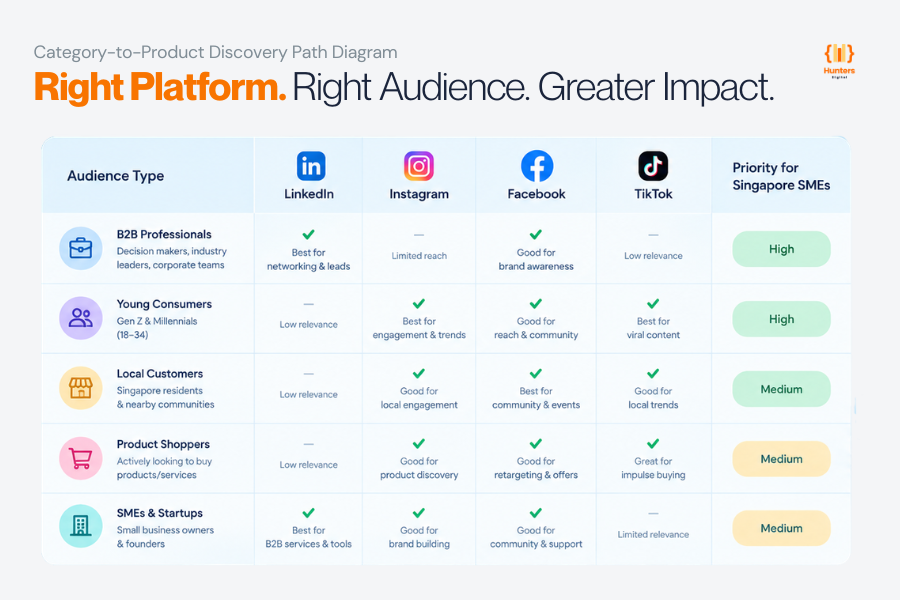
Not every Singapore business needs to be active on every platform. Spreading a social media budget across four or five channels with limited content depth usually produces worse results than concentrating on two or three platforms with a consistent, quality output.
LinkedIn vs. Instagram vs. Facebook for Singapore B2B and B2C
| Platform | Strongest For | Singapore SME Priority |
| B2B credibility, lead generation, thought leadership, professional services, corporate recruitment | High for professional services, technology, corporate services | |
| Visual product brands, lifestyle, F&B, retail, consumer services, younger audience | High for consumer brands, retail, hospitality | |
| Community engagement, local business, older demographic, event promotion, broad awareness | Medium – declining organically but retains audience for paid and community | |
| TikTok | Short-form video, younger consumers, entertainment-adjacent brands, trend-responsive content | Selective – high effort for qualified reach unless brand suits format |
Most Singapore SMEs in professional or B2B categories will see the strongest commercial return from LinkedIn and Instagram combined. The mix depends on where your buyers and your audience actually spend their time.
How to Evaluate a Social Media Management Proposal in Singapore
When reviewing a social media management proposal, the following checklist identifies whether you’re looking at a structured engagement or a posting service packaged as one.
| Evaluation Criterion | What to Look For |
| Strategy document included? | Platform rationale, content pillars, tone and voice, posting cadence |
| Source material process defined? | How does the agency collect input from you each month? |
| Approval workflow documented? | Who reviews, what’s the turnaround SLA, who has final sign-off? |
| Asset production scope clear? | What templates, graphics, photography direction are included? |
| Reporting framework specified? | What’s reported, how often, and what decisions does it inform? |
| Escalation contacts named? | Who do you call if something needs to be taken down or changed urgently? |
| 30/60/90-day review built in? | Is there a structured retainer review at key intervals? |
| IP ownership confirmed? | Who owns the content, templates, and creative assets at end of retainer? |
Conclusion
Social media management is more than publishing posts on a schedule. It requires a clear strategy, engaging content, and regular performance reviews to keep your business connected with the right audience. With the right approach, every post can help strengthen brand awareness, build trust, and support your business goals.
Hunters Digital provides social media management in Singapore for B2B and B2C businesses. From content planning and creative production to performance tracking, our approach focuses on building a consistent and effective social media presence that grows with your business.
Ready to make your social media work harder for your business? Contact us today to discuss your goals and request a customised retainer proposal that fits your needs.
Frequently Asked Questions
Social media management retainers in Singapore vary significantly depending on the scope. Basic posting-only packages may start from SGD 500 to SGD 1,500 per month. Full-service retainers covering strategy, content production, community management, and reporting typically range from SGD 2,500 to SGD 6,000 or more per month. The most useful question to ask is not what it costs, but what the scope includes at each price point.
Posting frequency is less important than posting quality and consistency. For most Singapore SMEs, three to five posts per week on one or two primary platforms will outperform daily posting across five platforms with thin content. The right cadence depends on your platform mix, content production capacity, and how much source material you can provide to support original content.
Beyond follower growth and impressions, look for signals that social media is contributing to business outcomes: direct enquiries or traffic from social, content that generates genuine engagement (saves, shares, comments from real accounts), and a consistent improvement in content quality over time. A good retainer should produce observable improvement in content quality and commercial contribution within 90 days.
LinkedIn is typically the highest-return platform for Singapore B2B businesses in professional services, technology, and corporate categories. It offers direct access to decision-makers, supports thought leadership content, and allows for precise audience targeting in paid campaigns. Instagram plays a supporting role for brand awareness and culture-building in B2B contexts.
At minimum: brand guidelines, product or service information, access to photos and visual assets, and a monthly brief covering upcoming activities, campaigns, and team updates. The more substantive your input, the more distinctive the content output. An agency working from genuine source material will always produce better content than one filling gaps with generic industry commentary.