



There are roughly three types of Singapore ecommerce businesses right now: those still figuring out if they need a store, those who launched one and are frustrated by the results, and those who have an established store but know something isn’t working the way it should.
This article is for the third group. If your online store is generating revenue but not growing it, if your conversion rate feels stubbornly low, or if you’re starting to feel the constraints of your current platform – this is what a strategic redesign looks like in 2026.
Why a Template Ecommerce Site Is Costing Singapore Brands More Than They Realise
The hidden cost of a low-conversion store
A Shopify template is a perfectly reasonable way to launch an ecommerce store quickly and affordably. It’s also, beyond a certain growth point, a ceiling.
Here’s the financial reality: if your store converts at 1.2% and a redesign brings you to 2.8%, that’s more than double the revenue from the same traffic. For a store generating $30,000 per month in turnover, a 1.6 percentage point improvement in conversion rate is worth roughly $25,000–$40,000 in additional monthly revenue – before you spend another dollar on ads.
Template sites underperform for a predictable set of reasons: slow load times on mobile because of theme bloat, trust architectures that weren’t built for your specific category, checkout flows with unnecessary friction, and product page structures that don’t support the structured data AI search systems now rely on.
What Has Actually Changed for Ecommerce in 2026
Ecommerce has changed quickly in 2026. Customers now use AI-powered search and Google Shopping to find products faster. To stay competitive, your online store needs fast loading speeds, accurate product information, and proper structured data so your products can appear in search results.
AI Mode and direct shopping actions: the new ecommerce reality
Google’s AI Mode has moved beyond answering questions. It’s now integrating app actions directly into search – so a user searching for a product can initiate a purchase or add-to-cart action without visiting your site. If your product data isn’t structured correctly, you’re invisible to these AI-mediated shopping interactions.
This isn’t theoretical. The brands showing up in AI-powered shopping results are the ones whose product catalogues are structured with proper schema markup, accurate pricing and availability data, and high-quality imagery formatted for AI extraction.
Performance Max product reporting: what it means for your data strategy
Google recently changed how Performance Max reports product data, pulling metrics from all networks simultaneously. For brands running Shopping campaigns, this creates a more complex attribution picture – and puts greater pressure on having clean, accurate product data at the source.
If your ecommerce platform doesn’t support clean product data feeds, that complexity gets worse, not better.
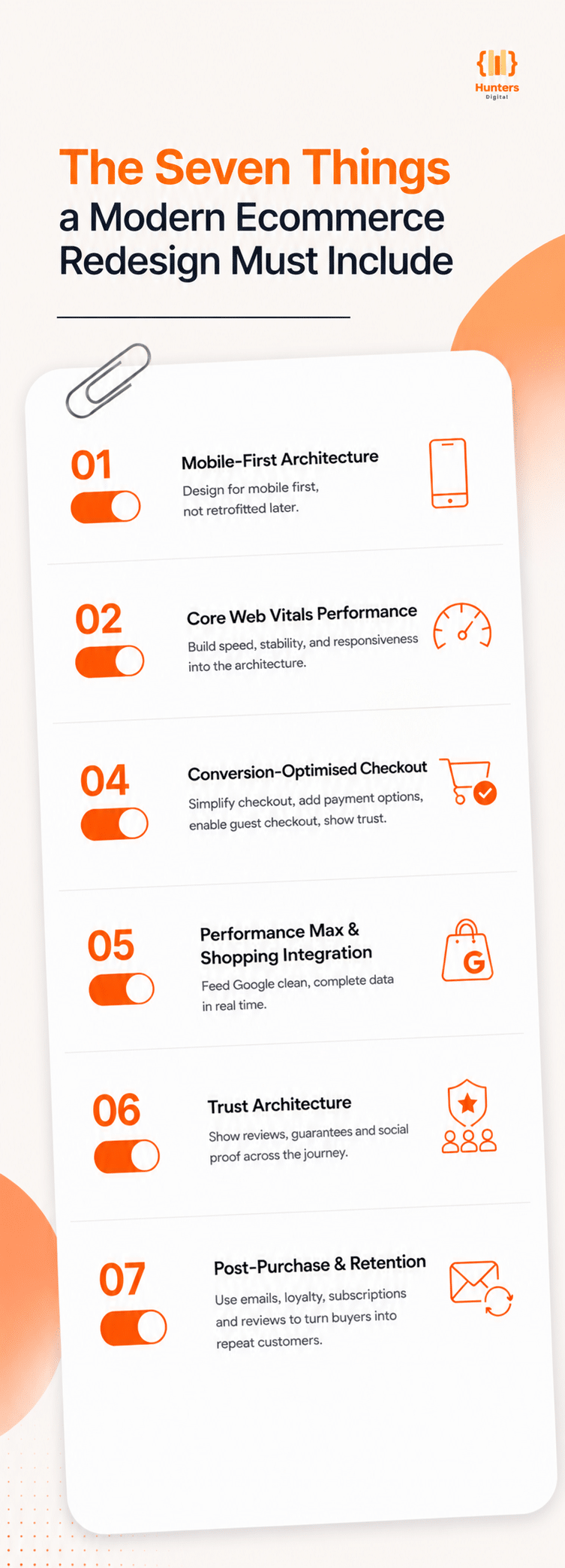
The Seven Things a Modern Ecommerce Redesign Must Include
A modern ecommerce website is more than just a new design. It should help you attract more visitors, improve conversions, reduce cart abandonment, and provide a better shopping experience. The seven features below will help your store perform better and support long-term business growth.
Requirement 1: Mobile-First Architecture (Not Mobile-Responsive)
There’s a meaningful difference between a mobile-responsive site and a mobile-first site. Responsive means the desktop version adapts to mobile. Mobile-first means the experience is designed for mobile first, then adapted for desktop.
In Singapore, mobile accounts for the majority of ecommerce browsing sessions. If your checkout, product discovery, and purchase decision are all happening on a phone, your site needs to be engineered for that context – not retrofitted for it.
Requirement 2: Core Web Vitals Performance
Google uses Core Web Vitals – Largest Contentful Paint, Cumulative Layout Shift, Interaction to Next Paint – as direct ranking signals. Template-based ecommerce sites, particularly those with installed apps and third-party scripts, frequently fail these benchmarks.
A 2026 redesign needs Core Web Vitals performance built into the architecture, not addressed as a plugin after the fact.
Requirement 3: Structured Product Data for AI Search
For your products to appear in Google AI Overviews, AI Mode shopping results, and rich snippets, every product page needs clean structured data: Product schema with name, image, price, availability, and review aggregates. This is not automatic on template themes and requires implementation at the development stage.
Requirement 4: Conversion-Optimised Checkout Flow
Cart abandonment rates for Singapore ecommerce typically sit between 65–75%. The majority of abandonment happens at checkout. The most impactful redesign changes are often in this final stage – reducing fields, adding payment method variety (GrabPay, PayNow, Atome), enabling guest checkout, and presenting trust signals at the point of payment.
Requirement 5: Performance Max and Shopping Ad Integration
If you’re running Performance Max or Shopping campaigns, your ecommerce platform needs to feed Google clean, complete product data in real time. Inventory mismatches, missing attributes, and delayed feed updates directly affect how your ads perform. The redesign should include a review of your product feed architecture and data hygiene.
Requirement 6: Trust Architecture – Reviews, Guarantees, Social Proof
Singapore consumers are research-oriented. They read reviews before purchasing, look for return guarantees, and pay attention to how recently reviews were left. A 2026 ecommerce site needs trust signals integrated strategically across the purchase journey – not just on a testimonials page.
This means: star ratings visible on category pages and search results (schema-driven), return policy displayed at checkout, real customer photos in product galleries, and social proof that speaks to the specific buying concern at each stage.
Requirement 7: Post-Purchase Experience and Retention Loops
New customer acquisition costs are rising. Brands that build retention into their ecommerce platform reduce their dependence on paid traffic over time. This means: transactional email sequences that extend beyond the order confirmation, loyalty mechanics built into the checkout experience, subscription or replenishment options where applicable, and post-purchase review requests that feed back into the trust architecture.
Shopify vs Custom Build: Choosing the Right Foundation in 2026
Choosing the right ecommerce platform depends on your business goals, budget, and future growth. Shopify is ideal for most SMEs because it’s quick to launch, easy to manage, and supports most ecommerce needs. A custom-built website offers greater flexibility but requires more time and investment.
| Criteria | Shopify |
| Setup Speed | Fast — weeks, not months |
| Monthly Platform Cost | $39–$399 USD/month |
| Customisation Depth | Good with themes; limited for complex functionality |
| App Ecosystem | Extensive; costs add up with scale |
| AI / Schema Support | Improving; requires configuration |
| Best For | SMEs, mid-market retail, straightforward catalogues |
| When to Move On | Complex B2B pricing, custom fulfilment, deep integration needs |
If your business requires advanced features such as custom pricing, ERP integration, or unique business processes, a custom ecommerce platform may be a better fit. Although it takes longer to build, it gives you complete flexibility and can be tailored to your exact requirements.
| Criteria | Custom (WooCommerce or Headless) |
| Setup Speed | Slower — months, significant planning required |
| Monthly Platform Cost | Hosting only; no platform fee |
| Customisation Depth | Unlimited — built to specification |
| App Ecosystem | Open source; development cost replaces plugin cost |
| AI / Schema Support | Full control; implemented to spec |
| Best For | Brands with complex requirements, B2B commerce, high-volume operations |
| When to Choose | When Shopify limitations are creating real business constraints |
For most Singapore SMEs, Shopify remains the right foundation. The question at redesign stage is not usually “which platform” but “how well is this platform being used.”
How to Know When You’ve Outgrown Your Current Platform
Eight signals that a redesign is commercially overdue:
- Your mobile conversion rate is significantly below your desktop rate
- Your site speed score is below 50 on Google PageSpeed Insights for mobile
- You’re paying for apps that solve problems built-in platforms should handle natively
- Your checkout has more than 5 steps
- Product schema markup is absent or incomplete
- You can’t change page layouts without developer intervention
- Your return customer rate is below 20% and you have no automated retention sequence
- Your current platform can’t cleanly feed Google Shopping with accurate, real-time product data
What a Strategic Redesign Brief Looks Like
Before briefing any agency, prepare these four things:
- Your current numbers: monthly traffic, conversion rate, average order value, mobile vs desktop split, top 10 products by revenue. Any agency that doesn’t ask for these upfront is planning aesthetics, not strategy.
- Your customer journey: where do your best customers come from, what do they typically research before buying, what objections do they have, and what triggers the final purchase decision.
- Your constraints: platform preference, budget range, timeline, internal team capabilities for ongoing management post-launch.
- Your goals: not “a better website” – specific outcomes. A conversion rate above X%. Mobile cart abandonment below Y%. Product feed accuracy above Z%.
Conclusion
Your ecommerce website should do more than just look good – it should help your business grow. A modern, high-performing online store can attract more customers, increase conversions, and turn more visitors into repeat buyers. If your website is slow, difficult to manage, or no longer meeting your business goals, now is the time to invest in a smarter solution.
At Hunters Digital, we build ecommerce websites that are designed for growth. From Shopify stores to WooCommerce and fully customised ecommerce solutions, we create fast, secure, and conversion-focused websites that help Singapore businesses stay ahead of the competition.
Ready to take your ecommerce business to the next level? Contact our team today for a consultation. We’ll review your current website, identify opportunities for improvement, and recommend the best solution to help you increase sales and achieve long-term growth.
Frequently Asked Questions
Project costs vary significantly based on platform, catalogue size, custom functionality, and integration requirements. Straightforward Shopify redesigns for mid-sized catalogues typically start from $5,000–$8,000. Custom builds with complex requirements range from $15,000 upward. The more useful question is: what is my current low conversion rate costing me per month, and how quickly would a redesign pay back?
A well-planned Shopify redesign with an established brand typically takes 6–10 weeks from brief to launch, depending on content readiness and approval turnaround. Custom builds take longer – 12–20 weeks is realistic for complex projects. Timeline is heavily influenced by how quickly the client can provide product content and approvals.
It can, if not handled carefully. URL structure, on-page content, and meta data all need to be migrated correctly to preserve existing rankings. A well-managed redesign with proper redirects and SEO migration should maintain or improve existing rankings. An unplanned platform migration can cause significant, temporary ranking losses.
Rarely, for most Singapore SMEs. The flexibility of WooCommerce comes with significantly higher development and maintenance costs. Unless your business has specific requirements that Shopify genuinely cannot meet – complex B2B pricing, bespoke fulfilment workflows, deep ERP integration – a well-customised Shopify build will outperform a poorly resourced WooCommerce migration.

Suggested Articles
- Google Shopping Ads Singapore: Is Your Product Feed and Product Page Ready to Compete?

- Social Media Management in Singapore: The 90-Day Retainer Scope That Produces a Useful Content System – Not Just a Post Calendar

- Ecommerce SEO in Singapore: A Category-to-Product Discovery Blueprint for Stores Losing Organic Sales

- Website Maintenance in Singapore: What SMEs Should Expect from a Plan That Protects Leads, Security, and Search Visibility