The most expensive website mistake Singapore SMEs make is choosing a platform because an agency recommended it – not because it fits the business.
Three years later, the same business is looking at a full rebuild because the platform can’t handle their product catalogue, their SEO requirements, or their team’s ability to update content without developer support.
Platform choice is a long-term decision that affects everything from monthly running costs to your ability to rank on Google to what happens when you want to change agencies. It deserves more than ten minutes of research before you commit to a build.
Why Platform Choice Matters More Than Most People Realise
The platform your website is built on determines:
- Who can edit and update the site – your team, an agency, or a developer
- How well the site ranks in search – not all platforms handle SEO equally
- What integrations are available – CRM, payment gateways, booking systems, inventory tools
- What the site costs to run per month beyond development
- What happens to your content and SEO history if you switch later
None of these factors relate to how the site looks. They relate to whether it works for your business over the next three to five years.
The Five Questions That Should Drive Your Platform Decision
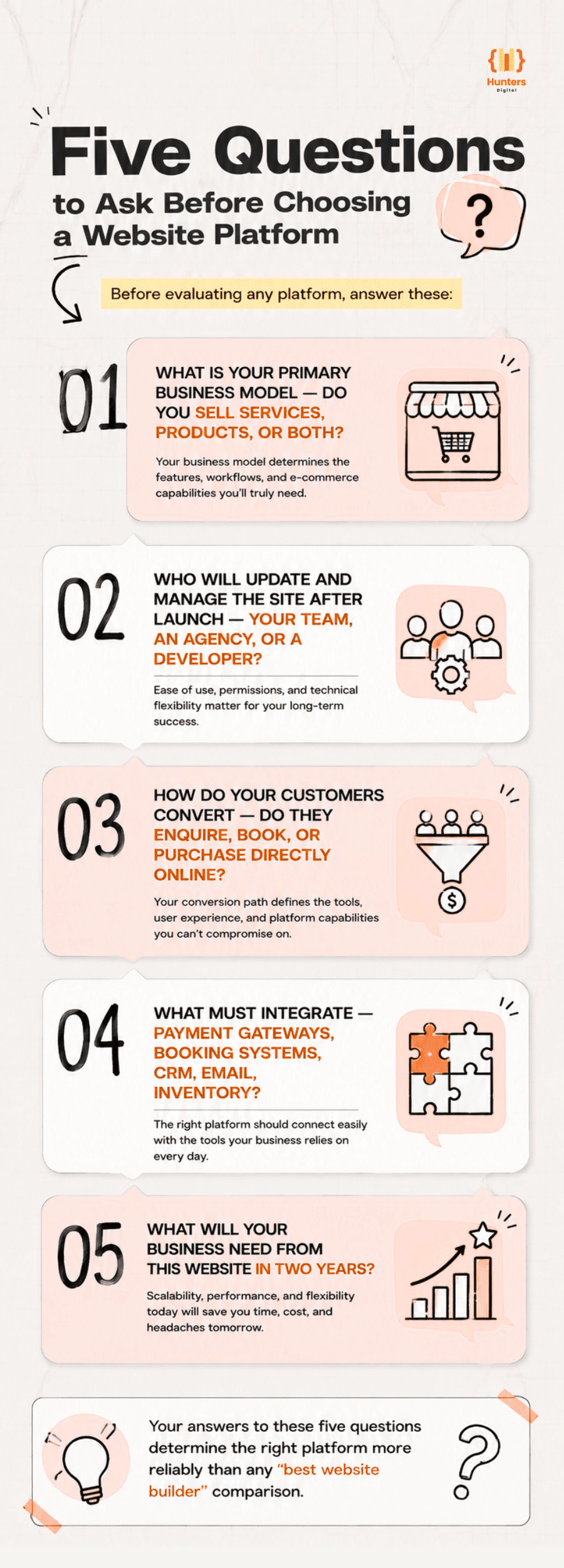
Before evaluating any platform, answer these:
- What is your primary business model – do you sell services, products, or both?
- Who will update and manage the site after launch – your team, an agency, or a developer?
- How do your customers convert – do they enquire, book, or purchase directly online?
- What must integrate – payment gateways, booking systems, CRM, email, inventory?
- What will your business need from this website in two years?
Your answers to these five questions determine the right platform more reliably than any “best website builder” comparison.
WordPress: Built for Flexibility and Long-Term Growth
WordPress strengths and limitations
It is the most widely used CMS globally – W3Techs data consistently places its market share above 40% of all websites – and it has the broadest agency support in Singapore’s development ecosystem. Its primary advantage is flexibility: almost any functionality can be built, and the plugin ecosystem means common requirements rarely need custom development.
For service businesses, WordPress’s SEO capabilities are well ahead of Wix. You control URL structure, canonical tags, schema markup, and technical SEO settings directly. For businesses investing in organic search, this control is commercially significant.
WordPress is also the most agency-agnostic option. A site built on WordPress can be handed to any competent developer or agency. You’re not locked into a vendor relationship because of the platform.
The limitations are real. WordPress requires plugin and theme updates, security monitoring, and regular backups – either managed by your team or covered by a maintenance retainer. A neglected WordPress site accumulates security vulnerabilities. This is not a reason to avoid it, but it is a running cost to plan for.
WordPress is well-suited to many Singapore service businesses – professional services, healthcare, B2B, corporate – particularly where SEO is a growth priority and the team has (or will develop) basic content management capability. It’s not the right choice in every situation, which is why the five-question framework above matters before committing to any platform.
Wix: Fastest to Launch, Best When Simplicity Is the Priority
Wix strengths and limitations
Wix’s value proposition is ease. The drag-and-drop editor, built-in hosting, and automatic updates remove the technical overhead that makes WordPress demanding for non-technical teams. For a small business that needs a clean, credible web presence and wants to manage content independently without developer support, Wix is a genuinely practical option.
Wix’s SEO limitations have improved significantly since 2022. Basic on-page optimisation, clean URLs, and structured data are all achievable on the platform. For local SEO and lower-competition terms, Wix sites rank regularly.
Where Wix falls short: complex integrations, high-volume content management, and situations where you need deep technical SEO control. The platform is also less portable than WordPress – if you build on Wix and later decide to migrate, you’ll manually reconstruct most of the site. There is no export of your page structure that translates cleanly to another platform.
Wix suits sole traders, small professional practices, and businesses that primarily need an online presence and credibility signal rather than a conversion or SEO engine.
Shopify: The Standard for Serious Ecommerce in Singapore
Shopify strengths and limitations
For Singapore businesses selling products online – fashion, consumer goods, health and wellness, specialty food – Shopify is the most practical ecommerce platform available. The built-in cart and checkout are well-optimised, payment gateway integration covers the Singapore-relevant options (Stripe, PayNow, GrabPay, Atome), and the app ecosystem handles most fulfilment, inventory, and customer-service needs.
Shopify’s monthly cost ($39–$399 USD depending on tier) is higher than a basic self-managed hosting cost for WooCommerce. The trade-off is that Shopify handles hosting, security, CDN, and payment compliance – overhead that would otherwise require developer attention on a self-hosted solution. Whether that trade-off makes sense depends on the business’s technical capacity and how it weighs platform fees against ongoing maintenance costs.
The limitation: Shopify is built for ecommerce, and its content and blogging functionality is significantly less capable than WordPress for businesses that want to build an SEO content strategy alongside their store. For businesses that combine a service offering with product sales, a hybrid solution – or a careful Shopify + content strategy approach – is worth discussing before committing.
WooCommerce (WordPress for ecommerce) is the main alternative. It offers more flexibility and no platform fee, but adds the maintenance burden and technical demands of WordPress with the complexity of an ecommerce layer on top. For businesses with developer resources or an ongoing management retainer, WooCommerce is viable and often preferable. For businesses without that in-house capacity, Shopify’s managed infrastructure typically reduces operational risk.
The Platform Decision Matrix
| Decision Criteria | WordPress | Wix | Shopify |
| SEO control and flexibility | Excellent | Good | Good (ecom SEO strong) |
| Self-management by non-technical team | Moderate | Excellent | Good |
| Ecommerce capability | Moderate (WooCommerce add-on) | Limited | Excellent |
| Local payment integration (SG) | Via WooCommerce plugins | Limited | Excellent (native) |
| Ongoing maintenance requirement | High (plugin/security management) | Low (platform managed) | Low (platform managed) |
| Monthly running cost (post-build) | $15–$40 SGD hosting + maintenance | $25–$50 SGD/month | $55–$560 SGD/month (platform fee) |
| Portability (migrate away) | Excellent | Poor | Moderate |
| Agency / developer ecosystem | Widest | Limited | Wide |
| Content strategy support | Excellent (full CMS) | Moderate | Limited |
| Best for | Service, B2B, content-led, SEO-focused | Small biz, simple presence | Product-led ecommerce |
Migration: When to Move Platform and What to Expect
Common migration scenarios Singapore businesses encounter:
- Wix → WordPress: typically driven by SEO requirements or content management limitations. Timeline depends heavily on site size and content volume. All content must be manually migrated. 301 redirects are essential to protect existing rankings.
- WordPress → Shopify: typically for businesses that outgrow a WooCommerce setup. Product data migrates more cleanly than page content. SEO migration requires careful URL mapping.
- Old custom CMS → WordPress or Wix: often triggered by an agency handover where the original CMS is inaccessible or unmaintained.
Migration is never invisible. There will be a period of ranking flux after any platform change – the length varies depending on the site’s size, authority, and how thoroughly the migration is handled. The risk is manageable with proper redirect planning, but it should not be treated as zero.
Conclusion
The right website platform isn’t the one with the most features – it’s the one that fits how your Singapore business operates today and where you want it to go next. WordPress gives you flexibility and SEO control, Wix keeps things simple, and Shopify makes ecommerce easier to scale.
Before choosing a platform, think beyond the initial website cost. Consider your SEO goals, content needs, integrations, maintenance requirements, and how easily you may need to scale or migrate in the future.
Planning a website build, redesign, or platform migration in Singapore? Get a recommendation based on your business needs – not an agency’s platform preference. We build on WordPress, Wix, and Shopify and recommend the platform that makes the most sense for your goals.
Ready to choose the right platform?
Request a Website Development Consultation and let’s identify the right platform for your business before you invest in the build.
Frequently Asked Questions
Wix for basic content management. Shopify for ecommerce management. WordPress for sites where your team is willing to invest in a short learning curve – most basic WordPress edits (adding a blog post, updating a service description, changing a photo) are straightforward with a well-built theme. The difficulty comes with plugin updates and structural changes.
Yes, with proper migration planning. The key steps: implement 301 redirects from every old Wix URL to the new WordPress URL, carry over all existing meta titles and descriptions, submit the new sitemap to Google Search Console immediately after launch, and monitor Search Console for crawl errors in the weeks following. Some ranking fluctuation after a platform migration is normal – the extent and recovery time depend on how well the migration is executed and the site’s existing authority. Without proper redirects, traffic losses can be long-lasting.
Shopify tends to be the lower-friction option for businesses without dedicated technical support, because hosting, security, and core updates are managed by the platform. WooCommerce offers more flexibility and avoids a monthly platform fee, but requires ongoing technical management. The right choice depends on your business’s specific customisation requirements, existing development relationships, and tolerance for technical maintenance overhead.
Not directly. Google evaluates page experience, content quality, and technical SEO signals -not the underlying CMS. However, different platforms offer different levels of technical SEO control, which indirectly affects how well you can implement best practices. WordPress offers the most control. Wix and Shopify have improved significantly but have some constraints on advanced technical SEO implementation.

Suggested Articles
- Website Redesign vs SEO: What Should You Fix First?

- Are LinkedIn Ads Worth It for Singapore B2B Companies? A Practical Budget, Offer, and Lead-Quality Framework

- Website Maintenance in Singapore: What SMEs Should Expect from a Plan That Protects Leads, Security, and Search Visibility
- SEO Pricing in Singapore: What a Good SEO Retainer Should Include – and What to Question Before You Sign