
For most of the past two years, the conversation about AI and search has focused on one concern: AI Overviews are appearing above traditional results, stealing clicks, and reducing website traffic. That’s a real issue and worth addressing.
But there’s a more significant shift happening that hasn’t received the same attention: Google AI Mode is no longer just answering questions. It’s starting to complete actions.
And that changes the SEO conversation entirely.
From Information to Action: What Google’s AI Mode Shift Actually Means
The Instacart moment: when search stopped linking and started doing
Google recently announced integrations between AI Mode and platforms like Instacart and Canva – allowing users to add items to a shopping cart or create a design directly from the search interface. No website visit. No click. The action completes inside Google.
This is what we mean by the “action engine” shift. Search is no longer primarily a navigation tool that sends users to websites. It’s becoming an interface through which users can directly accomplish tasks – and the websites and businesses that sit behind those actions need to be structured in a specific way to be part of that infrastructure.
For Singapore businesses, this has direct implications across retail, food and beverage, professional services, and any category where users book, enquire, purchase, or take a specific next step.
What zero-click search actually costs businesses that ignore it
Before the action engine era, zero-click search meant a user got their answer from a featured snippet and didn’t visit your site. That’s a cost – you provided the information without getting the traffic.
In the action engine era, zero-click extends to transactions. A user searches for a service or product, AI surfaces your offering, and the conversion – the call, the reservation, the purchase – happens through the AI interface. Businesses structured to support this capture those actions. Businesses that aren’t, don’t.
Why Traditional SEO Is Necessary But No Longer Sufficient
Traditional SEO – keyword rankings, backlinks, on-page optimisation – remains important. Google still serves billions of traditional search results every day, and organic rankings remain a primary source of qualified traffic for most Singapore businesses.
The problem is that a business optimising only for traditional SEO is ignoring two additional layers of search visibility that are growing rapidly. Missing those layers doesn’t mean you’re losing ground today. It means you’re falling behind where the ground will be in 12 to 18 months.
The Three Layers of Modern Search Visibility
Search visibility is no longer just about ranking on Google’s first page. Businesses now need a balanced strategy that combines traditional SEO with AI-focused optimisation. These three layers help improve your online visibility and keep your business competitive in modern search.
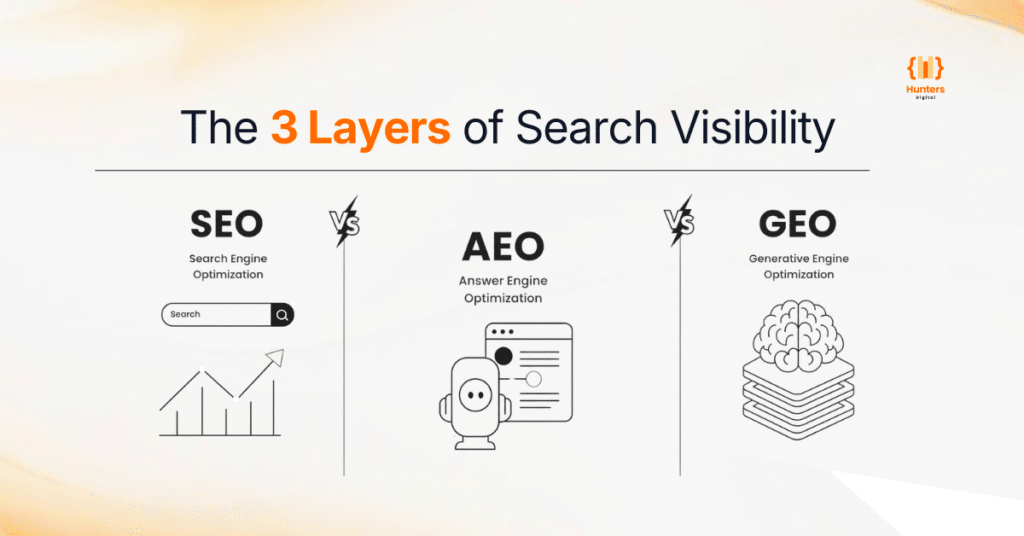
Layer 1: Traditional SERP Rankings (still necessary)
Page one rankings for target keywords remain the foundation. They drive direct traffic, support brand recognition, and feed the authority signals that layers two and three depend on. This hasn’t changed. What’s changed is that it’s no longer enough on its own.
Layer 2: AI Overview and Featured Snippet Capture
AI Overviews appear above traditional results on a growing proportion of queries. Featured snippets – the direct answer boxes – have been around longer but are now more visible. Being the source that Google’s AI cites for a direct answer is Answer Engine Optimisation (AEO).
AEO involves structuring your content with clear, direct answers to specific questions, implementing FAQ schema, using proper heading hierarchy, and writing with the precision and factual clarity that AI systems prefer as sources.
Layer 3: Action Engine Integration – the Emerging Frontier
This is the newest and least understood layer. It’s Generative Engine Optimisation (GEO) applied to transactional contexts – ensuring your business is the entity that AI systems turn to when a user wants to take an action, not just get an answer.
For most Singapore businesses, being positioned for Layer 3 in 2026 is about building the structural groundwork: entity optimisation, knowledge graph inclusion, business data accuracy across all indexed platforms, and the authority signals that make AI systems treat your business as a reliable, citable source.
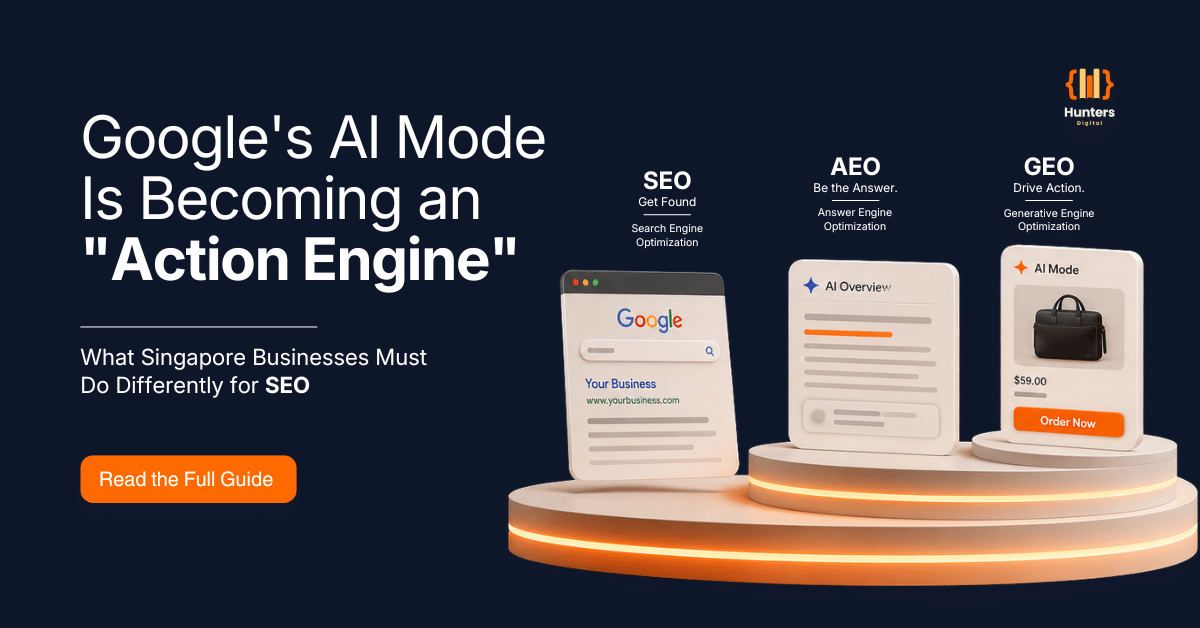
How SEO, AEO and GEO Compare
SEO, AEO, and GEO all help improve your online visibility, but they work in different ways. SEO helps your website rank in search results, AEO helps your content appear in AI answers and featured snippets, and GEO helps AI platforms recognise and recommend your business. Using all three gives your business stronger visibility across both search engines and AI-powered platforms.
| Dimension | SEO | AEO | GEO |
| What it optimises | Rankings in traditional search results | Direct answers and featured snippets | Brand citations in AI-generated responses |
| Where it shows up | Blue links, Google Search | AI Overviews, Featured Snippets, Voice Search | ChatGPT, Perplexity, Gemini, AI Mode actions |
| Key mechanism | Keywords, backlinks, technical health | Content structure, FAQ schema, factual precision | Entity authority, knowledge graph, structured data |
| Timeline to results | 3–6 months | 4–8 weeks for initial visibility | 8–16 weeks for initial citation signals |
| Still relevant in 2026? | Yes – foundational | Yes – growing rapidly | Yes – emerging and accelerating |
How to Become the Source Data for AI Actions
Structured data: the language AI uses to understand your business
When Google’s AI wants to understand what your business offers, it draws on structured data – schema markup that explicitly tells search engines what a page is about, what your products are, what your services cost, and how users can take action.
For Singapore businesses, the highest-priority schema types in 2026 are: LocalBusiness (with complete operating details), Product (for ecommerce), Service (for professional services), FAQPage (for content authority), and Review/AggregateRating (for trust signals).
Many Singapore businesses have no schema implemented at all or have a basic article schema and nothing else. This is increasingly significant as AI systems rely more heavily on structured data to decide what to cite and what to act on.
Authority signals: why AI cites some businesses and ignores others
AI systems – including Google’s – are trained on patterns of authority. They cite businesses and sources that are:
1. Referenced by other credible sources (digital PR, citations, mentions)
2. Consistent across platforms (same name, address, contact, description across Google, Bing, social, directories)
3. Active and current (recent content, recent reviews, recent activity)
4. Specific and factually precise in their content
A Singapore accounting firm with a well-maintained GBP profile, consistent citations across business directories, recent client reviews, and precise service descriptions is significantly more likely to be surfaced by AI systems than a competitor with a neglected profile and generic content.
Content formatting: how to write for both humans and AI extraction
Content that ranks well in traditional SEO already overlaps significantly with content that AI systems extract. But there are specific formatting choices that improve AI extraction specifically:
1. Direct answer to the primary question within the first 100 words
2. Clear H2 and H3 hierarchy that signals the structure of information
3. Tables and comparison frameworks (AI systems extract structured information efficiently)
4. Numbered processes and step-by-step guides (AI prefers sequential structure)
5. FAQ sections at the end of pages (directly feeds Featured Snippet and AI Overview extraction)
6. Factual precision – specific numbers, dates, statistics – over vague generalisations
What This Means for Different Types of Singapore Businesses
The action engine shift affects different business types differently:
Service businesses (professional services, healthcare, home services): Priority is Layer 2 AEO – appearing as the direct answer when users ask “best accountant Singapore” or “corporate lawyer Singapore.” GBP optimisation and review authority are foundational.
Ecommerce and retail: Priority is Layer 3 action engine integration – ensuring product data is structured for AI shopping actions and that inventory, pricing, and availability data are accurate and current.
B2B and high-consideration services: Priority is brand authority in AI-generated responses – ensuring that when a decision-maker asks ChatGPT or Perplexity for agency recommendations in Singapore, your business is in the set of options returned.
All three business types need Layer 1 (traditional SEO) as the foundation. The question is which additional layer to prioritise based on where your customers are in their decision journey.
The Content and Technical Moves That Matter Now
Eight actions Singapore businesses should take before the end of Q3 2026:
1. Implement or audit LocalBusiness schema with complete, accurate details
2. Add FAQ Page schema to your top 10 service or product pages
3. Review your GBP profile against the 15-point checklist (published in our July 9 guide)
4. Audit citation consistency across Google, Bing, Yelp, and Singapore business directories
5. Reformat your five highest-traffic pages with a direct answer in the first paragraph
6. Add structured comparison tables or process frameworks to evergreen service pages
7. Request reviews that reference your specific services and location (not just star ratings)
8. Review your content calendar – are you answering specific questions or publishing general thought pieces?
Conclusion
As Google’s AI evolves from simply answering questions to completing actions, businesses that adapt today will have a significant competitive advantage tomorrow. Traditional SEO is no longer enough-your website must be optimized for AI visibility, structured data, and action-driven search experiences.
Ready to future-proof your online presence? Let Hunters Digital help you build an AI-ready SEO strategy that improves rankings, increases visibility in AI search results, and positions your business for the next generation of search. Contact us today for a comprehensive SEO and AI visibility audit and stay ahead of the competition.
FAQs
Not entirely – but they are redistributing it. Queries that trigger AI Overviews typically see lower click-through rates to individual websites. The businesses that maintain traffic despite AI Overviews are those whose content is cited as the AI Overview source, those ranking in positions 1–3 below the Overview, and those whose search terms are transactional enough that AI defers to a website visit for the actual action
Yes. AEO (Answer Engine Optimisation) focuses on becoming the direct answer to specific queries – appearing in Featured Snippets, AI Overviews, and voice search. GEO (Generative Engine Optimisation) focuses on building your brand’s presence within AI-generated responses from LLMs like ChatGPT, Gemini, and Perplexity. AEO is more technical and content-driven; GEO is more authority and entity-driven. Both matter, and they complement each other.
Search for your target queries on Google and observe whether an AI Overview appears. If one does, identify whose content it’s drawing from. If it’s not yours, that’s the gap to close. Tools like SE Ranking and SEMrush now track AI Overview presence for target keywords.
Ask your current SEO agency directly: are they currently implementing FAQPage and LocalBusiness schema on your pages? Are they tracking your AI Overview appearance for target keywords? Are they building your entity authority through digital PR and citation management? If the answers are no, no, and no – you likely need an agency that’s moved beyond traditional SEO.

Suggested Articles
- Are LinkedIn Ads Worth It for Singapore B2B Companies? A Practical Budget, Offer, and Lead-Quality Framework
- Google Shopping Ads Singapore: Is Your Product Feed and Product Page Ready to Compete?

- Social Media Management in Singapore: The 90-Day Retainer Scope That Produces a Useful Content System – Not Just a Post Calendar

- Ecommerce SEO in Singapore: A Category-to-Product Discovery Blueprint for Stores Losing Organic Sales