Most Singapore professional services firms have LinkedIn pages. Many have hundreds or thousands of connections. Very few are generating consistent, qualified enquiries from the platform.
The reason is not that LinkedIn doesn’t work for professional services in Singapore. It’s that most firms are using it as a broadcasting channel – publishing content and waiting for something to happen – rather than as a structured system for moving people from awareness to enquiry.
This article outlines the three-stage framework we use with Singapore professional services clients to convert LinkedIn presence into a predictable source of inbound business.
Why LinkedIn Is Underperforming for Most Singapore Professional Services Firms
The three reasons LinkedIn doesn’t generate business for most Singapore firms
In our experience working with Singapore B2B firms across law, accounting, consulting, and financial services, the same three problems appear consistently:
- Content that focuses on the firm rather than the client. Posts about company news, team achievements, and industry awards generate internal engagement. They rarely attract potential clients, because potential clients are looking for expertise that helps them, not evidence of a firm’s own success.
- No system for moving people through the funnel. Most LinkedIn strategies stop at ‘post regularly.’ There’s no intentional sequence for converting a new follower into a warm prospect into an enquiry. The result is an audience that grows but doesn’t convert.
- Inconsistency. Professional services leaders start LinkedIn content plans with good intentions and abandon them within four to six weeks because they don’t see immediate results. LinkedIn’s compound authority model rewards consistency over a 90-day horizon – not a two-week sprint.
The Difference Between LinkedIn Presence and LinkedIn Performance
Reach without relevance: why connections aren’t clients
A LinkedIn presence means you exist on the platform. LinkedIn performance means you are systematically moving the right people from awareness of your firm to consideration of your services to a direct enquiry.
The distinction matters because the inputs that create presence (connection requests, follower count, post likes) are not the same as the inputs that create performance (decision-maker engagement, DM conversations, profile visits from qualified prospects, inbound messages requesting a conversation).
Measuring LinkedIn by follower growth or post impressions is the professional services equivalent of measuring your sales team by the number of business cards handed out.
The 3-Step LinkedIn Strategy for More Business Enquiries
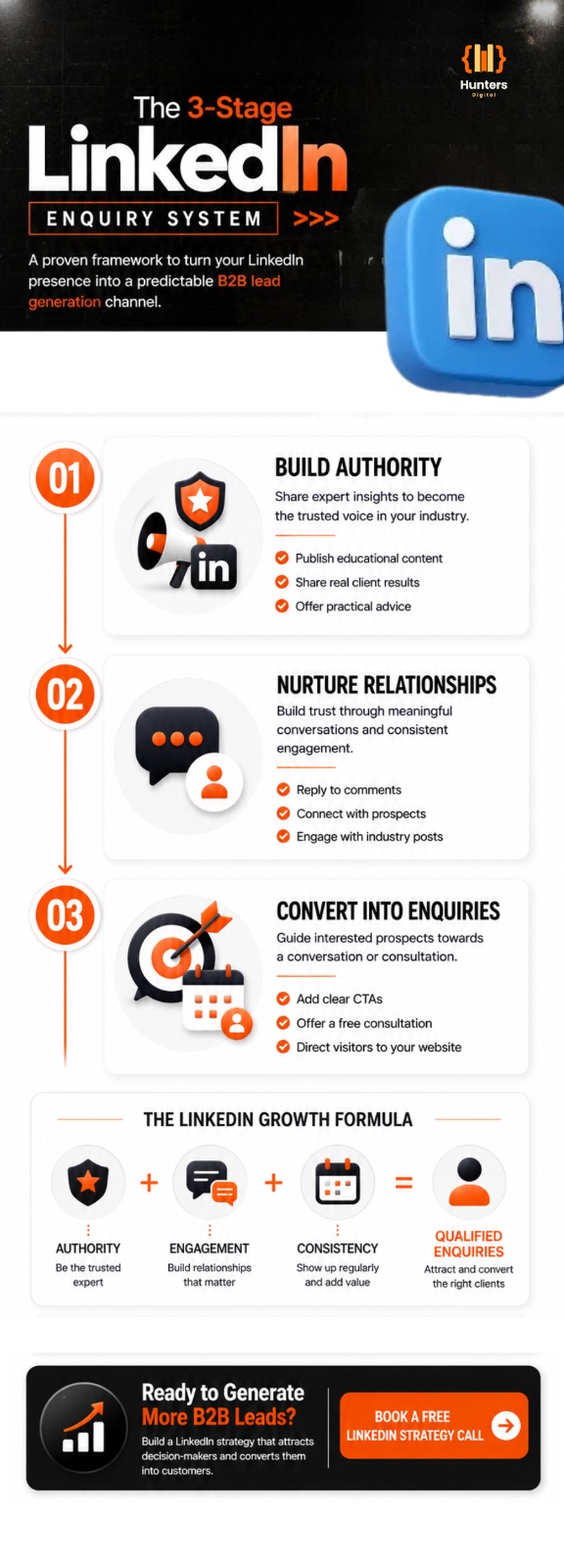
Growing on LinkedIn isn’t just about gaining followers. It’s about building trust, staying visible, and turning the right connections into qualified enquiries. Follow these three simple steps to attract, nurture, and convert potential clients.
Stage 1 – Authority: Positioning Your Firm as the Expert Worth Following
What authority content looks like for Singapore professional services
Authority content does one thing: it demonstrates that your firm understands the specific problems your clients face better than anyone else in the room. For Singapore professional services, this means content that is:
- Specific to your client’s industry or situation — not generic professional advice
- Opinionated – you have a point of view, not just information
- Commercially grounded – it connects expertise to a business outcome the client cares about
- Accessible – it explains complex thinking in plain language
A Singapore law firm specialising in employment disputes might publish a weekly post on a specific case type, explaining the ruling’s implication for employers in plain language. This demonstrates expertise, builds trust with HR and C-suite decision-makers, and positions the firm as the go-to authority on that category of dispute.
Authority content is not thought leadership for its own sake. Every piece should answer the implicit question: ‘Why would I trust this firm to handle my problem?’
Stage 2 – Nurture: Converting Followers into Warm Prospects
The content formats that drive follower-to-prospect conversion
Once a decision-maker follows your firm or regularly engages with your content, they are aware of your expertise. The nurture stage is about moving them from ‘I follow this firm’ to ‘I’m thinking about whether I should speak to them.’
The content formats that perform best at this stage:
- Case frameworks – ‘How we approached X type of problem’ (anonymised) – demonstrate methodology without claiming specific outcomes
- Opinion pieces on market developments – ‘What the recent regulatory change means for Singapore employers’ – demonstrate currency and relevance
- Process transparency – explaining how your firm works, what clients can expect, what good looks like – reduces the friction of an initial enquiry
- Client perspective content – sharing the questions you’re asked most frequently signals that others have the same problem and that you’re the person addressing it
Nurture content should be published consistently – minimum two to three times per week – over a sustained period. The goal is that when a follower reaches a trigger point (a new project, a problem arising, a budget cycle), your firm is the first one they think of.
Stage 3 – Conversion: Turning Engagement into Qualified Enquiries
When and how to move conversations off LinkedIn
The conversion stage is where most LinkedIn strategies fail. Firms publish good content, build an engaged audience, and then wait passively for enquiries that never quite materialise at the volume expected.
Conversion requires intention. Two practical mechanisms work consistently for Singapore professional services:
The direct message approach that doesn’t feel like spam
When a decision-maker engages meaningfully with your content – a genuine comment, a share, a repeated like – this is a signal of interest, not just politeness. Following up with a personalised direct message that references the specific interaction and offers something of value (a brief conversation, a relevant resource, a specific question) is not spam. It is sales intelligence applied correctly.
The message should: acknowledge the specific engagement, demonstrate that you’ve thought about their situation, offer a concrete next step with no pressure to commit. It should not: pitch a service, list your credentials, or use template language.
A CTA embedded within certain content pieces can also drive conversion – a post that ends with ‘if you’re facing this situation, I’m happy to have a 15-minute conversation about how we’ve approached it’ will generate direct messages from qualified prospects at a predictable rate if the audience is correctly built.
The 3-Stage System Applied: A Singapore Professional Services Example
A hypothetical example: Singapore management consultancy over 90 days
To illustrate how the three stages work in practice, consider a hypothetical Singapore management consultancy targeting C-suite decision-makers in mid-sized manufacturing firms.
Months 1–2 (Authority): The founding partner publishes three posts per week on operational efficiency challenges specific to Singapore manufacturers – supply chain resilience, MOM compliance implications, and digital transformation ROI. Each post generates genuine engagement from operations directors and CFOs in the target segment. Follower count grows by 40%. More importantly, the right followers are growing.
Month 2–3 (Nurture): The firm introduces a weekly ‘client question’ post format – anonymised questions from real engagements with the partner’s answer. Decision-makers recognise their own problems in the questions. Profile visits from qualified prospects increase. Two inbound messages arrive asking about services.
Month 3 (Conversion): The partner follows up with three decision-makers who have engaged consistently. Two respond positively. One becomes a client. The third becomes a client three months later.
This is not a fast process. But it is a predictable one – and it produces clients with high lifetime value and low acquisition cost.
LinkedIn Profile Optimisation: The Foundation Everything Else Depends On
Headline, About section, and Featured section – the three profile priorities
Before any content strategy works, the LinkedIn profile of your firm’s founding partner or senior relationship holder must communicate clearly to a first-time visitor: who you help, what problem you solve, and what they should do next.
Three elements matter most:
- Headline: Not your job title. The clearest one-line statement of who you help and how. ‘I help Singapore law firms manage employment disputes before they become litigation’ outperforms ‘Partner | Employment Law | XYZ Legal’.
- About section: Written for your target client, not about you. Start with the problem your clients face. Explain your approach. End with a clear CTA. This is not a biography.
- Featured section: Pin your two or three most relevant pieces of content or resources – the ones that best demonstrate expertise to a first-time visitor evaluating whether to follow or engage.
What Consistent Posting Actually Looks Like – and Why Most Firms Give Up
The realistic posting cadence for a time-poor professional
The most common LinkedIn objection from Singapore professional services leaders: ‘I don’t have time to post three times a week.’
This is usually a content production problem, not a time problem. The solution is batching – dedicating 90 minutes to two hours every two weeks to producing a fortnight’s worth of posts, rather than trying to generate content in real time.
A realistic content calendar for a Singapore professional services partner:
- Monday: An insight or opinion post – 150 to 250 words – on a current market development relevant to clients
- Wednesday: A client question, case framework, or process transparency post – practical and specific
- Friday: A lighter engagement post – a business principle, a lesson from experience, or a question directed at the audience
This cadence, sustained over 90 days, consistently produces a compound authority effect. The partners who stick with it report that by month three, inbound enquiries are arriving without any direct outreach.
The firms that give up at six weeks are making a common mistake: evaluating a compound-return strategy on a linear timeline.
Conclusion
A strong LinkedIn strategy doesn’t start with posting more content – it starts with making sure your profile clearly communicates the value you bring to potential clients. Your headline, profile summary, and featured content should instantly answer one question: Why should someone work with you?
Start with a profile audit. Ask yourself this simple question: Does your LinkedIn headline describe your job title, or does it describe the client problem you solve? If it’s the former, that’s the first thing to fix – and it only takes about 10 minutes.
At Hunters Digital, we help Singapore professional services firms optimise their LinkedIn presence to attract the right audience, build authority, and generate qualified inbound enquiries. From profile optimisation and content strategy to lead generation systems, we create LinkedIn strategies that support real business growth.
Not sure if your profile is working as hard as it should? Send your LinkedIn headline to the Hunters Digital team for a complimentary review, and we’ll provide practical recommendations to help you attract more of the right prospects.
Frequently Asked Questions
With a consistent three-post-per-week cadence and active network engagement, most Singapore professional services firms see the first inbound enquiry signals – profile visits, meaningful comments, DMs asking questions – within 60 to 90 days. First clients via LinkedIn typically arrive between months three and six.
Personal profiles consistently outperform company pages for professional services lead generation on LinkedIn. The platform’s algorithm prioritises personal content. Your company page supports brand recognition, but your business development activity should be led by individual profiles of your senior relationship holders.
In our experience, opinion and insight content – posts where you take a position on a development relevant to your clients – consistently outperforms informational or promotional content. The more specific and opinionated the post, the more it will engage the right audience and be ignored by the wrong one.
For professional services, organic authority-building typically generates higher-quality enquiries than paid LinkedIn advertising because it creates genuine relationship signals before the first conversation. LinkedIn advertising becomes a valuable addition once your organic content is established – to amplify specific offers or content to a precisely targeted decision-maker audience.