


Here’s a scenario that plays out in Singapore every week: a business owner spends $3,000 on Google Ads. They get 200 clicks. Two people enquire. One becomes a client. The owner concludes that digital marketing “sort of works” and keeps the budget flat – not realising they’re operating a fundamentally broken system.
The problem isn’t the $3,000. The problem is that 198 of those clicks evaporated somewhere between the search result and the enquiry. That’s the leaky bucket – and for most Singapore SMEs, fixing the leaks will do more for ROI than doubling the budget ever could.
Why Most Singapore SMEs Are Measuring Marketing ROI the Wrong Way
The vanity metric trap: clicks, impressions and what they don’t tell you
Most digital marketing reports lead with reach, impressions, and clicks. These numbers look good in a presentation, but they tell you almost nothing about whether the investment is actually working.
The only metric that directly connects to business outcomes is cost per qualified lead, and beyond that, cost per new customer. Everything else – clicks, CTR, impressions, even traffic – is context, not conclusion.
This is why two businesses can spend the same amount on Google Ads and get completely different results. One has a leaky funnel. The other has patched it.
The Leaky Bucket: Where Your Ad Budget Actually Disappears
Think of your digital marketing funnel as a bucket. You pour ad spend in at the top. Revenue comes out at the bottom. A leaky bucket means that somewhere between the top and the bottom, prospects are escaping – and you’re paying for every single one of them.
There are five common leak points. Most businesses have at least two. Some have all five.
How to Calculate Your True Digital Marketing ROI
The formula Singapore business owners actually need
Before improving your marketing performance, you first need to establish a baseline.
Many businesses know exactly how much they spend on advertising each month, but surprisingly few know how much revenue those campaigns actually generate.
Without that information, every marketing decision becomes guesswork.
The simplest way to evaluate campaign performance is by calculating your Return on Investment (ROI).
ROI Formula
(Revenue from Ads − Ad Spend) ÷ Ad Spend × 100 = ROI%
Before calculating ROI, build a simple funnel audit using the following metrics.
| Your Monthly Funnel Audit • Ad Spend this month: $___ • Clicks generated: ___ • Landing page conversion rate: ___% • Leads generated: ___ • Lead-to-client conversion rate: ___% • New clients from ads: ___ • Average client value: $___ • Revenue from ads: $___ |
If you cannot confidently complete every line above, your first priority shouldn’t be launching another campaign.
It should be improving your tracking.
Businesses that understand every stage of their marketing funnel make better investment decisions because they know exactly where opportunities and problems-exist.
Why Conversion Rates Matter More Than Budget
One of the biggest misconceptions in digital marketing is that spending more automatically generates more customers.
In reality, conversion rate has a far greater impact on profitability than advertising budget.
Here’s what the maths looks like at different conversion rates – same ad spend, different funnel performance:
| Metric | Scenario A (Current) |
| Ad Spend | $3,000 / month |
| Clicks | 200 |
| Landing Page CVR | 1% |
| Leads Generated | 2 |
| Lead-to-Client Rate | 50% |
| New Clients | 1 |
| Avg Client Value | $2,500 |
| Revenue | $2,500 |
| ROI | -17% |
At first glance, these numbers may seem acceptable. The campaign generated traffic, enquiries, and even a customer. However, when the advertising cost is compared to the revenue generated, the business actually loses money. Despite attracting 200 visitors, only one customer was acquired, making the campaign unsustainable over the long term.
This is the reality for many businesses that focus solely on driving more traffic instead of improving what happens after visitors arrive on their website.
Now let’s see what happens when the landing page performs more effectively.
| Metric | Scenario B (Fixed Funnel) |
| Ad Spend | $3,000 / month |
| Clicks | 200 |
| Landing Page CVR | 3.5% |
| Leads Generated | 7 |
| Lead-to-Client Rate | 50% |
| New Clients | 3–4 |
| Avg Client Value | $2,500 |
| Revenue | $7,500–$10,000 |
| ROI | 150–233% |
Notice what changed.
The advertising budget remained exactly the same. Traffic remained exactly the same. The keywords remained the same.
The improvement came from fixing the leaks inside the marketing funnel. Instead of increasing advertising spend, the business increased the percentage of visitors who became enquiries. Those additional enquiries naturally produced more customers, significantly lowering acquisition costs while dramatically increasing overall profitability.
This is why experienced marketers often focus on conversion optimisation before campaign expansion.
Same budget. Same ads. The only difference is the conversion rate on the landing page. That’s the leaky bucket in financial terms.
The Five Leak Points – and How to Plug Them
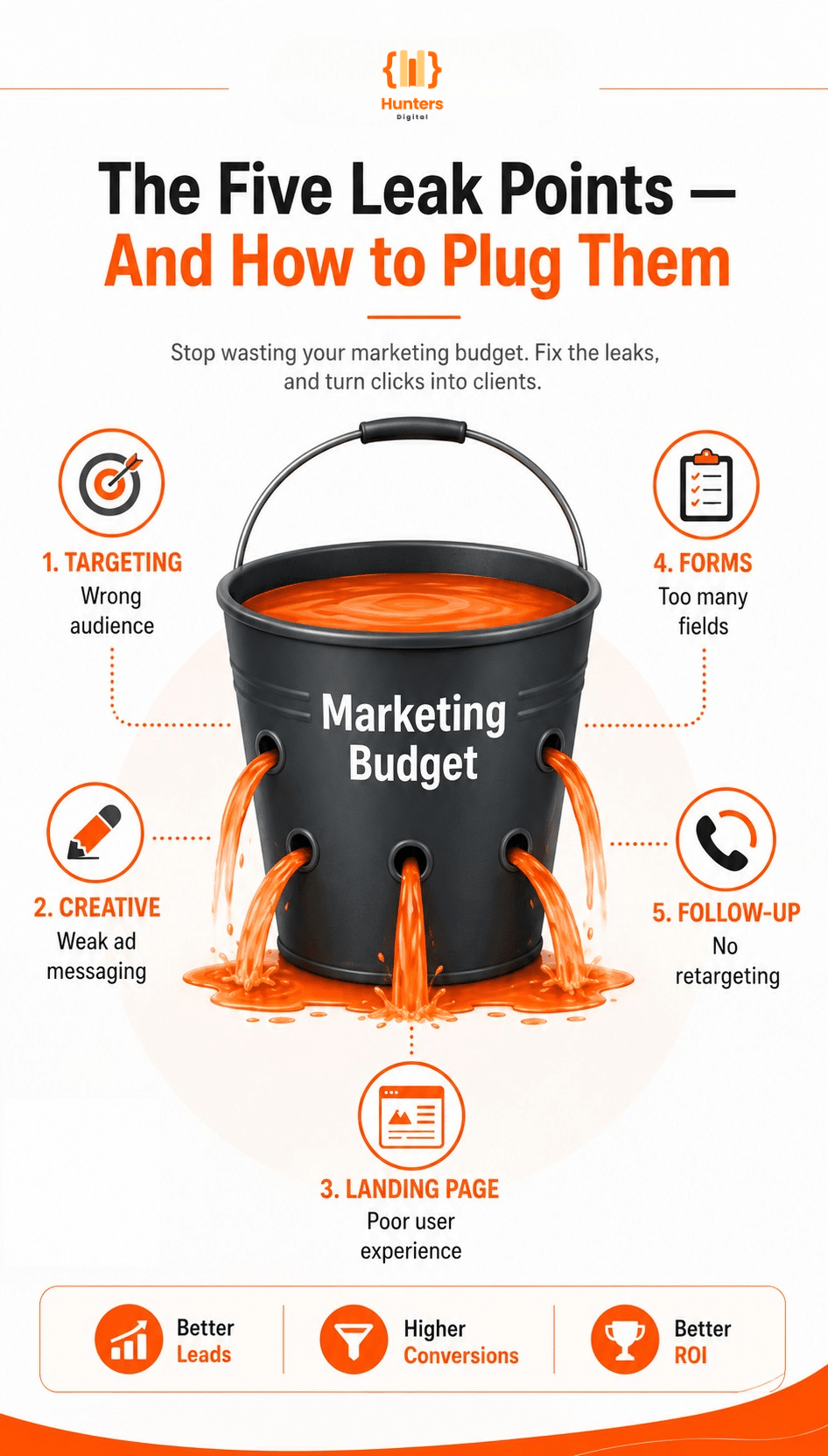
Even the best advertising campaigns can lose potential customers if there are gaps in your marketing funnel. From targeting the wrong audience to missing follow-ups, these five common leak points can quietly drain your ad budget. Here’s how to identify each one and fix it to improve conversions and maximise your ROI.
Leak 1: Ad targeting reaching the wrong audience
If your ads are showing to people who would never buy from you, every click is wasted money. This is common when keyword match types are too broad, when demographic targeting hasn’t been refined based on actual lead quality, or when AI Max’s expanded reach is bringing in intent-adjacent traffic that doesn’t convert.
Fix: Review your Search Term Reports weekly. Identify the queries that generated clicks but zero enquiries, and add them as negative keywords. Ask your team which leads were genuinely qualified – and work backwards to the targeting that produced them.
Leak 2: Ad creative that doesn’t convert clicks to interest
A click means someone was curious enough to leave Google. It doesn’t mean they were sold. If your ad promised something your landing page doesn’t immediately deliver, that curiosity evaporates within three seconds.
Fix: Your ad headline and your landing page headline should tell the same story. If the ad says “Fix Your Google Ads ROI,” the landing page should open with something that continues that promise – not your company name or a generic service list.
Leak 3: Landing pages that lose warm prospects
This is the biggest leak for most Singapore SMEs. The average landing page conversion rate sits around 2–3%. Top performers hit 5–8%. The difference is usually structural – not design.
The most common landing page failures: no clear value proposition above the fold, trust signals buried or absent, CTA that requires the visitor to scroll on mobile, and form fields that ask for too much too soon.
Fix: Run a five-minute mobile audit. Open your landing page on your phone. If you can’t see a specific headline, a reason to trust you, and a clear CTA within the first screenful – you’ve found your biggest leak.
Leak 4: Forms and CTAs that create friction
Every additional field on a contact form reduces your conversion rate. A six-field form asking for name, email, phone, company, budget, and message will convert at roughly half the rate of a two-field form asking for name and phone number.
The same applies to CTAs. “Submit” is not a call to action. “Get My Free Consultation” is. “Learn More” takes the visitor nowhere useful. “See How We Fixed This for Selamat Employment” gives them a reason to click.
Leak 5: No follow-up system for unconverted leads
Some prospects click, land on your page, and leave – not because they’re not interested, but because the timing wasn’t right. Without a retargeting strategy or email nurture sequence, that lead is gone permanently.
Fix: Set up a basic retargeting audience in Meta or Google for anyone who visited your landing page but didn’t convert. Show them a different angle – a testimonial, a case study, a specific outcome. This is often the cheapest source of additional leads available to any Singapore SME.
What a Fixed Funnel Looks Like: Before and After
The following example demonstrates why conversion rate optimisation is often more valuable than increasing your advertising budget. Both scenarios use exactly the same monthly ad spend and generate the same number of website visitors. The only difference is how effectively the landing page converts visitors into leads.
This simple comparison highlights why improving your website can often produce a greater return on investment than launching new advertising campaigns.
| Stage | Before | After |
| Targeting | Broad keywords, no negative list | Intent-matched keywords, weekly negative review |
| Ad Creative | Generic headline, same for all campaigns | Pain-point headline matched to landing page |
| Landing Page | Homepage redirect, no dedicated page | Dedicated page: clear value prop, trust signals, mobile CTA |
| Form / CTA | 6 fields, “Submit” button | 2 fields, specific CTA with outcome language |
| Follow-Up | No retargeting, no email sequence | Retargeting audience + 3-email nurture sequence |
| Result | 1% CVR, $3,000 cost per client | 3.5–5% CVR, $700–$900 cost per client |
Notice that nothing changed except the landing page conversion rate. The advertising budget remained the same, the number of clicks stayed constant, and no additional campaigns were launched.
This demonstrates an important lesson for every Singapore SME: before increasing your advertising budget, make sure you’re maximising the value of the traffic you’re already paying for.
Improving existing campaigns is almost always more cost-effective than simply spending more money on acquiring additional visitors.
When to Call a Professional – and What to Ask For
You don’t need an agency to run a basic audit on your own funnel. But if your ad spend exceeds $2,000 per month and your cost per lead isn’t clearly tracked, a professional CRO engagement typically pays back within 60 days.
What to ask any agency you’re considering:
- Can you show me my current landing page conversion rate before we discuss anything else?
- How do you track leads back to specific ads and keywords?
- What changes will you make in the first 30 days, and how will you measure the impact?
- Do you produce and test new creative, or do I need to supply it?
An agency that answers those questions with clarity is worth the conversation. One that pivots to talking about impressions and reach probably isn’t.
Conclusion
Increasing your advertising budget won’t solve poor ROI if your marketing funnel is leaking prospects at every stage. Before spending another dollar on Google Ads or Meta Ads, make sure your targeting, ad creative, landing pages, forms, and follow-up process are working together to convert visitors into customers.
Small improvements across these five leak points can dramatically reduce your cost per lead, increase conversions, and generate more revenue from the same marketing budget. The goal isn’t to buy more traffic – it’s to convert more of the traffic you’re already paying for.
Ready to Stop Wasting Your Ad Budget?
If you’re spending more than $2,000 per month on digital advertising but don’t have a clear picture of your cost per lead or conversion rates, there’s a good chance your marketing budget is leaking through avoidable gaps.
At Hunters Digital, we help Singapore SMEs identify conversion bottlenecks, optimise every stage of the customer journey, and turn more clicks into qualified leads – without simply increasing ad spend.
Book a free Digital Marketing ROI Audit today, and we’ll show you exactly where your funnel is losing leads, what to fix first, and how to generate more enquiries without increasing your ad spend.
Frequently Asked Questions
Industry averages hover around 2–3%. Strong performers typically achieve 4–6%. For high-ticket services or competitive categories, 2–3% is a realistic baseline – but even moving from 1% to 2.5% can halve your cost per lead without changing your ad spend.
Yes. In most cases, fixing the funnel produces faster ROI improvement than increasing budget. Adding budget to a leaky funnel simply means losing more money faster. Start with the audit, then scale what’s working.
Structural changes – landing page fixes, form simplification, CTA updates – typically show measurable impact within two to four weeks on campaigns with sufficient traffic. Retargeting improvements often show results faster. Full funnel optimisation is a 60–90 day process.
Not necessarily. Many of the highest-impact CRO improvements – headline rewrites, CTA changes, form reduction, trust signal additions – can be made to existing pages. A full website rebuild becomes relevant when the underlying architecture prevents conversion-focused changes, or when the site is technically outdated in ways that affect page speed and mobile performance.

Suggested Articles
- Are LinkedIn Ads Worth It for Singapore B2B Companies? A Practical Budget, Offer, and Lead-Quality Framework
- Google Shopping Ads Singapore: Is Your Product Feed and Product Page Ready to Compete?

- Social Media Management in Singapore: The 90-Day Retainer Scope That Produces a Useful Content System – Not Just a Post Calendar

- Ecommerce SEO in Singapore: A Category-to-Product Discovery Blueprint for Stores Losing Organic Sales