


A dental clinic owner in Tampines once told me she’d given up on digital marketing because “it doesn’t work for local businesses.” When I looked at her Google Maps listing, she was appearing in position 8 for “dentist Tampines.” Position 8 is effectively invisible – the Map Pack shows three results, and almost nobody scrolls past them.
Her Google Ads weren’t performing because she was competing against clinics that owned the Map Pack. Those clinics weren’t there by chance. They’d done specific things that earned those positions.
If your service business isn’t in the top three Map Pack results for your target area and category, here’s what they’re doing that you’re probably not.
Why the Map Pack Beats Page One for Local Businesses
When someone in Singapore searches for a local service, the Google Map Pack – the three-listing block with ratings, addresses, and contact buttons – typically appears above all organic results. On mobile, it often fills the entire first screen.
For local service businesses, a Map Pack position 1–3 generates more calls, direction requests, and website visits than organic page one rankings in most categories. And it includes the direct-action buttons – call, directions, message – that high-intent buyers actually use.
The difference between position 3 and position 4 isn’t a ranking preference. For many Singapore service businesses, it’s the difference between a consistent source of phone enquiries and effective invisibility.
How Google Decides Who Appears in the Map Pack
Google evaluates several local signals when deciding which businesses appear in the Map Pack. Understanding the three core factors helps Singapore businesses identify where their local SEO efforts should be focused.
The three Map Pack ranking factors: proximity, relevance, prominence
Google applies three criteria to every local ranking decision:
- Proximity: How close is this business to where the searcher is located? You can’t move your business, but your service area settings and registered address affect this.
- Relevance: How well does this business match what the searcher is looking for? This is where your GBP profile, category selection, and service descriptions do the work.
- Prominence: How trusted and well-known is this business across the internet? Determined by review volume, citation consistency, website authority, and overall online presence depth.
Most local businesses have a basic handle on proximity and relevance. The competitive edge is almost always in prominence – and it’s where the most consistent improvement is available.
The Seven Ranking Signals That Matter Most
Google Maps rankings aren’t based on one optimisation trick. Your business needs a combination of relevant, consistent, and trustworthy signals.
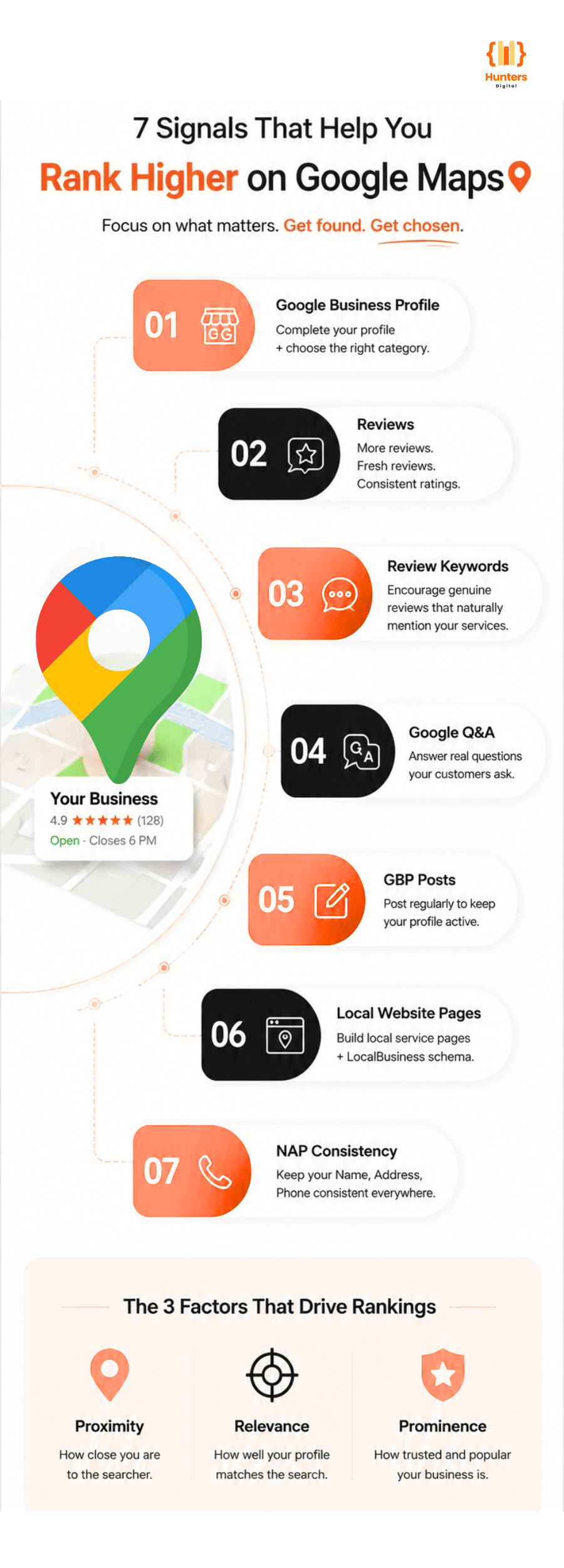
Google’s local ranking system evaluates multiple signals before determining which businesses should appear for a particular search. The seven areas below are important optimisation priorities for Singapore businesses looking to improve visibility, generate enquiries, and compete for Map Pack positions.
| Signal | What to do |
| GBP completeness and primary category | Fill every section. Your primary category should reflect what you most want to rank for — not a general description of your business. |
| Review quantity, recency, and rating | Aim for 20+ reviews minimum, 4.3+ average, with new reviews coming in every month. Recency carries significant weight. |
| Keyword presence in reviews | You can’t prompt this directly. But when you deliver experiences specific enough that customers describe them in detail, service keywords appear naturally. |
| Q&A content | Proactively add 10–15 common customer questions with detailed answers. Check monthly — unanswered public questions damage trust. |
| GBP post frequency | Post at minimum once per week. Posts expire after 7 days (offers last longer). Regular posting signals an active, current business. |
| Website authority and local pages | Your website authority is part of your prominence score. Local service pages with genuine location-specific content extend Map Pack reach across areas. |
| NAP consistency across directories | Same name, address, and phone number across every Singapore directory listing. Inconsistencies suppress rankings. |
Review Strategy: The Most Underestimated Local SEO Lever
Reviews do more than build customer trust. A consistent flow of genuine, recent reviews can strengthen your business’s local presence while giving potential customers more confidence when choosing between competing businesses.
Review velocity: consistent generation vs. occasional spikes
Most Singapore service businesses collect reviews inconsistently – a flurry of reviews when the business launches, then silence for months. Google’s algorithm treats a steady stream of recent reviews as a far stronger signal than a historical pile of old ones.
Review velocity – a sustainable rate of 2–4 new reviews per month – consistently outperforms periodic spikes followed by gaps. The systems that produce it are simple:
- A standard post-service follow-up message (SMS or WhatsApp) sent within 24 hours, with a direct Google review link
- A QR code at the point of service – reception desk, checkout counter, service vehicle – linking to your review page
- A team protocol so that asking for reviews becomes a normal part of the service completion, not an afterthought
In competitive categories like dental, legal, or renovation, targeting 4–6 new reviews per month accelerates prominence building meaningfully.
Why Your Website Still Matters for Map Pack Rankings
Your Google Business Profile is only one part of your local search presence. Your website provides additional context about your services, locations, expertise, and relevance, helping support the signals that contribute to stronger local visibility.
Local service pages: the website structure that supports Map Pack rankings
Your GBP listing is connected to your website, and Google factors your website’s authority and local relevance into your prominence score. A website with no location-specific content, no local keyword presence, and missing structured data sends weak signals that limit Map Pack performance.
The minimum local SEO website structure:
- A primary service page with your main service and Singapore location referenced naturally throughout
- LocalBusiness schema markup with complete address, phone, operating hours, and service area
- Location-specific service pages if you operate across multiple Singapore areas (e.g., “Renovation Services Tampines”)
- Page speed and Core Web Vitals compliance – slow pages reduce both traditional SEO and local ranking performance
NAP Consistency and Citation Building
Citations are online references to your business information.
They can appear on directories, business websites, social platforms, industry listings, and other relevant online resources.
Consistent business information across trusted online directories strengthens confidence in your business information. Every important listing should display the same business name, address, phone number, and website. Even small differences can create inconsistencies that should be identified and corrected during a local SEO audit.
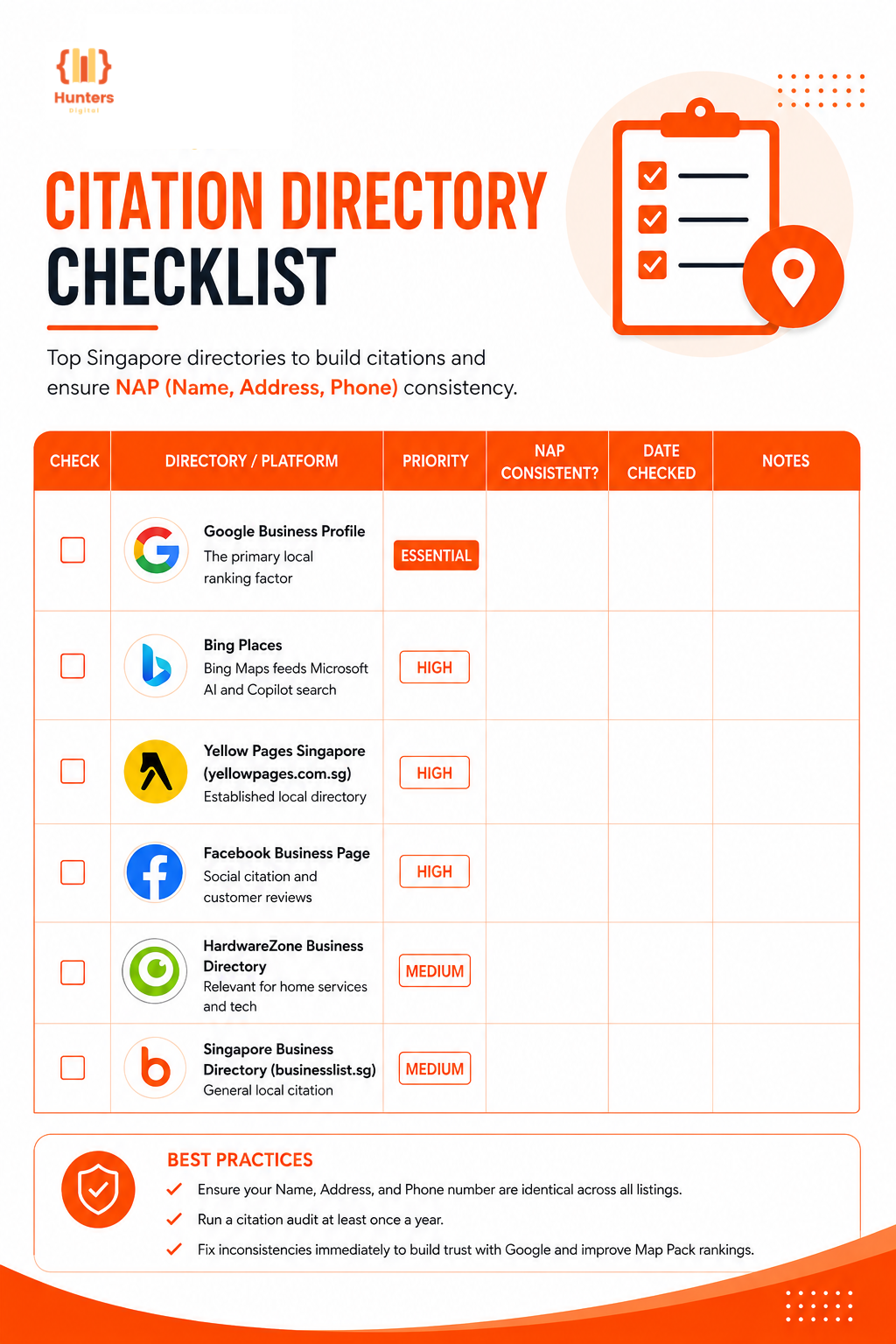
| Singapore Directory / Platform | Priority |
| Google Business Profile | Essential — the primary local ranking factor |
| Bing Places | High — Bing Maps feeds Microsoft AI and Copilot search |
| Yellow Pages Singapore (yellowpages.com.sg) | High — established local directory |
| Facebook Business Page | High — social citation and customer reviews |
| HardwareZone Business Directory | Medium — relevant for home services and tech |
| Singapore Business Directory (businesslist.sg) | Medium — general local citation |
| Carousell Business | Medium — useful for retail and services with listings |
Run a citation audit annually – check your top 15–20 directory listings for NAP accuracy. Old addresses, different phone numbers, or name variations confuse Google’s confidence in your business information.
Download a Citation Directory Checklist here.
How to Track Progress Month-to-Month
Three metrics worth tracking consistently:
- Map Pack position: search your primary target keywords in incognito mode near your business location. Note your position for each keyword. Track month-on-month.
- GBP Insights: Google Business Profile shows direction requests, phone calls, website clicks, and search views. Month-on-month growth confirms your optimisation is translating into visibility.
- Review velocity: track monthly review count and current average rating. A declining review rate is an early warning signal.
Conclusion
Being invisible on Google Maps doesn’t mean customers aren’t searching. It means they’re finding your competitors instead.
If your Singapore service business isn’t consistently appearing in the Google Map Pack for your target keywords, you’re potentially losing high-intent calls, enquiries, and customers every day. The businesses winning those top positions aren’t relying on luck – they’re building the right signals across their Google Business Profile, reviews, website, and local citations.
At Hunters Digital, our Local SEO team helps clinics, contractors, F&B businesses, and service companies across Singapore build stronger local visibility and compete for valuable Map Pack positions.
Want to rank higher on Google Maps?
Request a Local SEO Consultation with us today. We’ll review your current local presence, identify key areas for improvement, and recommend the next steps to help you achieve stronger Google Maps visibility.
Frequently Asked Questions
For less competitive local categories with a fully optimised GBP profile, initial Map Pack appearances can happen within 4–8 weeks. In competitive categories like dental, legal, and renovation in central Singapore, consistent improvement takes 3–6 months. Ongoing work – regular posting, review generation, citation building – is what maintains and improves positions over time.
Google requires a verifiable business address for Map Pack listings. Service-area businesses (contractors, cleaners, mobile services) can hide their address from the public while listing a service area, which qualifies them for Map Pack appearances in their defined region. A virtual office or registered address works for the verification process.
Fake negative reviews from competitors are a real issue in some Singapore categories. If you receive a review you believe is fraudulent – no customer record, suspicious account, generic language – report it through the GBP dashboard. Google reviews flagged content and removes violations, though the process typically takes 2–4 weeks. Respond professionally to the review in the meantime, as prospective customers will see your response.
They serve different commercial functions. Local SEO builds long-term visibility that compounds over time and requires no per-click payment. Google Ads provide immediate visibility that stops the moment you stop spending. Most Singapore local service businesses benefit from both — Ads for immediate lead generation while Local SEO is being built, then Local SEO as the lower-cost, compounding channel once positions are established.

Suggested Articles
- Google Shopping Ads Singapore: Is Your Product Feed and Product Page Ready to Compete?

- Social Media Management in Singapore: The 90-Day Retainer Scope That Produces a Useful Content System – Not Just a Post Calendar

- Ecommerce SEO in Singapore: A Category-to-Product Discovery Blueprint for Stores Losing Organic Sales

- Website Maintenance in Singapore: What SMEs Should Expect from a Plan That Protects Leads, Security, and Search Visibility