
You’ve reviewed your Google Ads campaign. The keywords look right. The budget is adequate. The click-through rate is reasonable. But the leads aren’t coming in the way they should – and the ones that do are less qualified than they used to be.
If this sounds familiar, the problem is probably not your ads. It’s what your ads send people to.
Most Singapore SMEs invest significant energy and budget into ad campaign optimisation while treating their landing pages as static background infrastructure. This is the gap that’s costing them leads – and as Google’s AI Max for Search expands campaign reach to broader audiences, the gap is widening.
Why Ad Performance and Landing Page Performance Are Inseparable
The click is not the conversion – what happens in between is everything
A Google Ads click is a transaction. You paid for someone’s attention and redirected it to a page. What happens on that page is the entire point of the investment.
The relationship between ad performance and landing page performance is tighter than most advertisers realise. Google’s Quality Score – which directly affects how much you pay per click and where your ads appear – includes landing page experience as one of its three core components. A poor landing page doesn’t just fail to convert. It actively makes your ads more expensive.
This is why we consistently see the same pattern in Singapore SME accounts: campaign optimisation without landing page improvement produces diminishing returns. You can improve your cost per click by 15% through bid adjustments and still see your cost per lead rise if the landing page conversion rate drops.
The Average Singapore Landing Page: What the Data Says
Industry benchmark conversion rates: what 2.35% actually means
The average landing page conversion rate across industries is 2.35%. Top quartile performers convert at 5.31% or above. For paid media campaigns – where traffic is warm and intent is relatively high – conversion rates below 3% typically indicate a structural problem with the page rather than a targeting problem with the campaign.
In our experience working with Singapore SMEs across professional services, home services, healthcare, and F&B, the most common landing page conversion rates we encounter when auditing new clients sit between 0.8% and 2.1%. There is almost always significant room for improvement before touching the campaigns themselves.
7 Landing Page Problems We See Repeatedly in Singapore SME Campaigns
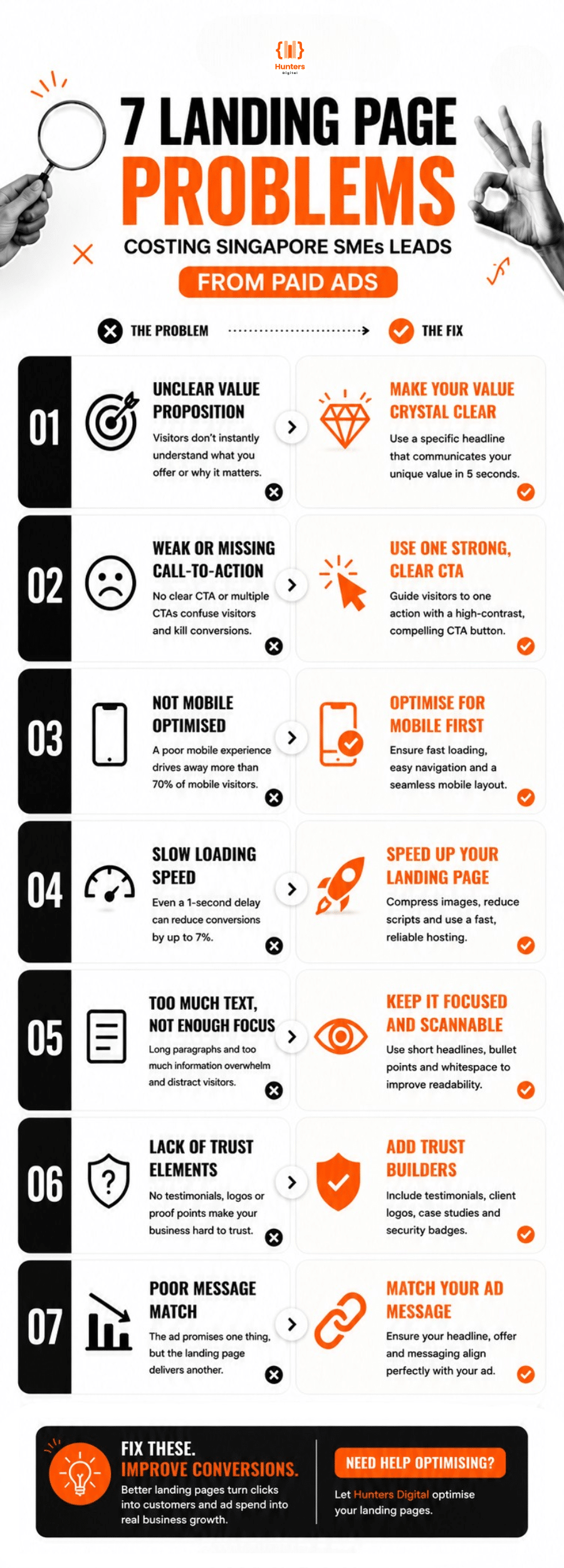
Problem 1: No Clear Value Proposition Above the Fold
The first thing a visitor should understand within three seconds of arriving on your page is: who you are, what you offer, and why they should care. Most Singapore landing pages lead with a hero image, a company name, or a tagline that answers none of these questions.
Fix: Your headline should address the specific pain point your ad promised to solve. If your ad said ‘Fix Your Google Ads ROI,’ your landing page headline should directly continue that promise – not pivot to your company history.
Problem 2: Generic Headline That Matches No Specific Search Intent
Message match is one of the most reliable conversion drivers available to any advertiser. When the language of an ad is reflected in the language of the landing page, visitor confidence rises. When it isn’t, visitors sense a disconnect and leave.
Fix: Create distinct landing pages for distinct ad groups. A page serving traffic for ‘Google Ads agency Singapore’ should not be identical to a page serving ‘Meta Ads management Singapore.’
Problem 3: CTA Buried Below Where Most Visitors Stop Scrolling
Studies consistently show that the majority of page visitors – particularly on mobile – do not scroll past the first screenful of content. If your primary call to action appears below the fold, most visitors will never see it.
Fix: Place your primary CTA above the fold. Repeat it at natural pause points throughout the page. Don’t make visitors work to find how to contact you.
Problem 4: Missing Trust Signals for Singapore Audiences
Singapore buyers are comparatively cautious and research-oriented. They want evidence before they enquire. Yet most SME landing pages carry minimal social proof – no client logos, no case studies, no named testimonials, no industry recognition.
Fix: Add a minimum of three client testimonials with names, company names, and – where possible – photos. Include any industry accreditations, recognisable client logos, or media mentions relevant to your Singapore audience.
Problem 5: Form Friction – Asking for Too Much, Too Soon
A contact form with six required fields asking for name, email, phone number, company, budget range, and message will convert at a fraction of the rate of a form asking for name and phone number only. Every additional required field reduces conversion rate.
Fix: Qualify leads through conversation, not through form length. Capture the minimum information needed to initiate contact. Use follow-up to gather detail.
Problem 6: Mobile Experience Not Treated as the Primary Experience
In Singapore, mobile accounts for the majority of search queries. Yet many SME landing pages are built and reviewed on desktop, with mobile as an afterthought. The result is buttons that are too small to tap, text that requires zooming, and forms that are frustrating to complete on a phone screen.
Fix: Review your landing page on three different mobile devices before any campaign goes live. Mobile UX should be the design standard, with desktop as the adaptation.
Problem 7: Sending All Ad Traffic to the Same Generic Page
This is the single most common structural error in Singapore SME paid media campaigns. When all ads – regardless of keyword, audience, or message – point to the same homepage or generic services page, conversion rates suffer because the page cannot be relevant to every visitor simultaneously.
Fix: Build dedicated landing pages for your highest-spend campaigns. The investment in one well-built, properly optimised landing page typically pays back within the first month of improved conversion rates.
Before vs. After: What a High-Converting Landing Page Looks Like
The anatomy of a before/after landing page rebuild
Here is the structural difference between a typical underperforming Singapore SME landing page and a conversion-optimised version:
| BEFORE | AFTER |
| Company name as hero headline | Pain-point headline with value proposition |
| Generic tagline | Specific promise matched to ad message |
| Stock photography hero | Real team or client photo with social context |
| CTA at bottom of page | CTA above fold + repeated at 2 scroll points |
| No testimonials or proof | 3+ named testimonials + logos |
| 6-field contact form | 2-field form (name + phone) with low commitment CTA |
| Same page for all ads | Dedicated pages per campaign or ad group |
How AI Max Makes Landing Page Performance More Critical Than Ever
As covered in our Google Ads AI Max guide, Google’s intent-based matching now sends a broader and more varied audience to your landing pages than traditional keyword targeting ever did. This creates a compound problem for underperforming pages.
With narrow keyword targeting, a mediocre landing page might convert 1.5% of visitors – but at least those visitors were highly qualified. With AI Max expanding reach to intent-adjacent searches, the same mediocre page now needs to convert a wider audience, and will typically perform worse.
The data point that matters: improving landing page conversion rate from 1.5% to 3% halves your cost per lead without touching your ad spend. That improvement is available to most Singapore SME advertisers through structural CRO alone.
How to Run a Basic Landing Page Audit Yourself
You don’t need a specialist to identify the most obvious problems. Here’s a 10-minute audit protocol:
- Open your landing page on your phone – not your desktop. Does the main message appear immediately without scrolling?
- Read the headline. Does it connect to what your ad promised? Would a stranger know what you offer within 5 seconds?
- Look for your CTA. Is it visible without scrolling? Is it obvious what happens when you click it?
- Count your trust signals. Do you have at least 3 testimonials? Any client logos? Any third-party recognition?
- Try to complete your contact form. How many fields does it require? How long does it take on mobile?
- Check Google Analytics (or equivalent) for your current conversion rate, time on page, and bounce rate on this specific URL.
If any of these steps reveals a problem, you’ve identified a priority. The most common result of this exercise: businesses discover that their primary landing page has never been properly evaluated for conversion performance – only for appearance.
When to Bring in a Professional: CRO as a Commercial Investment
A professional CRO engagement involves more than design changes. It includes:
- Conversion rate benchmarking against your specific industry and audience
- Heatmap and session recording analysis to understand how visitors actually behave on the page
- A/B testing to validate changes before full implementation
- Message-match auditing across all active ad campaigns
- Mobile UX optimisation as a primary deliverable, not an afterthought
For Singapore SMEs spending $3,000 or more per month on paid media, a CRO engagement typically pays back within 60 to 90 days through reduced cost per lead alone – before accounting for the revenue generated by improved lead quality.
Conclusion
Your ads are only as effective as the landing page that turns clicks into customers.
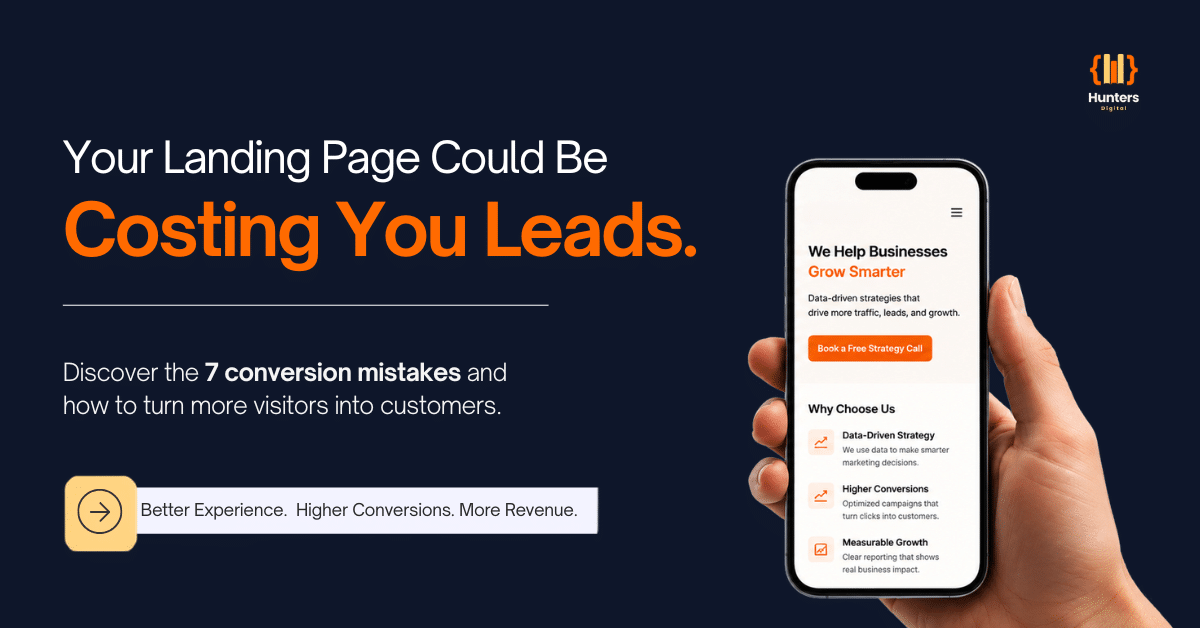
If your campaigns are bringing traffic but not enough quality leads, the solution may not be increasing your budget – it may be fixing the gaps between the click and the conversion. A stronger landing page with the right message, structure, and user experience can help you reduce wasted ad spend and improve your lead quality.
Not sure where your landing page stands? Use our 6-question self-audit above to identify your biggest conversion gap.
Share your results with us, and we’ll provide one specific improvement recommendation to help you optimise your page – no commitment required.
Ready to improve your landing page performance? Contact us today and take the first step towards turning more clicks into valuable leads.
Frequently Asked Questions
The clearest indicator is your click-through rate versus your conversion rate. If your CTR is reasonable (above 2–3% for search) but your conversion rate is below 2%, the problem is almost certainly the page, not the campaign. Another signal: if changing bids or targeting doesn’t meaningfully improve lead volume, the bottleneck is downstream of the click.
Not necessarily – but you should have distinct landing pages for your most significant campaign types. At minimum, campaigns targeting different services, audiences, or search intents should not point to the same generic page. Start by creating dedicated pages for your three highest-spend campaigns.
Most structural improvements – headline changes, CTA placement, form simplification – show measurable impact within two to four weeks with sufficient traffic volume. For lower-traffic campaigns, allow six to eight weeks to accumulate enough data to evaluate performance with statistical confidence.
Yes. Targeted landing page optimisation is often more commercially effective than a full website rebuild. A dedicated landing page – built specifically for a single campaign objective – will typically outperform a generic website page regardless of how well the rest of the site is designed.

Suggested Articles
- Google Shopping Ads Singapore: Is Your Product Feed and Product Page Ready to Compete?

- Social Media Management in Singapore: The 90-Day Retainer Scope That Produces a Useful Content System – Not Just a Post Calendar
- Ecommerce SEO in Singapore: A Category-to-Product Discovery Blueprint for Stores Losing Organic Sales
- Website Maintenance in Singapore: What SMEs Should Expect from a Plan That Protects Leads, Security, and Search Visibility