
A website that generates consistent, good-quality leads has five things in place: clear service pages that explain the problem, audience, process, and outcome; visible proof such as reviews, case studies, and results; an obvious next step for visitors to take; accurate tracking so the business knows what is working; and landing pages that match what brought the visitor there in the first place. For most Singapore SMEs, missing even one or two of these areas quietly limits lead generation, regardless of how much is spent on marketing.
Why Most ‘Marketing Problems’ Are Actually Website Problems
When a Singapore SME isn’t getting enough enquiries, the instinct is usually to look at the channel – try a new ad platform, post more on social media, or invest in SEO. Often, the channel isn’t the problem. The website is.
A visitor who lands on a service page that says ‘we help businesses grow with end-to-end solutions’ learns nothing about whether this business can help them. A visitor who can’t find a clear way to get in touch leaves without enquiring, even if they were interested. A business that doesn’t track which pages produce enquiries has no way of knowing whether its website is the bottleneck at all.
These are not new problems, and they are not unique to any one marketing channel. They affect organic search visibility, the return on paid advertising, the impression a referral makes when they check a business out online, and, as one more data point, how AI search tools and AI-assisted ad platforms interpret a business when deciding how to present it. AI search is one more reason this clarity matters now. It was never the only reason.
The good news is that these gaps are usually straightforward to identify and fix-and the businesses that address them tend to see improvements across every channel at once, because the underlying issue was never channel-specific. The rest of this guide walks through a practical five-area audit Singapore SMEs can use to find out where their website stands.
What a Lead-Ready Website Actually Looks Like
A lead-ready website is not necessarily an expensive or highly designed one. It does four things consistently: it explains its services in specific terms rather than general claims; it backs those claims with real proof; it anticipates the questions a visitor would ask next, through FAQs and supporting content; and it gives every visitor a clear next action-an enquiry form, a booking link, a WhatsApp button, or a phone number that is easy to find and easy to use.
This is the foundation of good conversion rate optimisation, and it has been true long before AI search existed. What has changed is the number of audiences reading this content: human visitors from every channel, and, increasingly, AI systems summarising a business on a visitor’s behalf. The underlying standard, however, is the same: be specific, be credible, and make the next step obvious.
Why This Matters Across Every Channel-Not Just One
A common mistake is to treat website clarity as a ‘search’ issue or an ‘AI’ issue, separate from paid media or sales conversations. In practice, the same gaps show up everywhere.
On organic search, Google increasingly assembles answers by breaking one question into several related searches-a technique sometimes called query fan-out. A thin service page that only states a service exists, without explaining who it’s for, how it works, or what results look like, gives search systems very little to retrieve when a buyer’s question touches on pricing, process, or outcomes for a specific type of business. The practical fix is the same as it has always been for strong SEO: build genuine topic depth around real buyer questions, not just a single page per service.
On paid media, Google Ads and Meta are both moving toward more automated, AI-assisted campaign management, including ad formats that draw on a business’s own landing pages to power lead conversations. If a landing page doesn’t clearly state the offer, who it’s for, and what happens next, these systems have weak material to work from, and the gap typically shows up as poor lead quality rather than poor click-through rates. For Singapore SMEs already running Meta or Google Ads, this connects to a familiar problem: campaigns that generate clicks but not enquiries. Before reviewing ad creative or increasing budget, the landing page itself is often the highest-leverage place to look.
And for every channel-search, ads, referrals, LinkedIn, word of mouth, the same five-area audit below determines whether a visitor becomes a lead.
The Website Conversion & Lead-Readiness Audit: Five Areas to Review
The following five areas form a practical audit that Singapore SMEs can use to assess whether their website is generating the leads it should-across every channel, not just one.
| Audit Area | What to Review | Why It Matters |
| Service clarity | Does each service page explain the problem it solves, who it is for, how the process works, and what the client gets? | Gives visitors-and any system summarising the page-specific material to understand and act on. |
| Proof and trust | Are testimonials, case studies, reviews, and team credibility visible and specific? | Builds confidence before enquiry. Generic five-star badges don’t do this; specific outcomes do. |
| Conversion paths | Are CTAs, forms, WhatsApp links, and enquiry flows clear, mobile-friendly, and tested? | Determines whether interest-from any source-actually becomes a lead. |
| Tracking and reporting | Are GA4 events, conversion actions, and lead sources correctly configured and reported clearly? | Without this, it is impossible to know which channels and pages are actually producing business outcomes. |
| Landing-page readiness | Does the page a campaign sends traffic to match the ad’s message, answer likely objections, and load quickly? | Directly affects paid media efficiency and the quality of leads from every campaign. |
Most Singapore SMEs will find that at least two or three of these areas need attention-and the businesses that address all five tend to see compounding benefits: better organic visibility, more efficient paid campaigns, and higher-quality enquiries, because the same underlying clarity supports all three.
What Not to Do When Trying to Fix a Website That Isn’t Converting
When a website isn’t generating enough leads, the instinct is often to add more – more pages, more content, more ad spend, more popups. This rarely solves the underlying problem, and can make it worse.
Adding more content without addressing unclear service pages just gives visitors more unclear pages to read. Increasing ad spend on campaigns whose landing pages haven’t been reviewed tends to amplify the existing problem – more visitors arriving at a page that wasn’t converting before. And adding urgency tactics like countdown timers or aggressive popups, without first fixing clarity and trust, often increases bounce rates rather than enquiries.
The practical sequence is: review the five audit areas first, fix the clearest gaps-usually service clarity and conversion paths first – and only then consider scaling content production, paid spend, or more advanced optimisation.
Conclusion
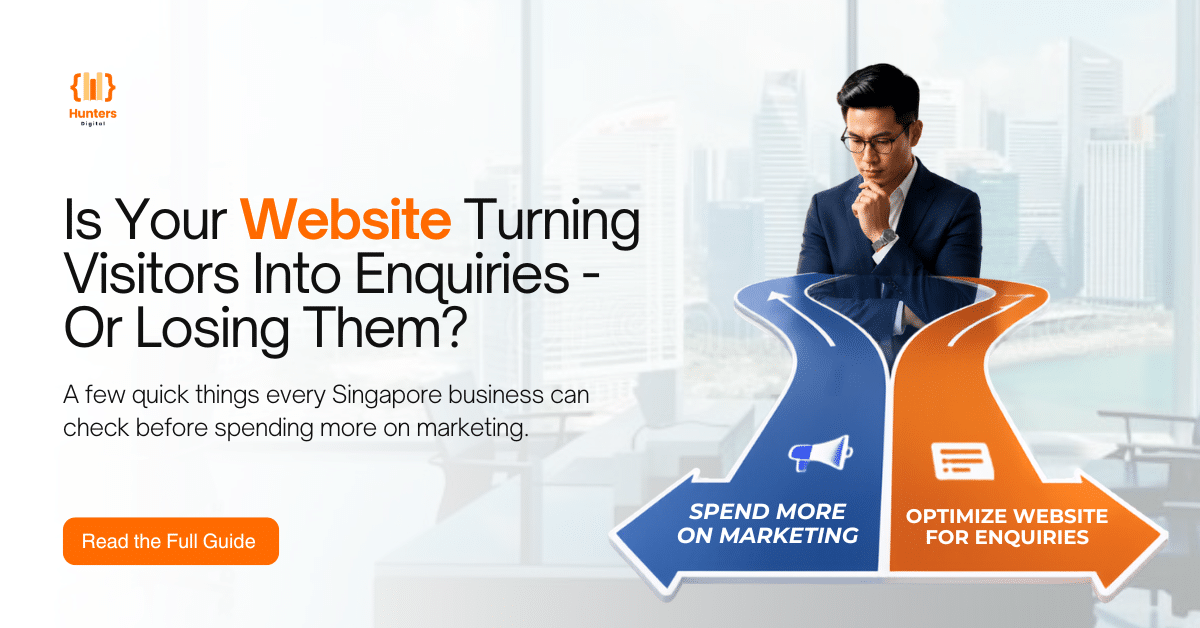
If your website isn’t generating the leads it should – whether traffic is coming from search, ads, referrals, or somewhere else – the most useful starting point is a structured review across the five audit areas above, not a piecemeal check of any single channel.
For paid campaigns that are sending traffic to pages that don’t match the offer, our landing page service creates conversion-focused pages aligned with campaign intent.
When the gaps are structural – such as unclear service pages, weak proof placement, or an untested conversion path – our website development team builds growth-focused websites with these foundations in place from the start.
Without correct tracking, it’s not possible to know which improvements are working. Our tracking and attribution service ensures GA4 and conversion data reflect real business outcomes.
Strong service-page content and topic depth support both organic visibility and the clarity this audit is built around.
For businesses who want to extend this clarity into AI-search and AI-citation visibility specifically, our AEO and GEO services build on the same foundations covered in this audit.
We offer a practical Website Conversion & Lead-Readiness Review for Singapore SMEs-covering service clarity, proof, conversion paths, tracking, and landing pages in one session. Contact us to start the conversation.
Frequently Asked Questions
This is almost always a conversion path or clarity problem rather than a traffic problem. Check whether your service pages clearly explain what you do and who it’s for, whether there’s visible proof of credibility, and whether the next step – enquiry form, WhatsApp, booking link – is obvious and easy to use on both desktop and mobile.
It’s a structured review of five areas that determine whether a website turns visitors into enquiries: service page clarity, proof and trust signals, conversion paths, tracking and reporting, and landing – page readiness for any campaigns running. It applies regardless of where traffic comes from – organic search, paid ads, referrals, or direct visits.
In most cases, yes. If the landing pages a campaign sends traffic to do not clearly match the ad’s message, provide proof, or make the next step obvious, increasing budget tends to amplify the existing problem rather than solve it. Reviewing landing-page readiness alongside campaign structure is typically more cost-effective than scaling spend first.
Start with the highest-traffic or highest-commercial-value service page. Check whether it clearly explains who the service is for, what the process looks like, what results have looked like for similar clients, and what the visitor should do next. If any of these is unclear or missing, that page is the starting point for the broader audit.
Yes, as a secondary benefit. AI search tools and AI-assisted ad platforms increasingly rely on the same website content that human visitors read – clear service descriptions, real proof, and useful FAQs. A website that’s clear enough to convert a human visitor is generally also clear enough for these systems to interpret accurately. But this is a reason the audit matters a little more now – not the reason it matters in the first place.

Suggested Articles
- Google Shopping Ads Singapore: Is Your Product Feed and Product Page Ready to Compete?
- Social Media Management in Singapore: The 90-Day Retainer Scope That Produces a Useful Content System – Not Just a Post Calendar
- Ecommerce SEO in Singapore: A Category-to-Product Discovery Blueprint for Stores Losing Organic Sales
- Website Maintenance in Singapore: What SMEs Should Expect from a Plan That Protects Leads, Security, and Search Visibility